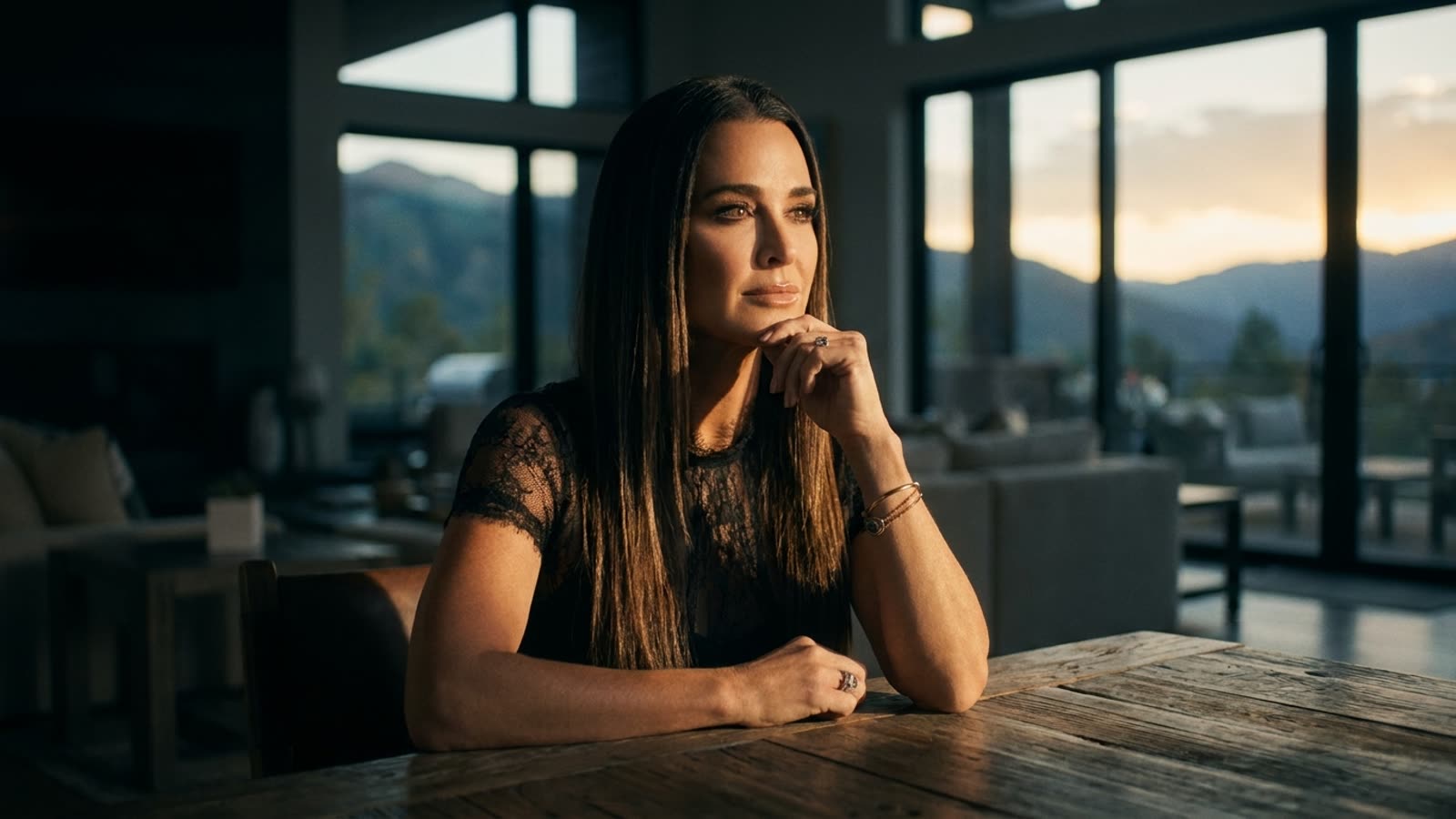
The woman who once defined herself as Kim Richards' little sister and Paris Hilton's aunt has finally become the undisputed protagonist of her own narrative—and it only took a marriage implosion, a body transformation, and a friendship with a country singer to get there.
Kyle Richards, now 57, has been a fixture on The Real Housewives of Beverly Hills since its 2010 premiere, but her current cultural moment feels categorically different from the previous fourteen seasons of diamond-holding. Where she once occupied the diplomatic middle ground—the producer-friendly housewife who rarely drew blood—Richards has spent the past two years courting genuine controversy and, in doing so, achieving something rare in the reality-television ecosystem: renewed relevance.
The separation strategy
Richards' July 2023 announcement that she and Mauricio Umansky were separating after 27 years of marriage initially read as personal tragedy. In retrospect, it was the inciting incident of a carefully managed reinvention. The timing coincided with Umansky's Netflix series Buying Beverly Hills, ensuring maximum cross-platform visibility. The subsequent speculation about Richards' relationship with country artist Morgan Wade—neither confirmed nor convincingly denied—has kept tabloid interest at a simmer for the better part of two years.
What makes Richards' approach notable is its refusal of the traditional divorced-housewife playbook, which typically involves tearful confessionals and eventual redemption through a new relationship with a man. Richards has instead embraced ambiguity as content, letting the Wade rumors generate headlines without offering the closure that would end the news cycle.
The physical transformation industrial complex
Richards' dramatic weight loss and fitness transformation have been documented with the granularity usually reserved for professional athletes. She has been transparent about Ozempic use while also crediting rigorous exercise—a both-and approach that reads as more honest than the typical celebrity wellness deflection. The transformation has repositioned her within the housewife hierarchy: no longer the relatable everywoman, now the aspirational figure other cast members measure themselves against.
This physical reinvention dovetails with a broader shift in how Richards presents herself on social media. The aesthetic has migrated from wealthy-mom-next-door to something closer to influencer-athlete, heavy on workout content and athleisure partnerships.
The franchise leverage
Richards remains the only original Beverly Hills housewife still holding a diamond, a longevity that grants her unusual power within Bravo's ecosystem. Her willingness to generate storylines—rather than simply react to them—has made her indispensable to producers navigating cast turnover. The network's investment in her continued relevance is evident in the screen time allocation and confessional positioning of recent seasons.
Our take
Kyle Richards has understood something that eludes most reality-television veterans: the audience's appetite for transformation outstrips its appetite for consistency. By blowing up the stable-marriage, stable-weight, stable-persona formula that defined her first decade on screen, she has made herself interesting again. Whether this represents authentic personal growth or masterful brand management is, of course, the wrong question. In reality television, the distinction has never mattered less.