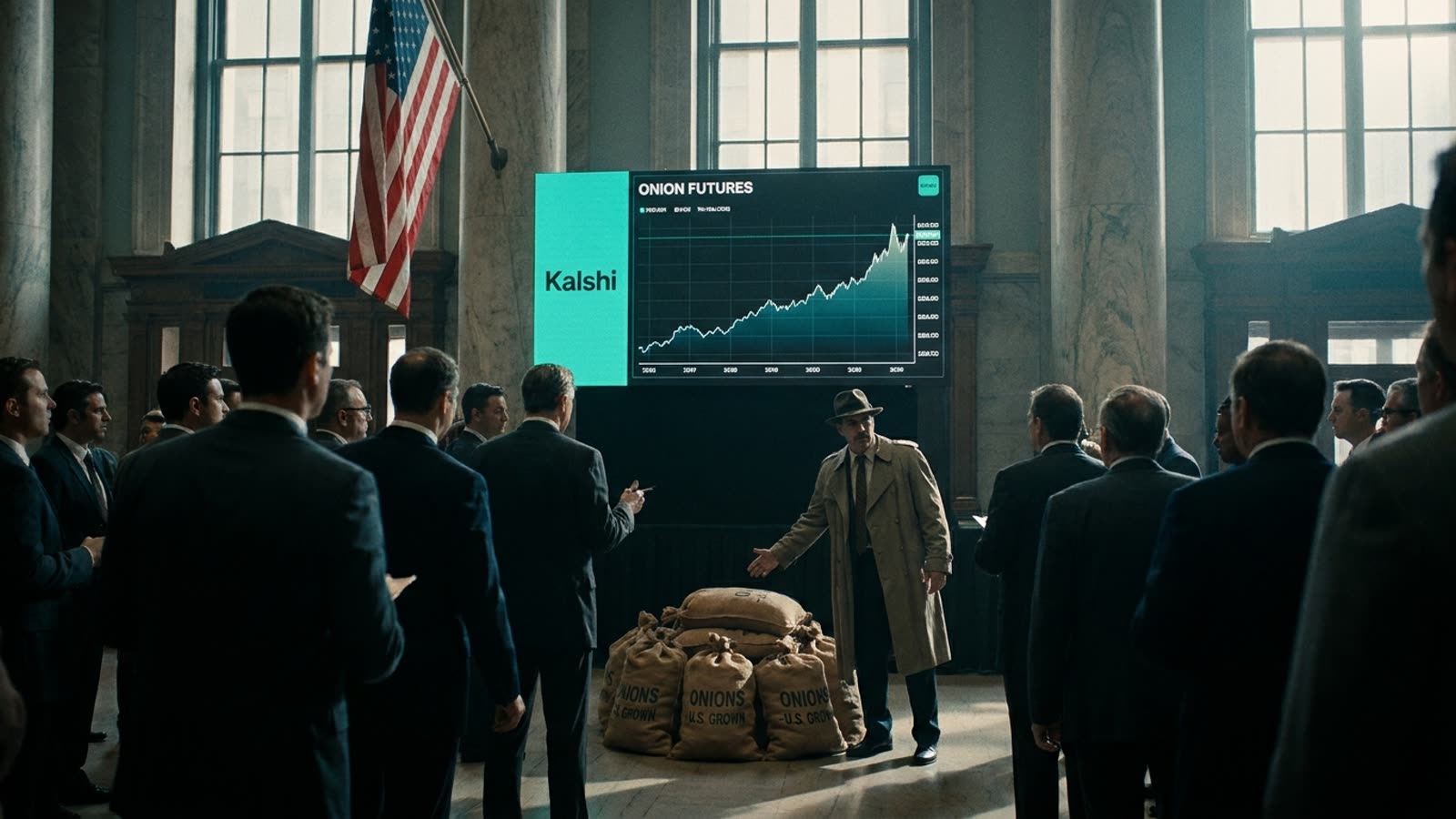
The most consequential piece of agricultural legislation in American history may be a law that bans trading in exactly one vegetable. The Onion Futures Act of 1958 — still on the books, still enforced — prohibits futures contracts on onions, and onions alone, making the humble allium the only commodity in the United States with its own dedicated trading ban. Now Kalshi, the prediction market platform that has spent the past two years picking fights with regulators, wants Congress to kill it.
The company's lobbying push, disclosed in recent federal filings, targets not just onions but a broader principle: that Depression-era and mid-century commodity rules have no place governing modern prediction markets. Kalshi already offers contracts on everything from Federal Reserve rate decisions to Oscar winners. Onion prices, and by extension box office receipts (which fall under separate but philosophically similar restrictions), represent the frontier.
The great onion corner of 1955
The law exists because of Vincent Kosuga, an onion farmer from Pine Island, New York, who in the mid-1950s executed one of the most brazen commodity manipulations in American history. Working with a partner, Kosuga accumulated roughly 30 million pounds of onions — enough to fill warehouses across Chicago — then shorted the futures market while simultaneously dumping his physical holdings. Onion prices collapsed so thoroughly that a 50-pound bag sold for less than the bag itself. Farmers were ruined. Congress, prodded by a young Gerald Ford, responded with the only commodity-specific trading ban ever enacted.
The irony, as economists have noted for decades, is that onion prices have remained more volatile than those of comparable vegetables that do have futures markets. The ban may have removed a tool for hedging rather than a source of speculation.
Why Kalshi cares
Kalshi's interest is not primarily in onions. The company's real target is the regulatory architecture that treats prediction markets as a species of gambling rather than a form of price discovery. The Onion Futures Act is useful to them precisely because it is so absurd — a single-vegetable carve-out that has survived for nearly seven decades through sheer legislative inertia.
The company has already won a significant court battle against the Commodity Futures Trading Commission over election contracts, establishing that prediction markets can operate in politically sensitive territory. Onions are, in a sense, the easy case: no national security implications, no concerns about voter manipulation, just a root vegetable and a Depression-era grudge.
Box office receipts present a more interesting test. The CFTC banned movie futures in 2010 after lobbying from Hollywood studios, which argued that such contracts could be manipulated by insiders and might distort production decisions. Kalshi's position is that modern prediction markets, with their smaller contract sizes and retail focus, pose none of the risks that worried regulators in the era of institutional commodity trading.
Our take
Kalshi is probably right that the Onion Futures Act is an anachronism, a monument to one farmer's greed preserved in amber by congressional indifference. But the company's broader argument — that prediction markets are simply neutral information aggregators deserving minimal regulation — deserves more scrutiny. Markets are never neutral; they create incentives, and incentives shape behavior. The question is not whether Vincent Kosuga's scheme could be repeated on a prediction market platform. It is whether new schemes, optimized for the mechanics of modern retail trading, might emerge in their place. Repealing a 66-year-old onion ban is good politics. Whether it is good policy depends on what comes next.