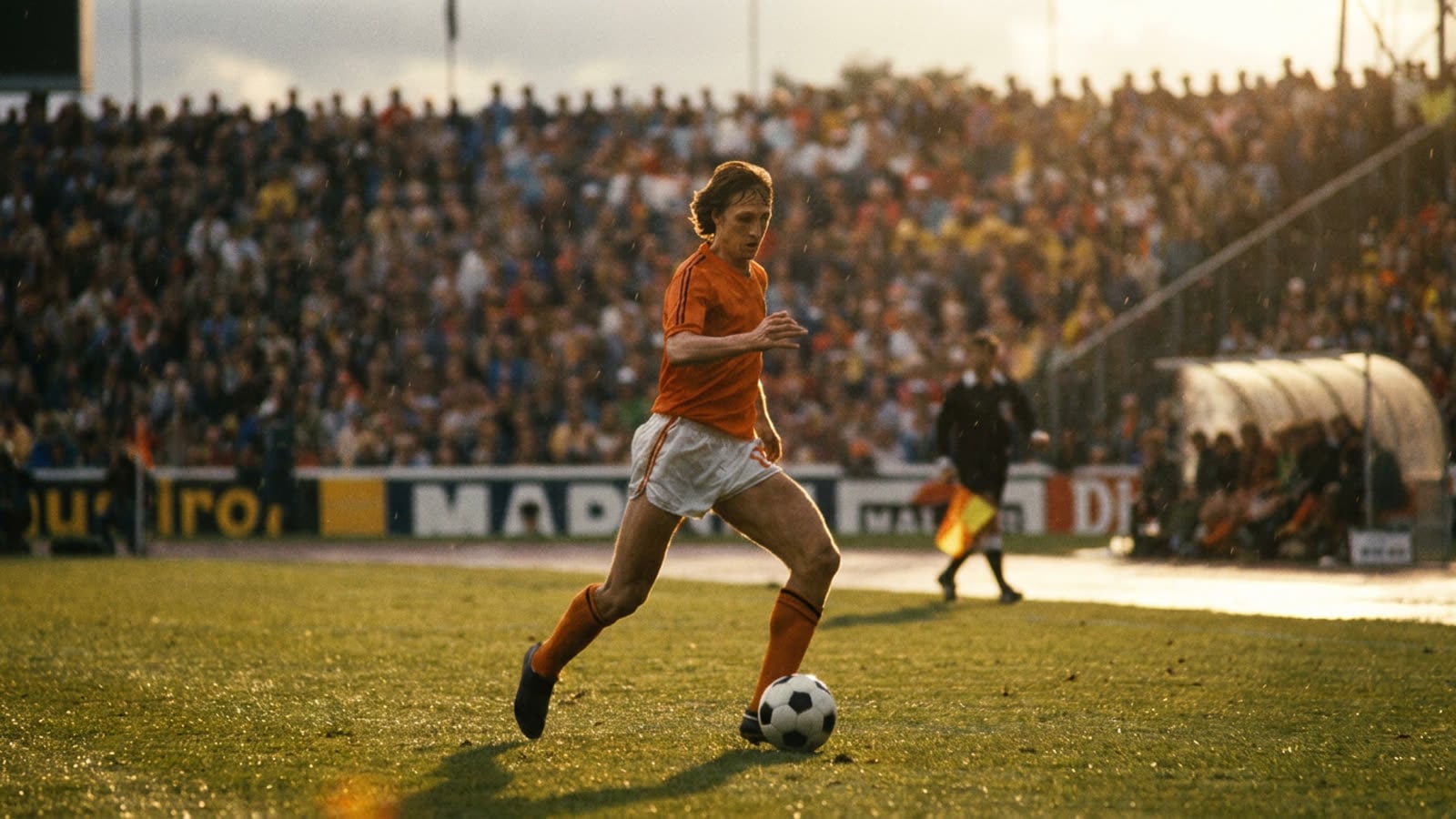
Every generation produces footballers who dominate their era, but only a handful fundamentally alter how the sport is conceived. Johan Cruyff belongs to an even smaller category: those who changed football twice, first as a player and then as an architect of ideas that outlived him.
The Cruyff Turn, executed against Sweden at the 1974 World Cup, remains the most famous piece of individual skill in the sport's history. But reducing Cruyff to a single feint misses the point entirely. The turn was a symptom, not the disease—a physical manifestation of a mind that processed football as a series of geometric problems rather than athletic contests.
The Ajax laboratory
Cruyff emerged from an Ajax Amsterdam system that was already experimenting with Total Football, the tactical philosophy that demanded every outfield player be capable of playing every outfield position. But he transformed experiment into doctrine. As the team's conductor, he orchestrated movement that made opponents feel perpetually outnumbered. The principle was deceptively simple: create triangles, occupy space intelligently, and force the opposition to chase shadows.
Three consecutive European Cups validated the approach. More importantly, they demonstrated that technical intelligence could overcome physical superiority—a revolutionary concept in an era when English football still worshipped the long ball and German football prized industrial efficiency above all else.
Barcelona's second founding
Cruyff's playing career at Barcelona was distinguished but relatively brief. His managerial tenure, from 1988 to 1996, proved more consequential. He inherited a club that had won a single league title in over a decade and built what became known as the Dream Team, winning four consecutive La Liga championships and the club's first European Cup.
The tactical innovations were significant—Cruyff essentially invented the modern false nine role and pioneered the use of wide players who drifted inside—but his structural contributions proved more lasting. He insisted Barcelona establish La Masia as a genuine academy rather than a holding pen, embedding his positional philosophy into the development of children who would later become Xavi, Iniesta, and Messi. The tiki-taka that dominated world football in the 2010s was Cruyff's intellectual property, executed by his grandchildren.
Our take
Cruyff died in 2016, but his football remains very much alive. Pep Guardiola, his most devoted disciple, has spent two decades proving that possession-based, position-fluid football can win at the highest level across multiple leagues. The debate over whether Cruyff or Arrigo Sacchi contributed more to modern tactical thinking is legitimate, but Cruyff's influence extends beyond the pitch into club philosophy, youth development, and the very language coaches use to describe space. He didn't just win matches; he won the argument about what football should aspire to be.