Every football philosophy eventually becomes a cliché, but Johan Cruyff's took longer than most. The principles he embedded at Ajax and Barcelona—positional interchange, pressing as an attacking weapon, the goalkeeper as a passing option—are now so universal that young coaches learn them as fundamentals rather than innovations. That ubiquity is the surest measure of his influence: Cruyff didn't merely win trophies, he altered what winning was supposed to look like.
The Dutch master, who died in 2016, remains the sport's most consequential figure who never managed a World Cup winner or assembled a galáctico-era budget. His legacy is architectural. He designed a style of play that his successors—Pep Guardiola, Louis van Gaal, Ronald Koeman—exported across continents, and he did so with an almost theological certainty that aesthetics and results were the same thing.
The player who coached while dribbling
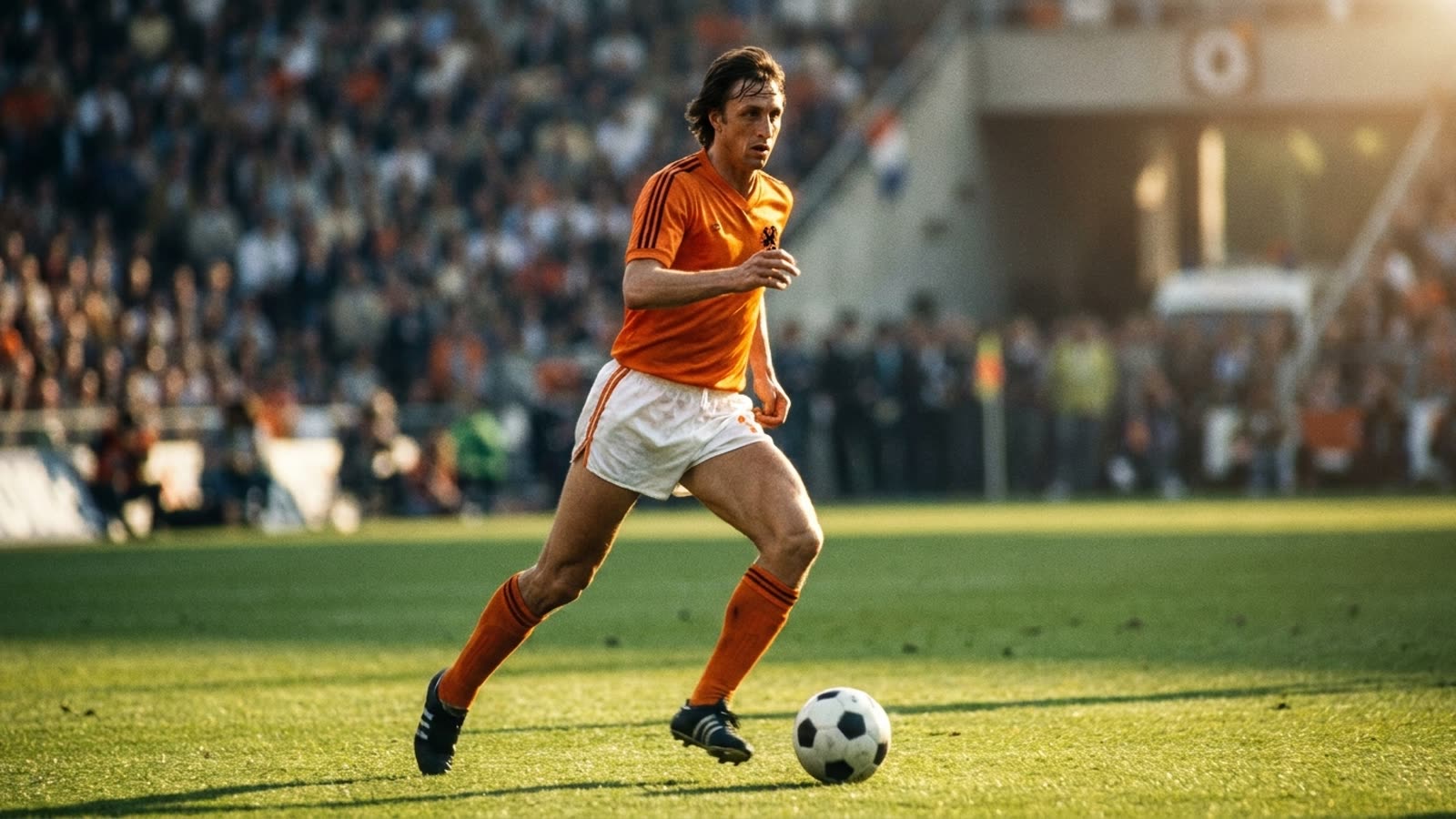
Cruyff's playing career established the template. At Ajax in the early 1970s, he was nominally a centre-forward, but the position was a suggestion rather than a constraint. He drifted wide, dropped deep, orchestrated from wherever the ball found him. The famous turn that bears his name—a drag-back feint that left defenders lunging at air—was less a trick than a statement of intent: space is created, not found.
His move to Barcelona in 1973 was transformative for both parties. The club had won a single league title in fourteen years; Cruyff delivered another within months. More importantly, he introduced a mentality. Barça, he insisted, should dominate possession not because it was safe but because it was suffocating. The opponent cannot score while chasing shadows.
La Masia and the institutionalisation of an idea
When Cruyff returned to Barcelona as manager in 1988, he inherited a club that had underperformed its resources for decades. His solution was infrastructural. He restructured La Masia, the youth academy, to prioritise technical players comfortable receiving the ball under pressure. Size and pace mattered less than spatial intelligence. The result was a production line that would eventually yield Xavi, Iniesta, Messi, and Busquets—players who moved as if connected by invisible thread.
His first-team squad won four consecutive league titles and, in 1992, the club's first European Cup. The final against Sampdoria, decided by a Ronald Koeman free-kick, was a coronation. But Cruyff's true victory was cultural. He convinced a historically anxious institution that it could win by playing beautifully, and that anything less was a betrayal of identity.
The disciples and the doctrine
Guardiola, a defensive midfielder in that 1992 side, absorbed every lecture. When he took charge of Barcelona in 2008, he didn't reinvent Cruyff's wheel; he fitted it with better tyres. The tiki-taka era—six Champions League finals for Guardiola-managed teams across Barcelona and Manchester City—is a direct inheritance. So is the modern obsession with build-up play from the back, with false nines, with midfielders who defend by keeping the ball.
Critics argue the style can curdle into sterility, possession for its own sake. Cruyff would have disagreed. He believed that control was inherently aggressive, that every completed pass was a small act of domination. The game, he once said, is played with the brain.
Our take
Cruyff's genius was understanding that football tactics are ultimately arguments about values. He argued that courage, intelligence, and collective movement should defeat brute physicality—and then he built institutions to prove it. Nearly a decade after his death, every academy that prioritises technical development, every manager who insists on playing out from the goalkeeper, every pundit who praises a team for "controlling the game" is speaking his language. The game moved on, but it moved in the direction he pointed.