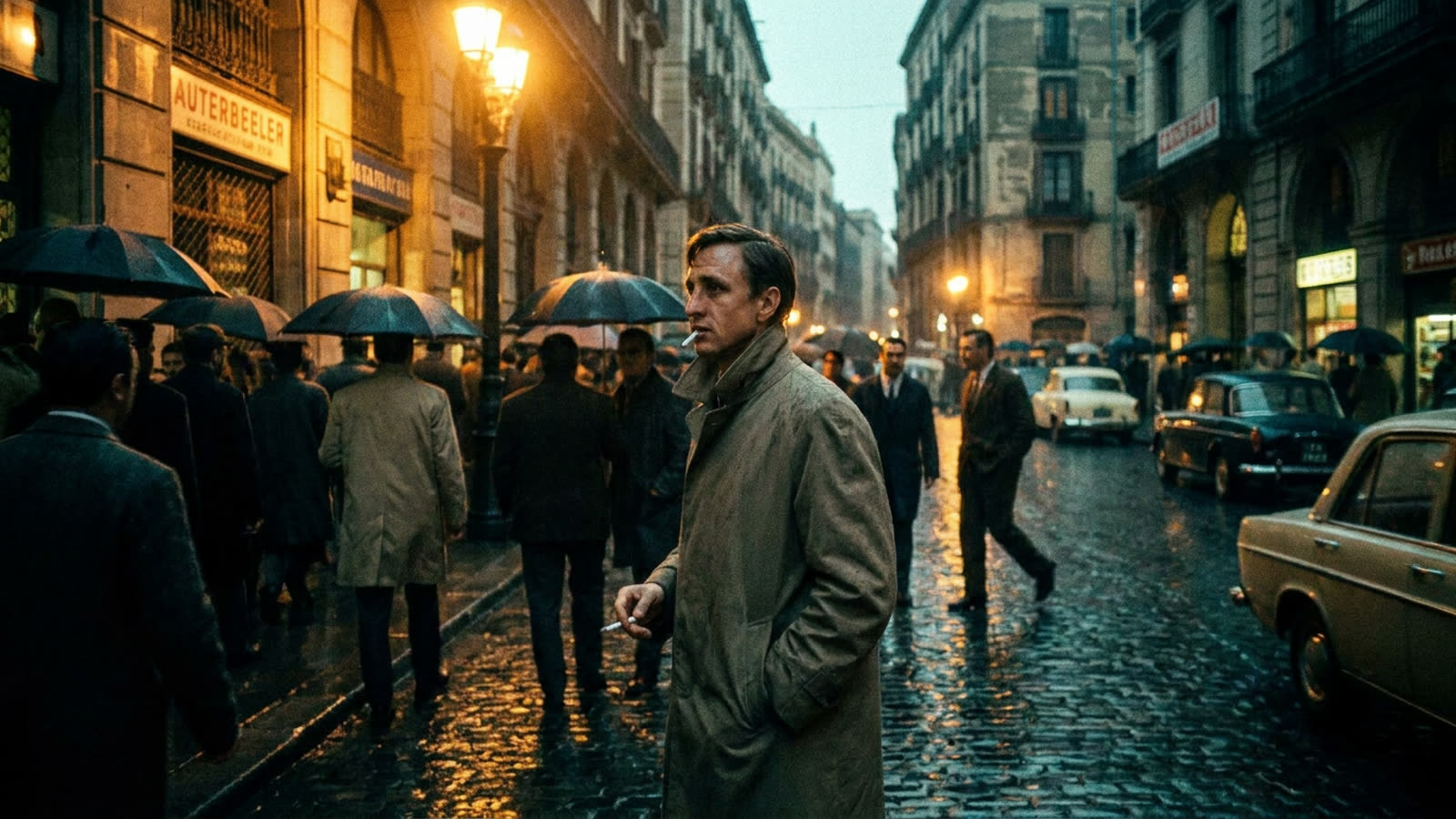
There is a particular kind of genius that does not merely win but changes the terms of the contest itself. Johann Sebastian Bach did not simply compose music; he reorganized what music could be. Johan Cruyff did something similar to football. The sport existed before him and would have continued without him, but it would have been a fundamentally different game — more mechanical, less beautiful, and far less interesting to think about.
Cruyff's playing career produced the expected hardware: three consecutive European Cups with Ajax, a Ballon d'Or, and a World Cup final appearance with the Netherlands in 1974 that his team famously lost to West Germany. But the statistics are almost beside the point. What Cruyff brought to football was a way of seeing — a conviction that space was the game's most precious commodity and that creating it was more important than filling it.
The turn that became a noun
Every schoolchild who has ever dragged the ball behind their standing leg and spun away from a defender has performed a "Cruyff turn," whether they know its provenance or not. The move itself is simple enough. What made it revolutionary was the context: Cruyff deployed it against Sweden's Jan Olsson in the 1974 World Cup, and the moment was broadcast to a global audience that had never seen such elegant deception at such high stakes. Football had always contained trickery, but Cruyff made it look like philosophy.
The turn was merely the most visible expression of a deeper principle. Cruyff believed that football was fundamentally about intelligence — about thinking faster than your opponent, about understanding geometry before the geometry existed. "Playing football is very simple," he once said, "but playing simple football is the hardest thing there is."
The Barcelona inheritance
Cruyff's influence might have faded into nostalgia had he not taken over Barcelona as manager in 1988 and proceeded to build a dynasty. His "Dream Team" won four consecutive La Liga titles and the club's first European Cup, but more importantly, he established a playing identity that the club has never fully abandoned. The emphasis on possession, the insistence on attacking football, the integration of La Masia academy graduates — all of this was Cruyff's doing.
Pep Guardiola, who played under Cruyff and later managed Barcelona to unprecedented success, has never hidden his debt. The tiki-taka style that dominated world football in the early 2010s was essentially Cruyff's Total Football refined and perfected. When Spain won the 2010 World Cup with a squad built around Barcelona's core, they were playing football that Cruyff would have recognized as his own.
Our take
The football world has a tendency to measure greatness in trophies, and by that standard Cruyff falls short of Pelé or Diego Maradona or the modern titans. But influence is a different currency, and by that measure Cruyff may be the most important figure the sport has produced. Every team that prioritizes possession over pragmatism, every manager who insists that football should be beautiful as well as effective, every academy that teaches children to think before they kick — all of them are working within a framework that Cruyff built. He did not just play the game; he taught us how to watch it.