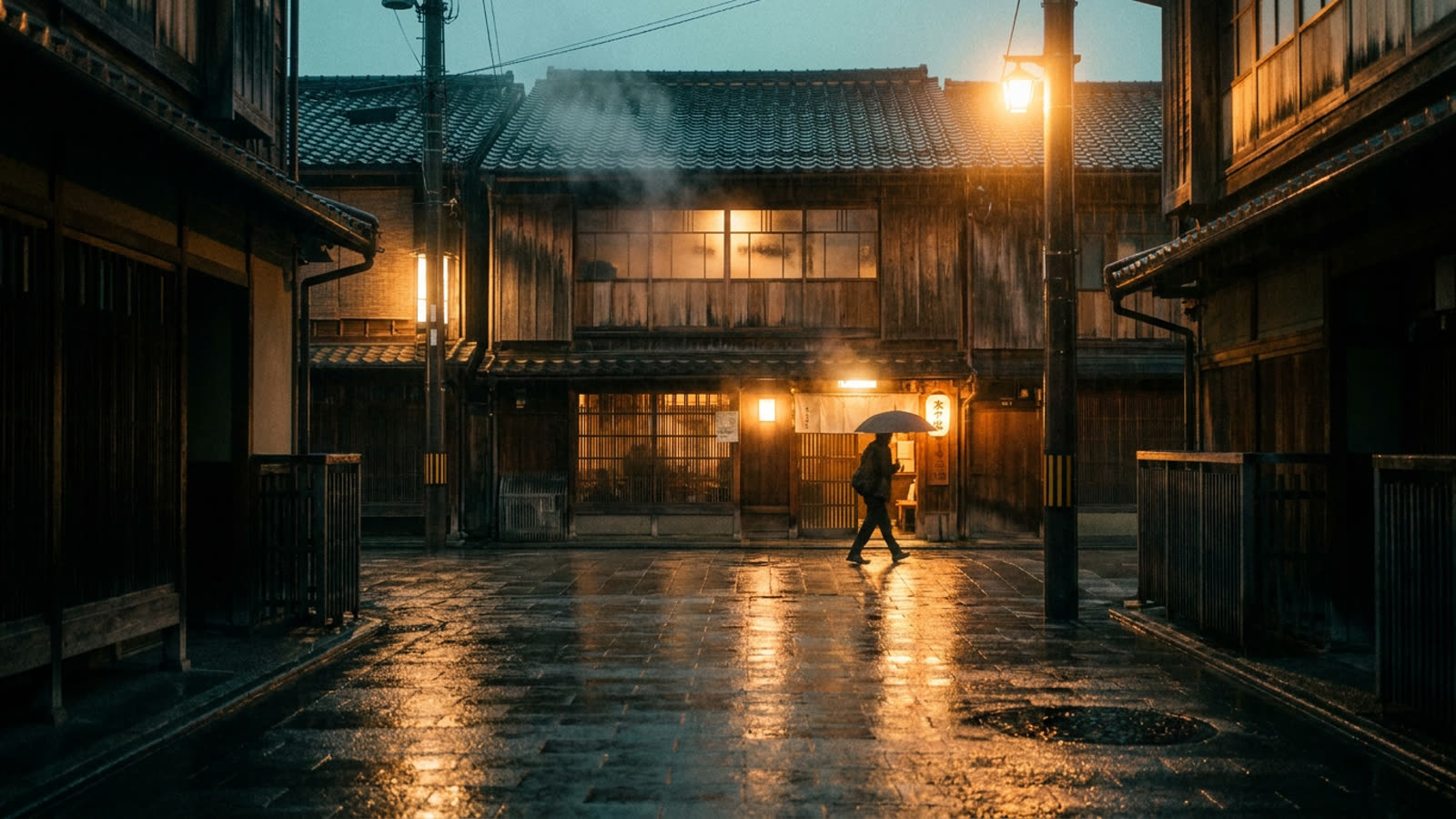
Walk into a kissaten in any Japanese city and you will notice the absence before the presence. No laptop glow, no queue snaking toward a counter, no milk alternatives chalked on a board. What you will find instead is a leather banquette worn to a shine, a proprietor in his seventies hand-dripping coffee with the focus of a calligrapher, and a silence so complete you can hear the ice crack in your glass of water.
The kissaten — literally "tea-drinking shop," though coffee long ago became the point — emerged in the early twentieth century as Japan's answer to the Viennese coffeehouse. By the postwar decades, these establishments had multiplied into the tens of thousands, each one a private island where salarymen could read newspapers, students could brood over unrequited love, and writers could stretch a single cup across an entire afternoon. The kissaten asked nothing of its patrons except presence.
The economics of refusal
Modern hospitality economics would declare the kissaten model suicidal. A single barista-owner, no table turnover pressure, beans roasted in micro-batches, interiors unchanged since the Showa era — the formula inverts every efficiency metric that chains like Starbucks and Doutor optimized. Yet thousands of kissaten endure, often operated by the same family for generations, their survival underwritten by a clientele that treats the establishment less as a vendor than as a secular temple.
The secret is that kissaten owners never tried to scale. They built businesses around a single room, a single craft, a single relationship with regularity. Rent in older buildings remained manageable; ambition remained modest. What looked like commercial naïveté turned out to be a hedge against the very pressures that bankrupted flashier competitors.
Aesthetics as ethics
Step inside Chatei Hatou in Tokyo's Shibuya or Rokuyosha in Osaka and you encounter interiors that function as time capsules — velvet curtains, wood paneling darkened by decades of cigarette smoke, hand-painted menu boards. These spaces were never "designed" in the contemporary sense; they accreted, layer upon layer, until the patina became the point.
The kissaten aesthetic now exerts a quiet influence on global interior design. Scandinavian minimalism and industrial exposed-brick have dominated café culture for two decades, but a counter-movement prizes warmth, enclosure, and the visible passage of time. Designers cite kissaten as the ur-text: proof that atmosphere can be inherited rather than manufactured.
Our take
The kissaten survives not because Japan is nostalgic but because the need it answers — for deceleration, for analog ritual, for a room where no one expects you to optimize — is universal and growing. Every city now has its "slow coffee" imitators, yet most miss the point by treating slowness as a brand rather than a practice. The kissaten's lesson is simpler and harder: build something small, do it well, and trust that enough people will always need a place to sit with their thoughts and a cup that never runs dry.