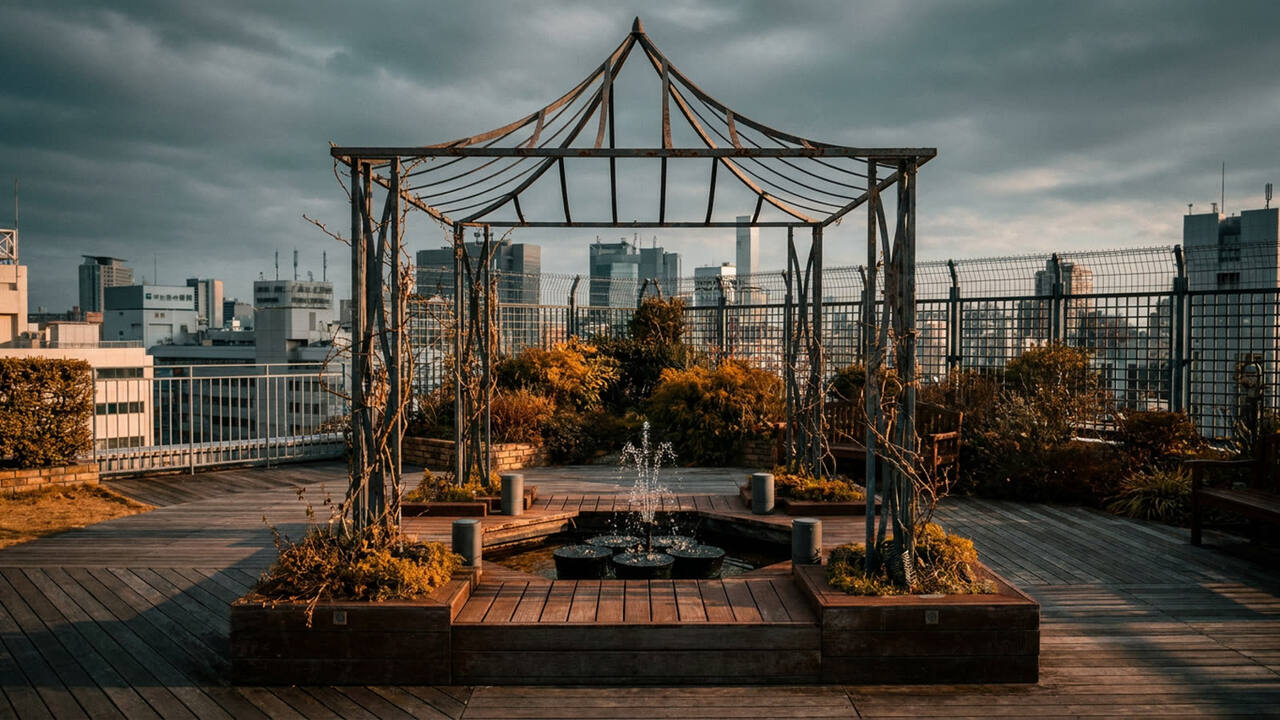
The elevator doors open onto the eighth floor of a Nagoya department store, and suddenly you are outdoors, surrounded by potted azaleas, a miniature Ferris wheel, and salarymen nursing Asahi drafts at plastic tables. This is the okujō, the Japanese department store rooftop — part amusement park, part beer garden, part urban oasis — and it is vanishing faster than anyone seems willing to acknowledge.
The okujō emerged in the 1920s but reached its apotheosis in the postwar decades, when Japan's great department stores — Mitsukoshi, Takashimaya, Matsuzakaya, Isetan — competed not merely on merchandise but on spectacle. A rooftop was not dead space to be leased to mobile carriers for antenna equipment; it was a destination. Children rode miniature trains past topiary elephants. Couples posed before modest observation decks. Families ate yakisoba under paper lanterns while the city hummed below.
The logic of vertical leisure
The phenomenon made a certain ruthless commercial sense. Japanese department stores were already vertical cities — basement food halls, ground-floor cosmetics, ascending floors of fashion, homewares, kimonos, and finally restaurants. The rooftop completed the circuit, ensuring customers who had ridden the escalators upward would linger, spend, and remember. It was experiential retail decades before the term existed.
The rooftops also solved a genuine urban problem. In dense cities with limited public parks, the okujō offered green space, fresh air, and a rare horizontal view. Department stores understood themselves as civic institutions, not mere retailers, and the rooftop was their gift to the neighborhood.
The slow fade
By the 1990s, the model was already under pressure. Suburban malls offered parking and sprawl. Convenience stores and specialty chains fragmented the department store's claim to comprehensiveness. The rooftops aged; the Ferris wheels rusted; insurance premiums climbed. One by one, the gardens closed, replaced by storage, staff smoking areas, or nothing at all.
Today, a handful survive — Mitsukoshi Nihonbashi maintains a modest shrine and garden; a few regional stores keep their beer gardens operating through summer. But the golden age is gone. The children who rode those miniature trains are now grandparents, and their grandchildren have never seen an okujō in its prime.
Our take
The death of the department store rooftop is not merely architectural nostalgia. It marks the end of a particular vision of commerce — one in which retailers saw themselves as stewards of urban life, not just extractors of wallet share. The okujō was inefficient, whimsical, and impossible to justify on a spreadsheet. That was precisely the point. In an era when every square meter must earn its keep, the notion that a store might offer its customers a garden, a Ferris wheel, and a cold beer simply because it could feels almost radical. We are poorer for its passing.