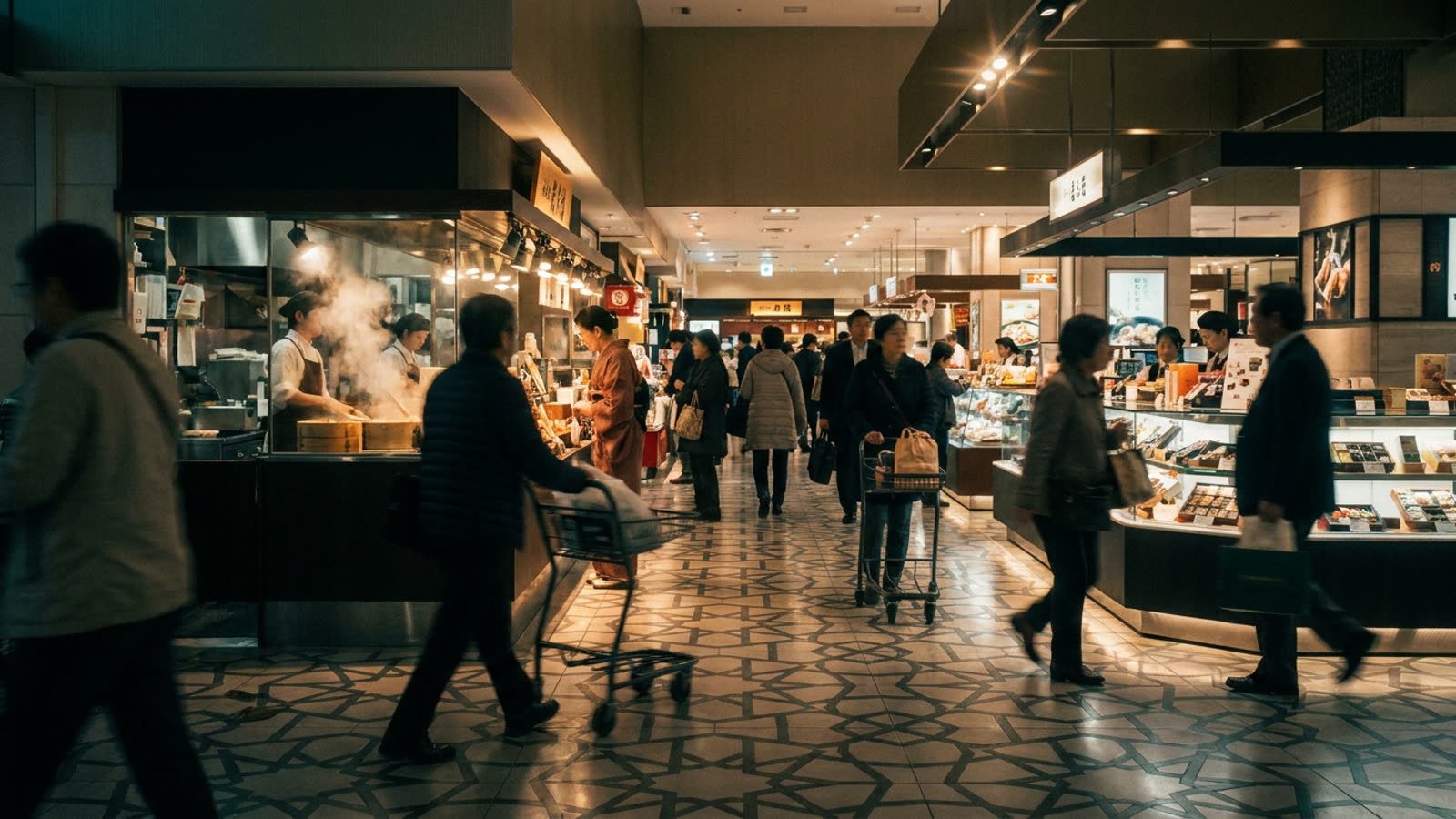
The first time you descend into a Japanese depachika, you will likely stand motionless for several minutes, overwhelmed by the sheer density of beautiful food arranged with museum-level precision. This is not an exaggeration. The basement floors of Japanese department stores—Isetan in Shinjuku, Takashimaya in Nihonbashi, Hankyu in Osaka—operate on aesthetic and service principles that make Whole Foods look like a gas station.
The word itself is a portmanteau: depaato (department store) plus chika (basement). But the linguistic shorthand fails to capture what these spaces actually are: curated galleries of Japan's food obsession, staffed by white-gloved attendants who wrap a single peach in tissue paper as though preparing it for interment in a pharaoh's tomb.
The architecture of abundance
A typical depachika occupies one or two basement levels and contains hundreds of vendors, each specializing in something impossibly specific. One counter sells only tamagoyaki—the sweet rolled omelet—in several regional variations. Another offers perhaps eight types of pickled plum. The wagashi confectioner displays seasonal sweets that change weekly, each designed to evoke a particular moment in the natural calendar: the first cherry blossoms, the summer moon, the autumn maple.
The layout follows an unwritten logic. Fresh fish and meat occupy the perimeter. Prepared foods—bento boxes, tempura, tonkatsu—cluster in the center. Western-style patisseries and chocolate shops anchor the entrances, their French names rendered in katakana. The effect is labyrinthine but somehow navigable, a food court elevated to the level of urban planning.
Service as performance
What distinguishes the depachika from any Western equivalent is the service culture. Staff bow when you approach. They bow when you leave. If you purchase something, they will wrap it with origami-level precision, add a cold pack if necessary, and present it with both hands. The transaction takes three times longer than it would elsewhere, and you will not mind.
This extends to the sampling culture. Many counters offer tastes freely, without the aggressive salesmanship that makes American sample stations feel like ambushes. The assumption is that you are a discerning person who deserves to make an informed decision. The assumption is correct.
Why export has failed
Japanese department stores have occasionally attempted to transplant the depachika concept abroad. These efforts have uniformly disappointed. The model depends on several factors that do not travel well: real estate costs that justify basement-level retail, a customer base willing to pay premium prices for incremental quality improvements, and a labor market that supplies workers trained in a service philosophy that takes years to internalize.
More fundamentally, the depachika reflects a cultural relationship with food that treats grocery shopping as a sensory pleasure rather than a logistical chore. Americans optimize for convenience; Japanese optimize for experience. Neither is wrong, but they produce very different retail environments.
Our take
The depachika represents something increasingly rare in global retail: a format that resists disruption because it cannot be made more efficient. You cannot Amazon Prime the experience of watching a craftsman slice wagyu to order, or the small thrill of discovering a regional specialty you have never encountered. In an era when commerce trends toward frictionless transactions, the depachika insists that friction—the right kind, applied thoughtfully—is the entire point.