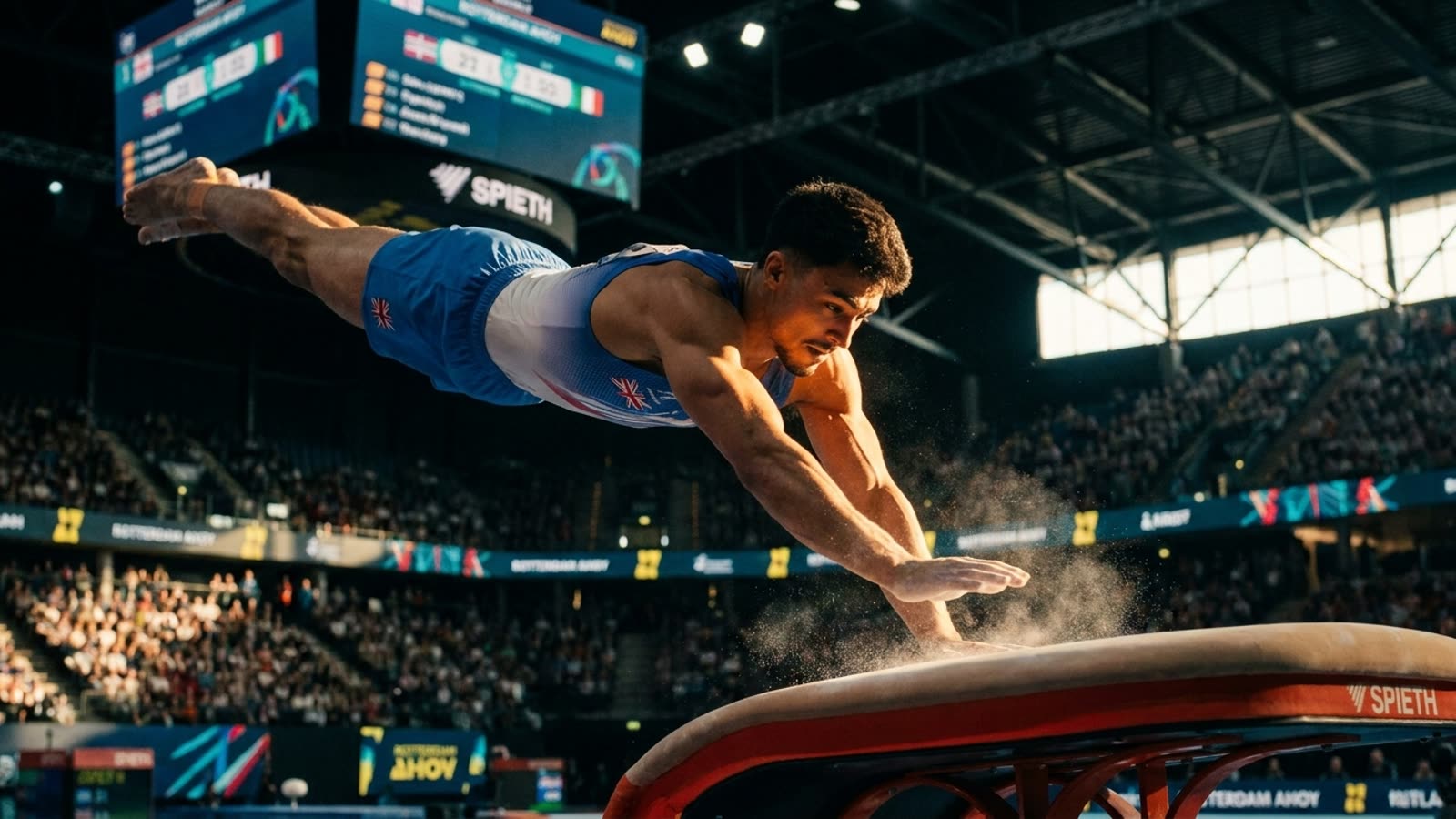
Before this week, no British male gymnast had ever won two individual medals at a single World Championships. Jake Jarman has now done it in Rotterdam with four days to spare, adding vault silver to his earlier apparatus medal and announcing, in the most emphatic terms possible, that British men's gymnastics has arrived at the sport's top table.
The vault final was supposed to be a coronation for the reigning Olympic champion, but Jarman's execution—clean landings, towering amplitude, the controlled aggression that has become his signature—forced the judges to take him seriously as a threat rather than a plucky outsider. His combined score across two vaults left him fractions behind gold but miles ahead of the narrative that British men are afterthoughts in this discipline.
The long road from Commonwealth darling to world contender
Jarman first caught wider attention at the 2022 Commonwealth Games in Birmingham, where he swept four golds in front of a home crowd delirious for any excuse to cheer. That haul was dismissed in some quarters as a product of thin competition, a big fish thriving in a small pond. Rotterdam is nobody's small pond. The men's vault final featured Olympic medallists, world record holders, and athletes from programs—China, Japan, South Korea—that have dominated apparatus gymnastics for generations. Jarman beat most of them.
His trajectory since Birmingham has been a study in incremental elevation: European medals, World Cup podiums, and now two silvers at the sport's most prestigious annual event. The progression is neither accidental nor purely individual. British Gymnastics has invested heavily in its men's program over the past decade, luring coaching talent and building training infrastructure that once seemed reserved for wealthier federations.
What vault reveals about a gymnast
Vault is the most unforgiving apparatus. There is no routine to recover within, no second tumbling pass to erase a wobble. You sprint, you launch, you land—and the judges see everything in those few airborne seconds. Jarman's willingness to compete difficult vaults under pressure, rather than dialling back to safer options, speaks to a competitive temperament that separates medallists from participants.
His second vault in the final was the riskier of the two, a calculated gamble that he could stick a demanding landing and outscore more conservative rivals. He nearly did. The margins in elite gymnastics are cruel; a half-step on the mat can mean the difference between gold and silver. But Jarman's decision to attack rather than protect tells you everything about where he believes he belongs.
Our take
Two individual World Championship medals in a single edition is not a fluke. It is a statement of intent from an athlete, and a program, that no longer views itself as an underdog. Jarman is 22. If his body cooperates—always the asterisk in gymnastics—he has at least two more Olympic cycles to convert these silvers into something shinier. Rotterdam was not the peak. It was the proof of concept.