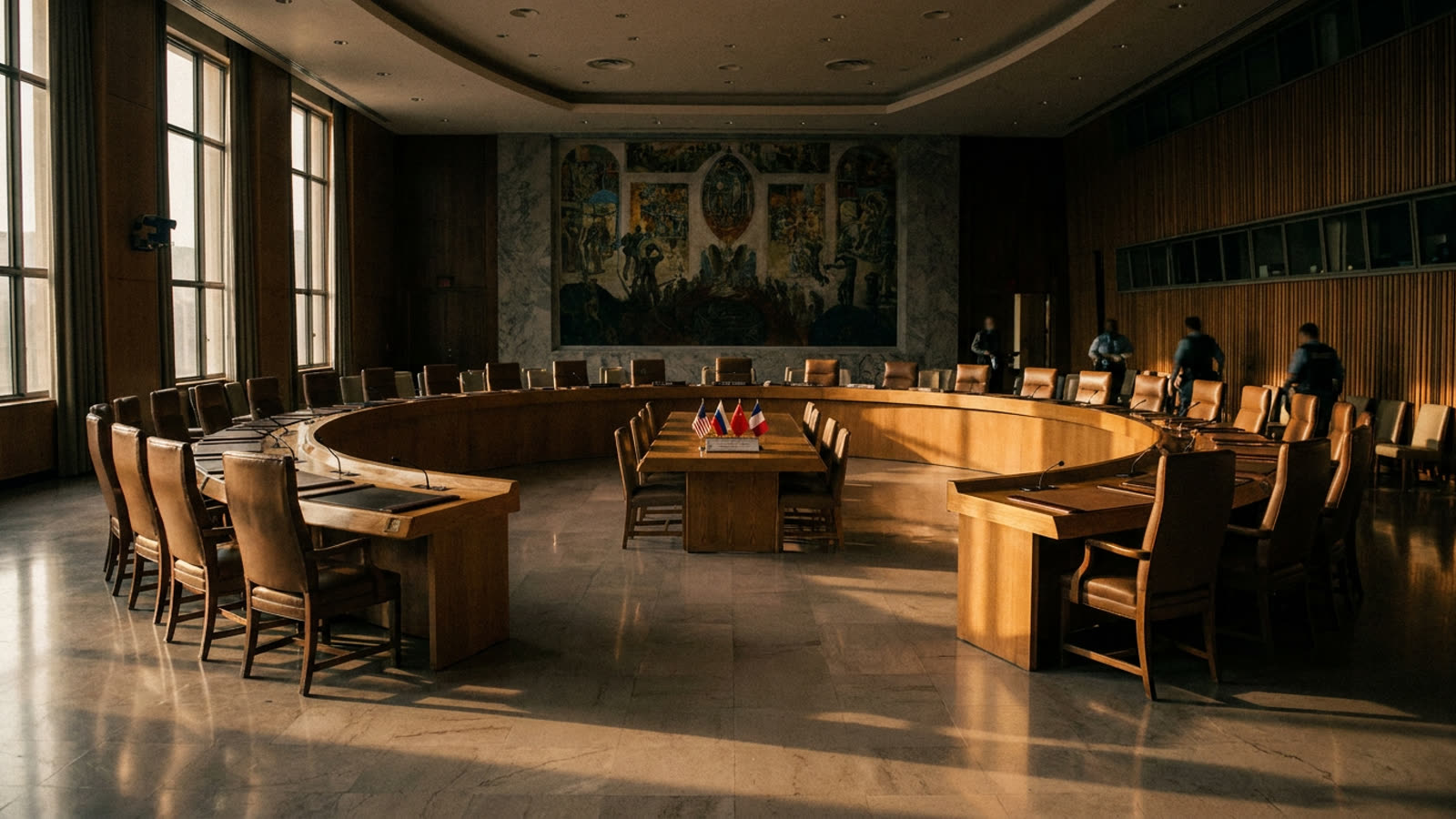
The United Nations Security Council is routinely accused of failure. It failed in Syria, failed in Ukraine, failed in countless crises where great powers clashed and civilians died. Critics demand reform, expansion, the abolition of the veto. They misunderstand the institution entirely. The Security Council was never designed to solve conflicts between major powers. It was designed to survive them.
The veto exists because the alternative was no United Nations at all. When the victors of the Second World War gathered to create a successor to the failed League of Nations, they confronted a brutal truth: the League collapsed because it had no enforcement mechanism, and any enforcement mechanism strong enough to matter would be unacceptable to sovereign great powers unless those powers could exempt themselves from its reach. The solution was elegant in its cynicism. The five permanent members—the United States, the Soviet Union, Britain, France, and China—would each hold absolute blocking power. No resolution could pass if any one of them objected.
The logic of designed paralysis
This was not idealism compromised by realism. It was realism from the start. The architects understood that a Security Council capable of authorizing action against a permanent member's core interests would either be ignored or trigger the very great-power war the UN existed to prevent. Better a body that could act decisively in conflicts where the major powers agreed, or at least did not strongly disagree, than one that pretended to universal authority it could never enforce.
The Cold War proved the wisdom of this pessimism. The Security Council was frozen for decades, vetoes flying from both Washington and Moscow. Yet the institution survived, providing a forum where adversaries could talk, where smaller conflicts could occasionally be managed, where the fiction of international law could be maintained until circumstances allowed it to become fact. The Korean War authorization slipped through only because the Soviet delegate was boycotting sessions—a procedural accident Moscow never repeated.
Why reform proposals always fail
Every few years, proposals emerge to expand the permanent membership, to limit veto use, to create accountability mechanisms. Germany, Japan, India, Brazil, and various African nations have legitimate claims to seats reflecting the modern distribution of power. None of these reforms will happen, for the same reason the veto exists in the first place: any change requires the consent of those who benefit from the current arrangement, and no permanent member will voluntarily dilute its own privilege.
The veto is not merely a procedural rule. It is a recognition that international law, unlike domestic law, lacks a sovereign to enforce it. Within nations, courts can compel because police and prisons stand behind them. Between nations, especially nuclear-armed ones, no such compulsion exists. The Security Council's authority rests entirely on the willingness of powerful states to accept its decisions. The veto ensures they only face decisions they can accept.
Our take
The frustration with the Security Council is understandable and often morally appropriate. Watching vetoes shield atrocities is genuinely obscene. But the anger is misdirected when it targets the institution's design rather than the underlying reality the design reflects. The Security Council does not cause great-power rivalry; it merely refuses to pretend that rivalry away. Abolishing the veto would not create a more just world order. It would create a United Nations that major powers ignored entirely, or one that collapsed the moment it tried to act against their interests. The veto is a mirror. We dislike what we see in it, but smashing the mirror changes nothing underneath.