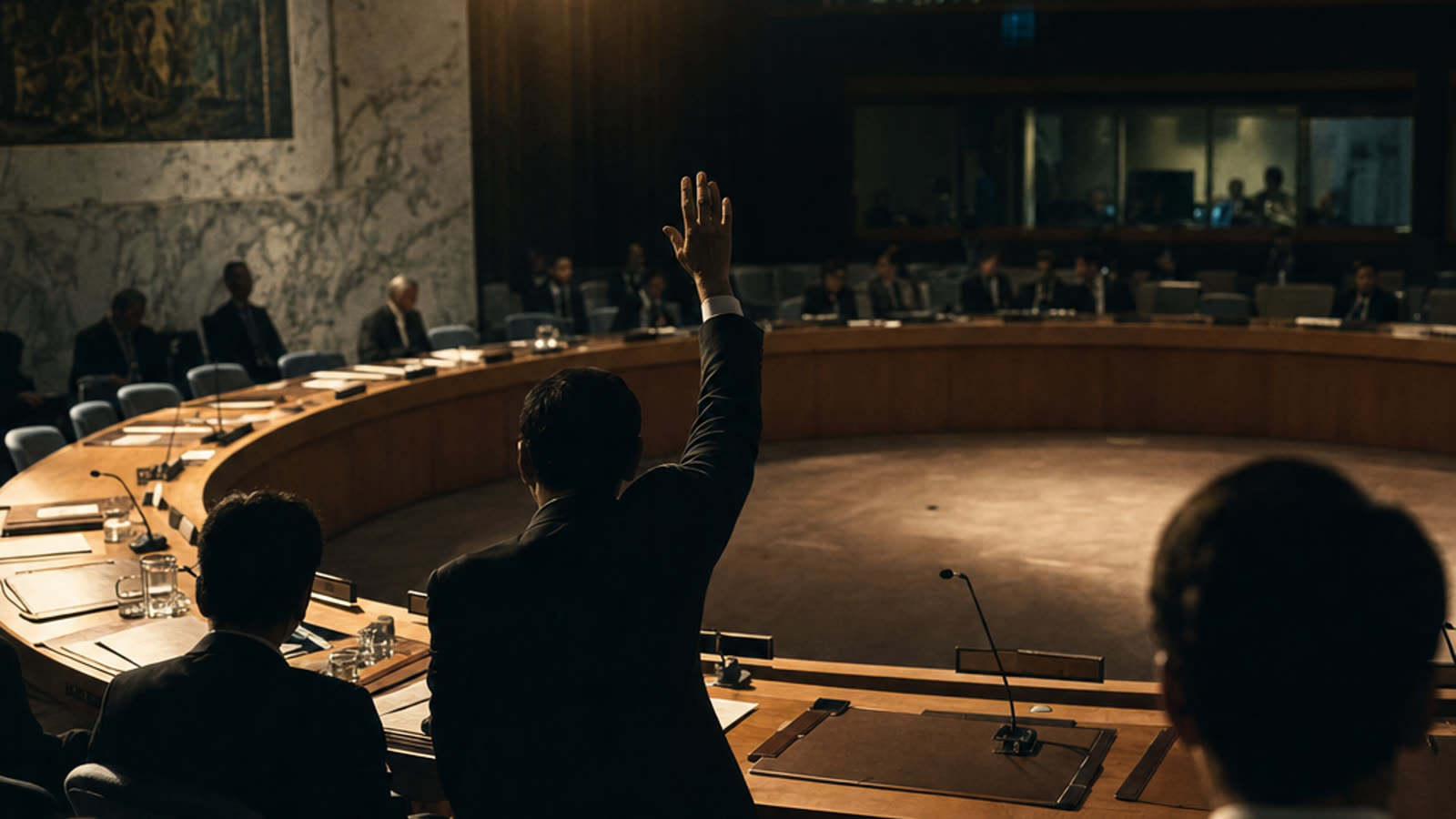
The United Nations Security Council veto is perhaps the most misunderstood mechanism in international relations. Critics denounce it as antidemocratic, a relic of 1945 power arrangements that paralyzes the body whenever great-power interests diverge. They are correct on every count except the conclusion they draw from it. The veto was never designed to make the Security Council effective in the conventional sense. It was designed to make it durable.
The Council's five permanent members—the United States, Russia, China, France, and the United Kingdom—each possess the unilateral power to kill any substantive resolution. This has happened hundreds of times since the UN's founding. Russia has wielded the veto most frequently, often to shield allies from condemnation or intervention. The United States has used it dozens of times, predominantly to protect Israel from critical resolutions. China exercises it sparingly but strategically. France and Britain rarely deploy it alone anymore, though their latent power shapes negotiations before votes ever occur.
The logic of institutional survival
The architects of the UN Charter, drafting in San Francisco as the Second World War ended, had watched the League of Nations collapse. That body operated on consensus among all members, which meant any state could obstruct action—and major powers simply walked away when the institution inconvenienced them. Japan left over Manchuria. Germany and Italy departed. The Soviet Union was expelled. The League died not from paralysis but from irrelevance; the powers that mattered stopped showing up.
The veto solved this by making the Security Council a club that great powers could never be outvoted in. They would stay because staying cost them nothing and leaving gained them nothing they did not already possess. The price was accepting that the Council would be unable to act against any permanent member's core interests. This was not a flaw in the design. It was the design.
How the veto shapes what never reaches a vote
The visible vetoes—the raised hands, the failed resolutions—represent only the surface of the mechanism's influence. Far more consequential is the veto's shadow: the resolutions never drafted, the interventions never proposed, the sanctions regimes never contemplated because sponsors know in advance they would die. Diplomats call this the "pocket veto," though it is really just rational anticipation.
This dynamic explains why Security Council action clusters around situations where no permanent member has vital interests at stake, or where interests temporarily align. Peacekeeping missions proliferate in conflicts great powers find peripheral. Sanctions regimes target middle powers without nuclear arsenals or permanent-member patrons. The Council acts decisively against Iraq in 1990 because Moscow, weakened and seeking Western integration, declines to protect its former client. It cannot act on Syria's civil war because Russia calculates differently.
The reform that will not happen
Proposals to reform or abolish the veto surface regularly. They founder on an obvious problem: any Charter amendment requires ratification by all five permanent members, each of whom would be voting to diminish their own power. This is not cynicism; it is constitutional structure. The veto protects itself.
More creative proposals—adding new permanent members, creating weighted voting, establishing override mechanisms—face the same barrier. Germany, Japan, India, and Brazil have sought permanent seats for decades. Their campaigns have produced conferences, working groups, and communiqués, but no Charter amendments. The P5 have no incentive to dilute their exclusive club, and the aspirants cannot agree among themselves on who deserves entry.
Our take
The Security Council veto deserves its criticism and its preservation. It renders the body incapable of addressing precisely the conflicts that matter most—those where great powers clash or protect clients. But it also keeps those powers inside the institution, talking, occasionally cooperating, and maintaining the fiction of a rules-based order even as they routinely violate its spirit. The alternative is not a more democratic UN. The alternative is no UN at all, or one that major powers ignore entirely. The founders understood that a weak institution which endures beats a strong institution which shatters. Eight decades later, their cynical wager continues to pay its modest dividends.