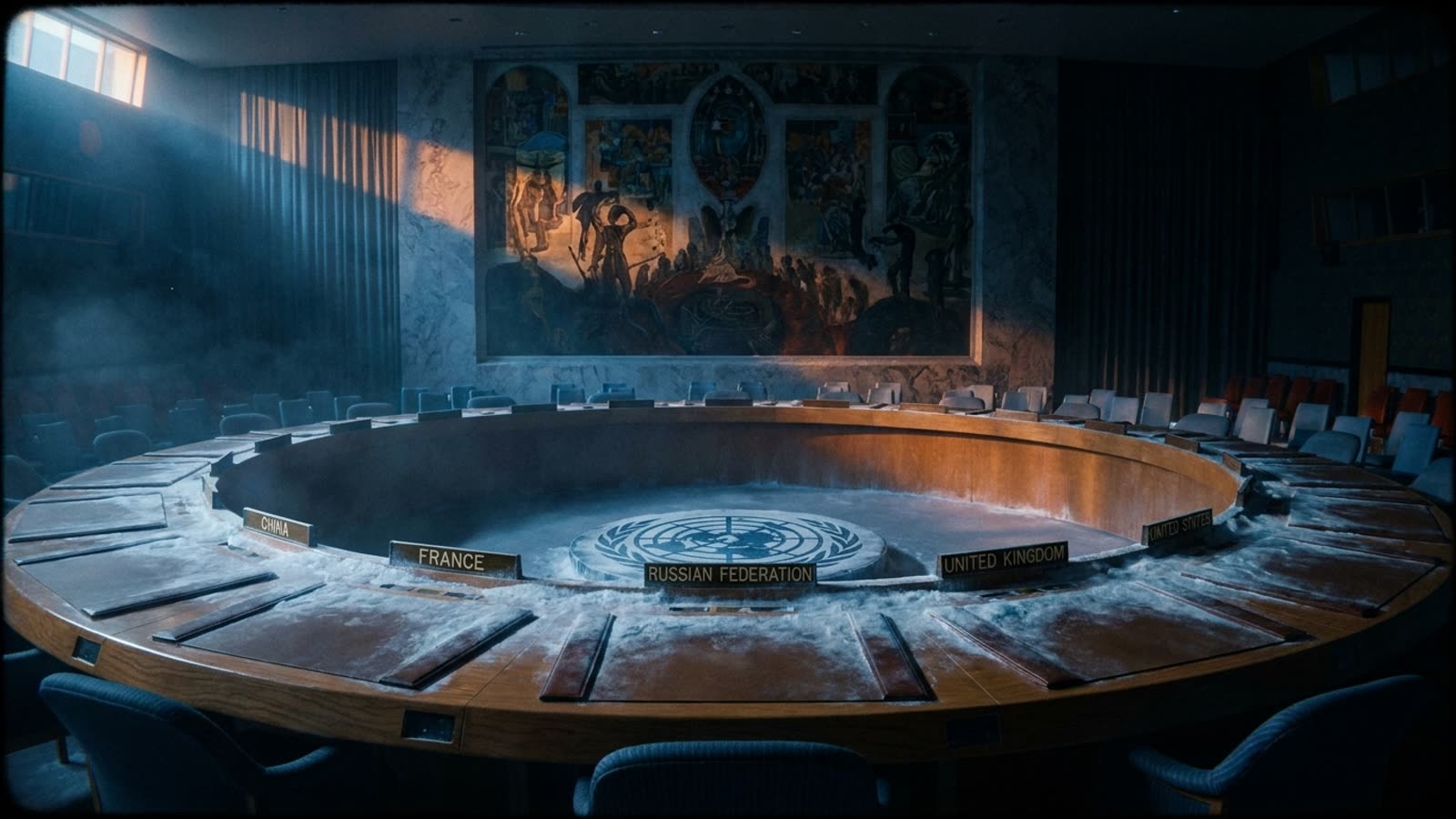
The United Nations Security Council meets in a chamber designed to project collective resolve, yet its most consequential moments are often its quietest: a single raised hand, a murmured "nyet" or "non," and resolutions that commanded months of diplomatic labor simply vanish. The veto power held by the five permanent members—the United States, Russia, China, France, and the United Kingdom—is not a bug in the international order. It is the feature that made the order possible at all, and the reason that order so frequently fails to function.
Understanding the veto requires abandoning the notion that the Security Council was built to solve problems. It was built to prevent a third world war by ensuring that no binding international action could be taken against the interests of the states most capable of waging one.
The architecture of stalemate
The veto emerged from the wreckage of the League of Nations, which had required unanimity among all members and consequently achieved nothing when it mattered most. At the 1945 San Francisco Conference, the victorious Allied powers—soon to be the P5—insisted on a different bargain: they would join a new collective security body, but only if they could never be bound by it against their will. The smaller nations protested; the great powers shrugged. Without the veto, there would be no United Nations at all.
The mechanism is deceptively simple. Any of the fifteen Security Council members can vote against a resolution, but only a P5 negative vote kills it outright. A single veto from Washington, Moscow, Beijing, Paris, or London is sufficient to block action on any substantive matter, from peacekeeping deployments to sanctions regimes to referrals to the International Criminal Court.
The veto in practice
Russia—and before it, the Soviet Union—has wielded the veto more than any other permanent member, frequently to shield allies from censure or intervention. The United States has used it most often to protect Israel from resolutions critical of its military operations or settlement policies. China historically abstained rather than vetoed, preferring to avoid confrontation, though its use has increased markedly in recent years on matters touching Taiwan, Xinjiang, and Hong Kong.
The veto's shadow is often longer than its direct use. Many resolutions are never formally introduced because sponsors know they face certain defeat. This "pocket veto" effect means the official count of vetoes dramatically understates the mechanism's influence. Diplomats negotiate not toward optimal outcomes but toward whatever the most reluctant P5 member will tolerate.
Reform that never arrives
Proposals to abolish or constrain the veto are as old as the veto itself. Suggestions have ranged from requiring two vetoes to block a resolution, to suspending the veto in cases of mass atrocity, to expanding the P5 to include powers like India, Brazil, Germany, or Japan. None have advanced, for the obvious reason that any Charter amendment requires ratification by all five permanent members, each of whom has a veto over changes to their veto.
The General Assembly has developed workarounds of limited utility. The "Uniting for Peace" resolution allows the Assembly to recommend action when the Security Council is deadlocked, but Assembly resolutions lack binding force. They are expressions of global opinion, not instruments of global governance.
Our take
The veto is indefensible in principle and indispensable in practice. It enshrines a hierarchy of states that no longer reflects the distribution of global power, and it guarantees paralysis precisely when the world most needs action. Yet abolishing it would likely cause the P5 to abandon the institution entirely, leaving something even worse: a United Nations that issues demands no great power feels obliged to consider. The veto is the price of keeping the most dangerous states inside the room. Whether that price remains worth paying is the question the institution has never been permitted to answer.