Every four years, Americans go to the polls believing they are voting for president. They are not. They are voting for a slate of electors who have pledged to vote for a particular candidate — pledged, but in most states not legally bound. This distinction, which sounds like trivia, is actually the load-bearing wall of American presidential politics.
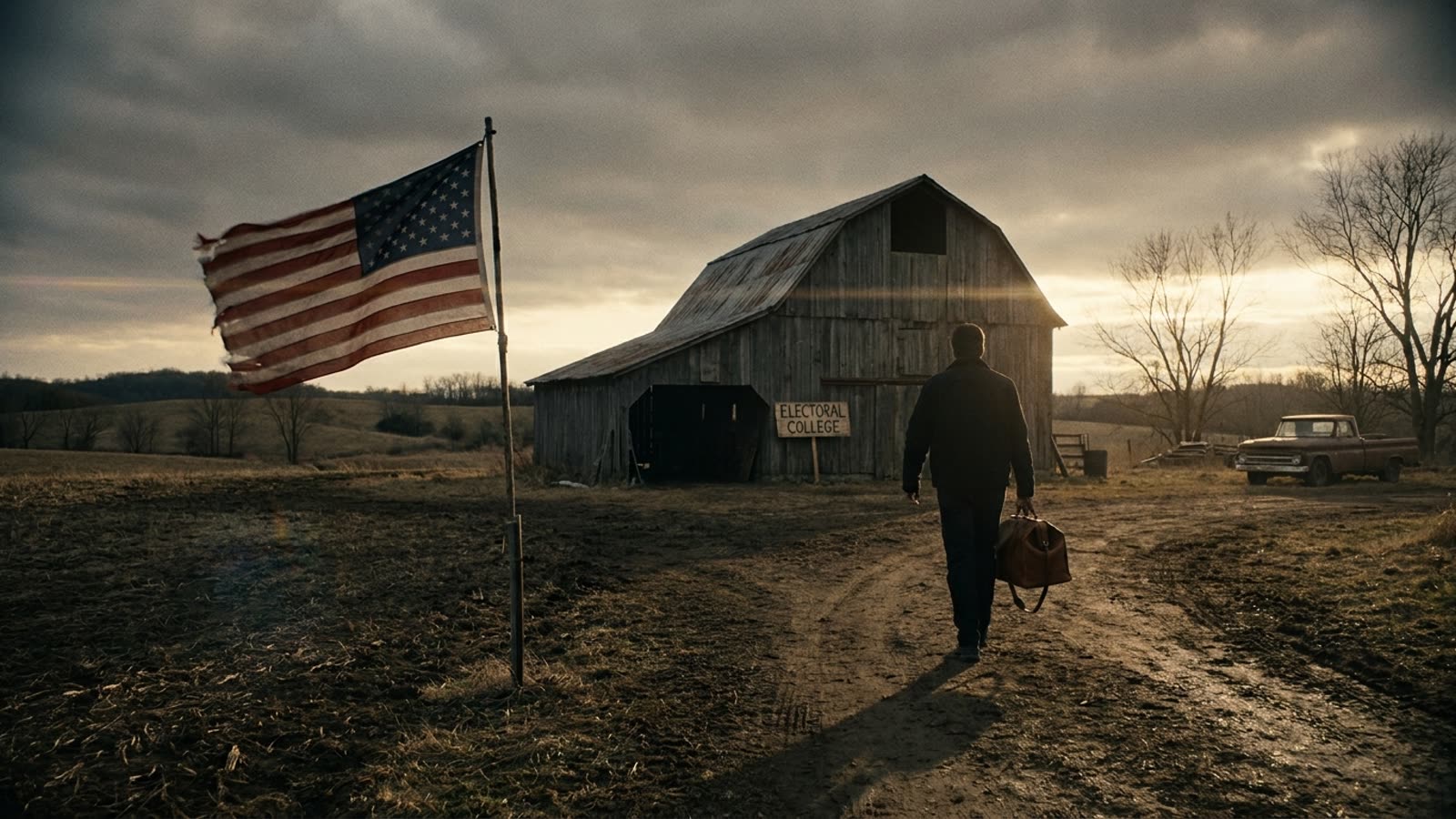
The Electoral College is neither a place nor an institution with a campus or a faculty. It is a process, one that convenes briefly in fifty state capitals and the District of Columbia in December following a presidential election, then dissolves. The 538 electors who compose it meet in their respective states, never as a single body. Most Americans could not name a single elector, yet these individuals technically hold the constitutional power to choose the president.
The mathematics of misrepresentation
The allocation of electors — each state receives a number equal to its congressional delegation — creates systematic distortions that shape every presidential campaign. Wyoming, with fewer than 600,000 residents, receives three electoral votes, meaning roughly one elector per 190,000 people. California, with nearly 40 million residents, receives 54 electoral votes, or roughly one elector per 720,000 people. A Wyoming voter's influence on the electoral outcome is therefore nearly four times greater than a Californian's.
This arithmetic is not an accident or an oversight. The constitutional convention of 1787 produced the Electoral College as a compromise between delegates who wanted Congress to choose the president and those who favored direct popular election. The result satisfied neither camp entirely but allowed the convention to proceed. The three-fifths compromise, which counted enslaved people as partial persons for apportionment purposes, further shaped the original calculus, giving Southern states additional electoral weight without extending the franchise.
The winner-take-all amplifier
The Constitution does not mandate winner-take-all allocation of electoral votes, yet 48 states employ this method. Maine and Nebraska allocate some electors by congressional district. This near-universal winner-take-all approach transforms the Electoral College from a weighted voting system into something more volatile: a mechanism that can convert narrow popular margins into landslide electoral victories, or award the presidency to the candidate who received fewer total votes.
The latter outcome has occurred five times in American history, twice in recent memory. The possibility structures everything about modern campaigning. Candidates concentrate resources in a handful of competitive states while ignoring the vast majority of the electorate. Voters in safe states become spectators to their own presidential elections.
Faithless electors and constitutional silence
The Constitution says nothing about how electors should vote, only that they shall vote. This silence has produced the phenomenon of faithless electors — those who vote contrary to their pledge. In 2016, seven electors cast ballots for candidates other than those they were pledged to support, the largest defection since 1872. The Supreme Court ruled in 2020 that states may enforce elector pledges, but enforcement mechanisms vary widely and the underlying constitutional ambiguity persists.
The Twelfth Amendment, ratified in 1804 after the chaotic election of 1800 produced a tie between running mates, requires separate ballots for president and vice president. But it preserved the contingency procedure: if no candidate achieves an electoral majority, the House of Representatives chooses the president, with each state delegation casting a single vote. This provision has been invoked twice, in 1801 and 1825. In a closely divided House, it could produce a president chosen by representatives of states containing a minority of the national population.
Our take
The Electoral College endures not because Americans approve of it — polling consistently shows majority support for direct popular election — but because amending the Constitution requires supermajorities that the current system's beneficiaries will never provide. Understanding its mechanics is therefore not an academic exercise but a practical necessity. The institution shapes which voters matter, which states matter, and which arguments candidates bother to make. It is, in effect, the operating system of American presidential politics, running silently beneath the surface of every campaign while determining outcomes that often surprise those who mistake the popular vote for the actual contest.