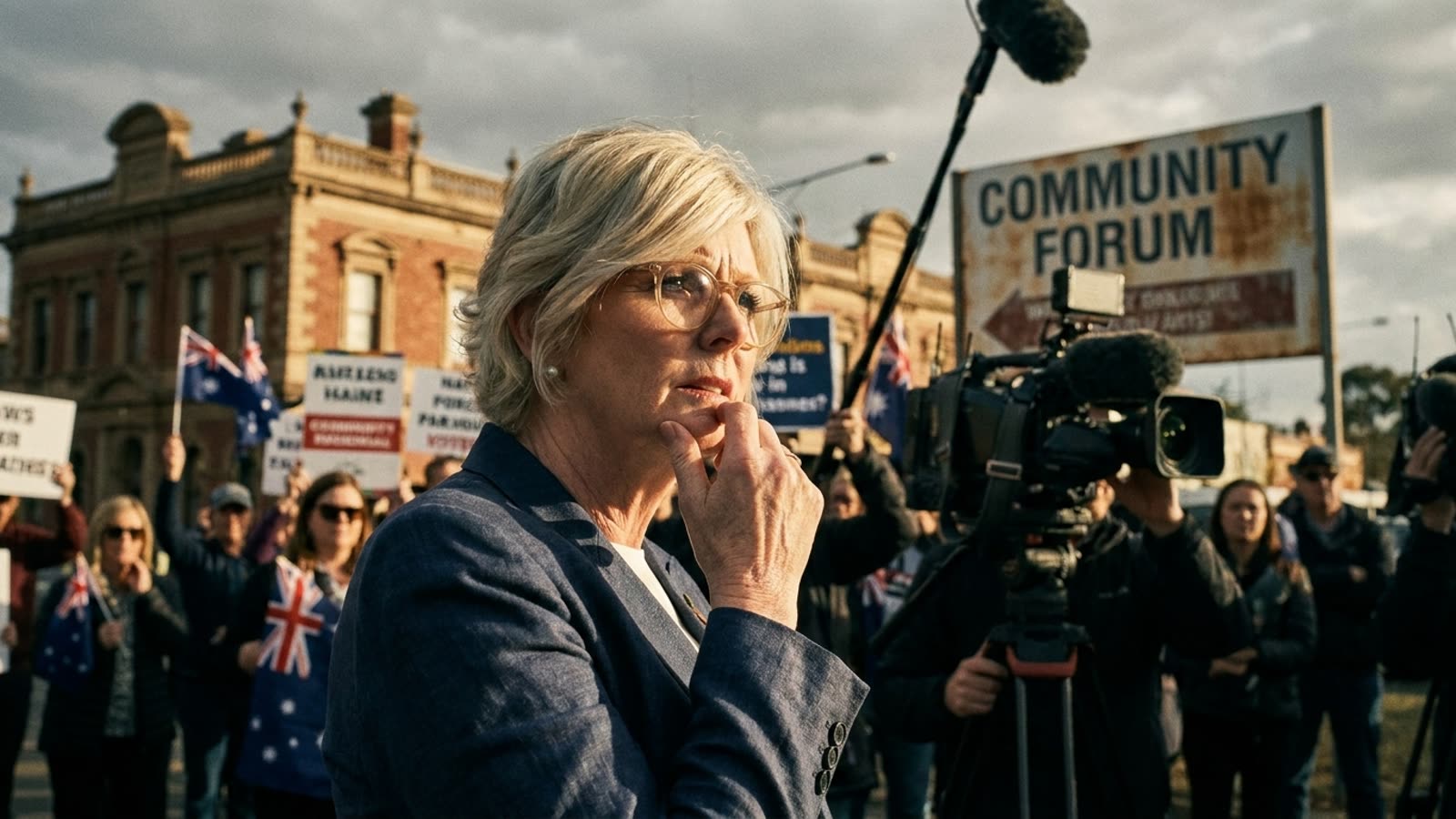
Helen Haines, the independent federal MP for Indi, remains in critical but stable condition after what Australian Prime Minister Anthony Albanese described as an attack that "wasn't an accident." A joint counter-terrorism taskforce is investigating, and the suspect faces charges carrying up to ten years' imprisonment—language that typically accompanies terrorism-related offenses under Australian law. The incident, which occurred as Haines left her electorate office in rural Victoria, has sent shockwaves through a political culture that prides itself on civility even amid fierce partisan combat.
Haines is no backbencher. She won Indi in 2019 as an independent, defeating the Nationals in a seat they had held for nearly a century, and retained it comfortably in 2022 and 2025. Her platform—climate action, healthcare access, integrity in government—made her a thorn in the side of both major parties but also a model of the crossbench MP who wins on substance rather than spectacle. That she was allegedly targeted in her own electorate, in broad daylight, suggests either a profoundly unhinged individual or a calculated attempt to intimidate elected representatives who operate outside the traditional power structures.
The terrorism question
The involvement of the Australian Federal Police's counter-terrorism unit is telling. Australian law defines a terrorist act as one intended to coerce or influence a government by intimidation, or to intimidate the public. If prosecutors believe the attack on Haines meets that threshold, it would mark the first time an assault on a sitting federal MP has been treated as terrorism. The last comparable incident was the 2016 stabbing of British MP Jo Cox, which prosecutors in the UK explicitly framed as an act of terrorism motivated by far-right ideology. Haines's politics—pro-climate, pro-integrity commission, skeptical of fossil fuel subsidies—have made her a target of online vitriol from the same corners of the internet that celebrate January 6 and call for the hanging of public health officials.
Australia has spent the past decade tightening its counter-terrorism laws, mostly in response to Islamist extremism and, more recently, far-right plots. Applying those laws to an attack on a parliamentarian would be a watershed. It would also be uncomfortable: acknowledging that domestic political violence is terrorism forces a reckoning with the fact that the threat is not confined to foreign ideologies but is growing inside the tent.
The independent problem
Haines is part of a cohort of independents—mostly women, mostly from formerly safe conservative seats—who have redrawn Australia's electoral map. The so-called "teal independents" and their rural counterparts have broken the major parties' stranglehold on the House of Representatives, forcing minority government and elevating issues like climate and corruption that the major parties spent years trying to bury. This has made them extraordinarily popular with voters and extraordinarily hated by the party machines they displaced. Online abuse of these MPs is routine and often gendered; Haines herself has spoken publicly about the threats she receives.
If the attack on Haines is confirmed as politically motivated, it will raise urgent questions about security for independents, who lack the protection details afforded to ministers and party leaders. It will also test whether Australia's political class can resist the temptation to use the incident as a cudgel: the right will blame inflammatory rhetoric from climate activists, the left will blame Murdoch media and shock jocks, and everyone will issue statements about civility while doing nothing to address the structural forces—algorithmic rage, economic anxiety, collapsing trust in institutions—that are turning disagreement into violence.
Our take
Haines's alleged attacker will face justice, and the counter-terrorism investigation will either produce charges or quietly fade. But the deeper problem won't be solved by one prosecution. Australia has spent years watching political violence escalate in the United States and Europe and telling itself it couldn't happen here. That complacency is now untenable. If an MP can be attacked in her own electorate, in a country with strict gun laws and relatively low violent crime, then the social contract that allows democracy to function—the agreement that we settle our differences at the ballot box, not with fists or worse—is fraying. Canberra can either take that seriously or wait for the next incident. The choice is binary, and the clock is running.