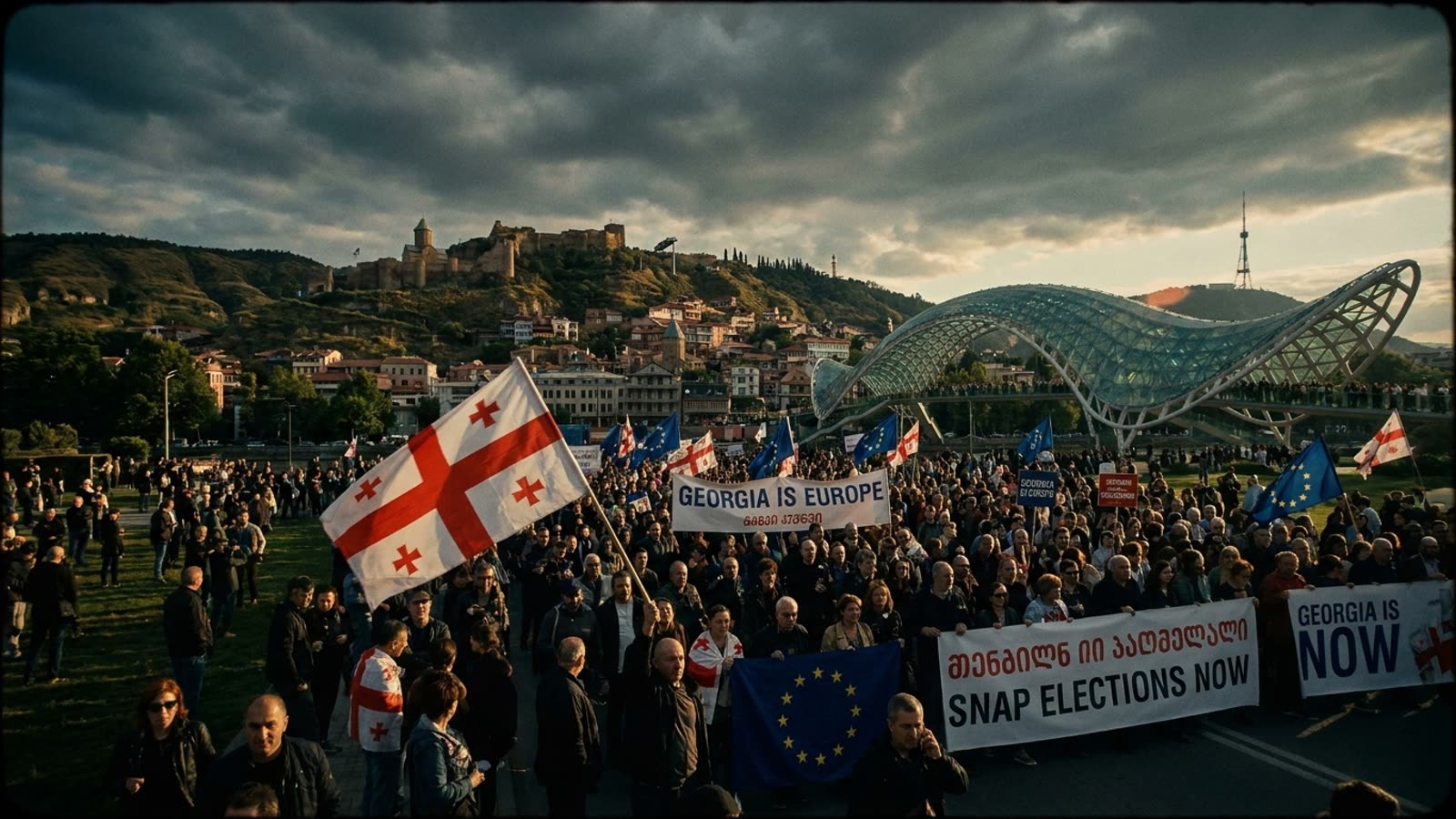
The streets of Tbilisi have become a laboratory for a question that haunts democratic movements everywhere: can sustained civil disobedience actually dislodge an entrenched government, or does it merely exhaust itself against institutional inertia?
Georgia's student-led protests, now stretching into their fourth week, represent the most serious challenge to the ruling Georgian Dream party since its founding. What began as scattered university demonstrations has metastasized into daily marches drawing tens of thousands, with protesters demanding snap parliamentary elections and the release of detained opposition figures. The movement's staying power has surprised even its organizers.
The generational fracture
The demographics tell a pointed story. Georgia's protest movement skews remarkably young—university students and recent graduates who came of age watching their European aspirations recede. Georgian Dream's decision last year to indefinitely pause EU accession talks, citing "external pressure," crystallized a generational betrayal for young Georgians who had organized their futures around eventual membership.
The ruling party's response has followed a familiar authoritarian playbook: selective arrests, media restrictions, and accusations of foreign interference. Yet the protests have maintained discipline, avoiding the provocations that might justify a heavier crackdown. Organizers have studied the failures of Belarus's 2020 movement and appear determined not to repeat them.
Brussels watches, hesitates
The European Union finds itself in its characteristic posture of concerned paralysis. Officials have issued statements expressing "deep concern" about democratic backsliding, but the bloc's leverage has diminished considerably since it effectively froze Georgia's candidacy. The protests have exposed an awkward truth: the EU's neighborhood policy works best when accession remains a credible carrot, and Georgian Dream called that bluff.
Meanwhile, Moscow watches with undisguised satisfaction. A destabilized Georgia serves Russian interests regardless of outcome—either the protests fail and Georgian Dream consolidates power with an increasingly authoritarian tilt, or they succeed and produce months of political uncertainty in a strategically vital corridor.
The stamina question
Protest movements face an asymmetric challenge: governments need only wait, while demonstrators must sustain intensity indefinitely. Georgian Dream appears to be betting on summer heat, exam schedules, and economic pressure to thin the crowds. The students are betting that their numbers and discipline can outlast the government's patience.
Neither side has shown willingness to negotiate seriously. The ruling party has offered vague promises of "dialogue" while refusing to discuss early elections. Protest leaders have rejected anything short of a concrete electoral timeline. This maximalism from both camps suggests the standoff will resolve through exhaustion rather than compromise.
Our take
Georgia's protests deserve more attention than they're receiving. This is not merely another post-Soviet color revolution attempt—it's a stress test for whether democratic movements can succeed in an era when authoritarian governments have learned to absorb and outlast them. The students occupying Rustaveli Avenue are asking whether Europe's democratic promises mean anything when tested. So far, the answer from Brussels has been an embarrassed silence.