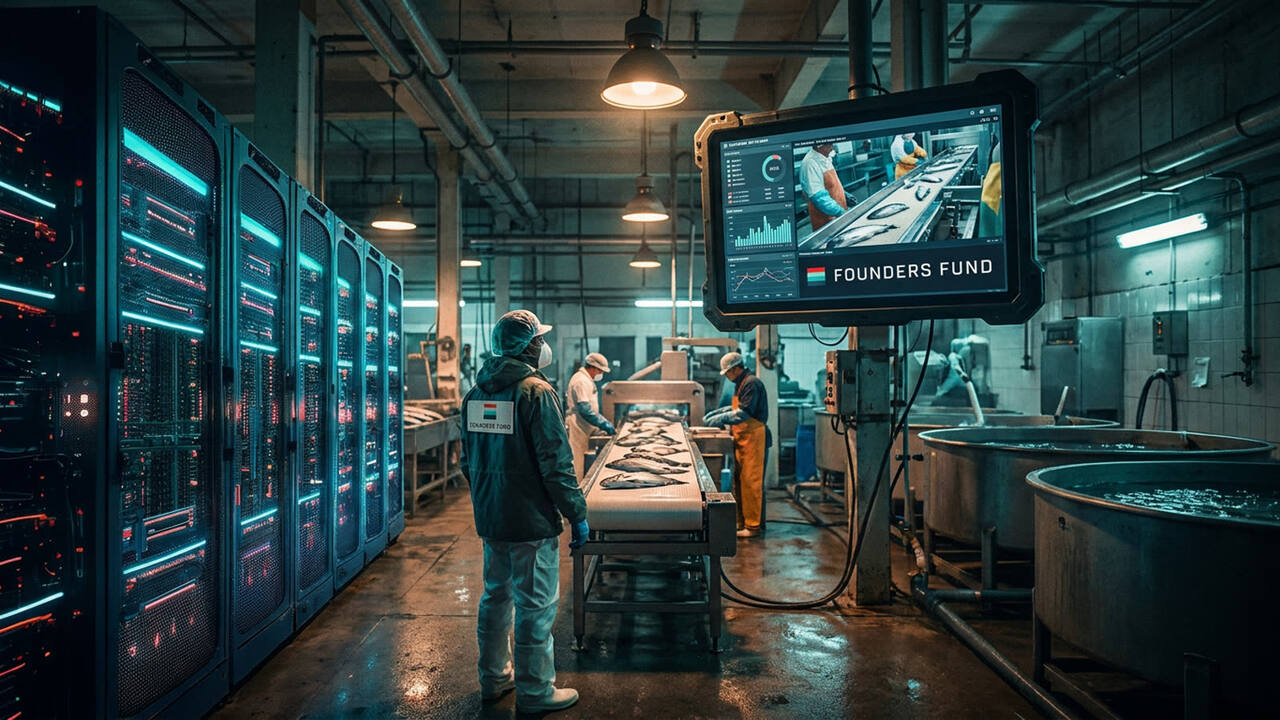
The venture capital firm that helped build Facebook, Palantir, and SpaceX has found its next frontier: making sure fish die with dignity. Founders Fund has led a funding round for a startup developing computer-vision systems that monitor fish stress levels during harvest, ensuring they are killed quickly and humanely. The investment sounds like a punchline, but it is actually a revealing signal about where AI money is flowing in 2026.
The thesis is straightforward, if unexpected. Aquaculture is a $300 billion global industry growing faster than any other food sector. Fish welfare regulations are tightening across the European Union and increasingly in Asia. And the dirty secret of fish farming is that nobody really knows how their fish die—whether they suffocate slowly in air, are crushed in nets, or are dispatched cleanly. Computer vision can watch what humans cannot, at scale, around the clock, in conditions that would make a human inspector quit by lunchtime.
The boring AI revolution
This is what the AI boom actually looks like in its mature phase. Not chatbots writing poetry, but cameras in fish processing plants running inference on whether a salmon is exhibiting stress behaviors before it meets its end. The technology is not glamorous. The margins are not software margins. But the moat is real: once a fish farm integrates welfare-monitoring AI into its operations, switching costs are substantial, and the data flywheel begins spinning.
Founders Fund has historically avoided the crowded generative-AI space, preferring to back companies building AI for physical-world applications—robotics, defense, biotech. The fish welfare bet fits this pattern. The firm appears to be wagering that the most defensible AI businesses will be those that embed themselves into regulated, fragmented industries where compliance is mandatory and human oversight is impractical.
Why welfare, why now
The timing is not accidental. The European Union's revised aquaculture welfare directive, expected to take effect in 2027, will require documented evidence of humane slaughter practices. Major retailers including Tesco and Carrefour have announced they will only source from certified-humane suppliers by 2028. The startup Founders Fund is backing—reportedly called AquaSense, though the firm has not confirmed the name—is positioning itself as the compliance infrastructure layer for an industry facing a regulatory cliff.
There is also a consumer dimension. Younger buyers increasingly demand transparency about how their food is produced, and fish has lagged behind poultry and beef in welfare certification. A computer-vision system that can generate auditable, timestamped records of humane treatment is not just a regulatory checkbox—it is a marketing asset.
Our take
The investment is easy to mock, but it represents something important about where AI creates durable value. The winners of the next decade will not be the companies building foundation models—those are already consolidating into a handful of giants. The winners will be the companies that figure out how to apply AI to messy, regulated, physical industries where the incumbents are too slow to adapt. Fish welfare is a strange place to plant a flag, but Founders Fund has made a career of strange places that turn out to be prescient. If you want to understand AI in 2026, stop watching the chatbot wars and start watching the fish.