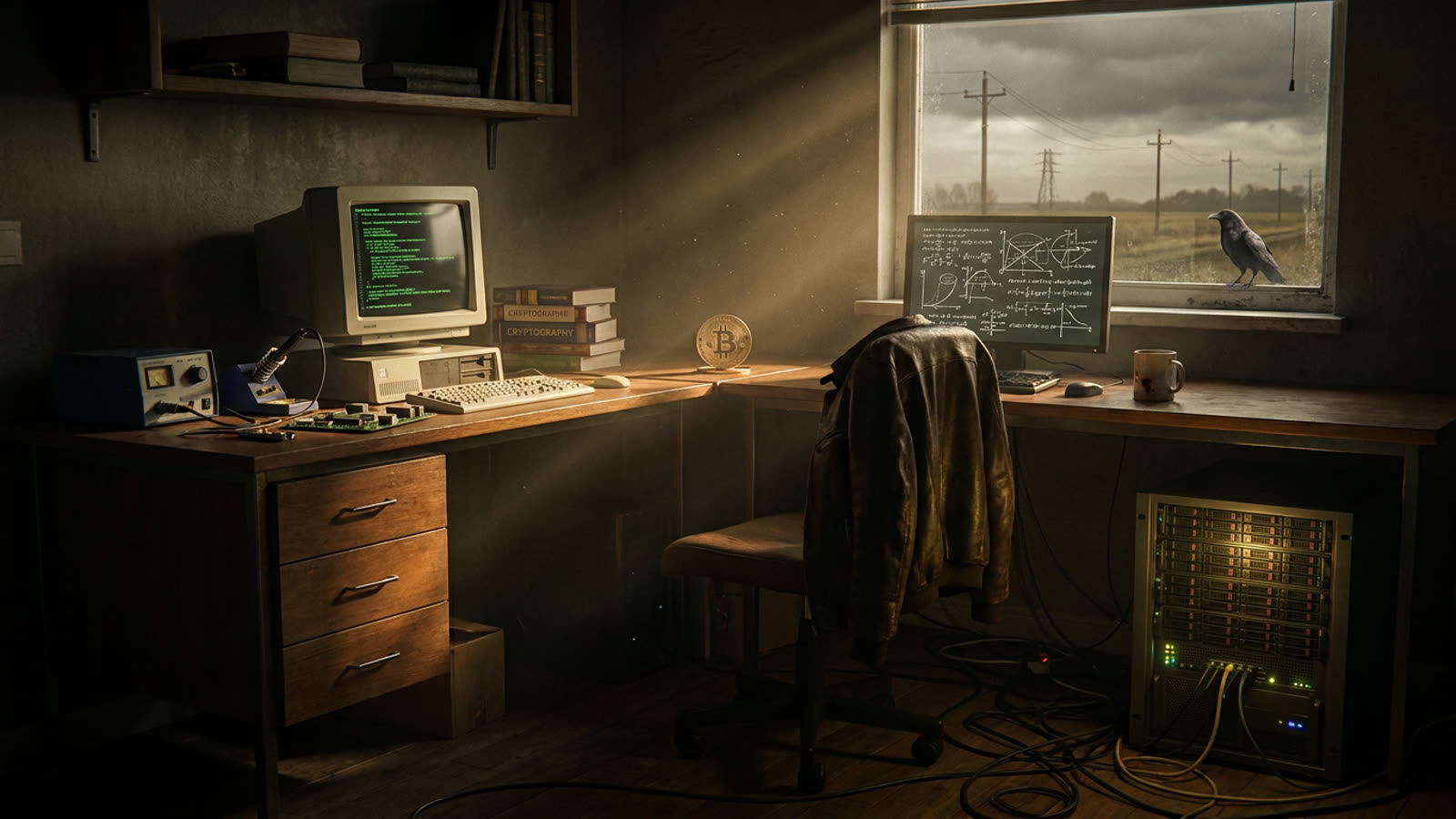
For seventeen years, the identity of Bitcoin's creator has been the digital age's greatest unsolved mystery. On April 22, 2026, a new documentary called Finding Satoshi offered its answer — and it's one that makes the mystery feel more human, not less.
Directed by Tucker Tooley and Matthew Miele, and anchored by a four-year investigation led by author William D. Cohan and private investigator Tyler Maroney, the film reaches a conclusion that surprises precisely because it is so plausible: Satoshi Nakamoto was never a single person. It was a shared pseudonym for two deceased cryptographers — Hal Finney and Len Sassaman.
Two Ghosts Behind a Revolution
Finney, a legendary computer scientist who worked on PGP encryption and was the first person to ever receive a Bitcoin transaction, died in 2014 from ALS. Sassaman, a fellow cypherpunk and privacy researcher who also worked on PGP, took his own life in 2011 — the same year Satoshi went permanently silent.
The theory isn't new. What Finding Satoshi adds is depth, evidence, and raw human testimony.
The film's most striking moment may be an interview with Fran Finney, Hal's widow, who concedes on camera that her husband "probably played a role" in Bitcoin's creation. Sassaman's widow, Meredith L. Patterson, also appears. Their willingness to engage with the question — even partially — is unprecedented.
"I think that was very, very powerful," Cohan told Decrypt.
How the Investigation Worked
Cohan and Maroney approached the mystery like a criminal case. They enlisted Kathleen Puckett, a former FBI agent who helped catch the Unabomber, to profile the psychological motivations behind Bitcoin's white paper. Her read: whoever wrote it didn't care about money.
That profile aligns uneasily with Bitcoin's 1.1 million unmoved coins — a fortune worth tens of billions of dollars that Satoshi has never touched. "If you had a $100 billion fortune, you're not just going to sit there and live a life of frugality," Cohan said, explaining why living candidates like Adam Back, Nick Szabo, and Wei Dai were ultimately ruled out.
The investigators worked with Alyssa Blackburn, a data scientist who cross-referenced each suspect's online activity timeline against Satoshi's. The match pointed to Finney and Sassaman.
The division of labor theory the film proposes is elegant: Finney wrote the code, while Sassaman wrote the words — including the nine-page white paper that launched a financial revolution. A potential discrepancy (Satoshi emailed a developer while Finney was running a race in Santa Barbara) actually supports the split-role theory rather than undermining it.
Why the Answer Matters Now
The documentary arrives at a peculiar cultural moment. Earlier this year, the New York Times published its own Satoshi investigation, pointing to Adam Back — who promptly denied it. Finding Satoshi directly addresses and then dismisses Back's candidacy, positioning the Finney-Sassaman thesis as more rigorous.
The film also features Michael Saylor, Bill Gates, Phil Zimmermann (creator of PGP), and a 90-minute interview with Sam Bankman-Fried conducted in 2021 — before his arrest — that didn't make the final cut.
What the documentary doesn't resolve is why. Why remain anonymous? Why never spend the coins? The film's most provocative suggestion is also its most poignant: these were men who cared deeply about what Bitcoin meant — privacy, financial sovereignty, freedom from centralized control — and not at all about what it was worth.
Both Finney and Sassaman died before Bitcoin became what it is today. They never saw the ETFs, the institutional adoption, the $100,000 price. If the Finding Satoshi thesis is correct, Bitcoin's creator didn't just remain anonymous by choice — he did so because the work was the point.
Our take
The mystery of Satoshi Nakamoto has attracted grifters, court claims, and headline-seekers for years. Finding Satoshi is something different: a methodical, four-year investigation that arrives at a conclusion that is both unprovable and deeply compelling. The fact that both candidates are dead means no one will step forward to confirm or deny it — which is, in its own way, the most Satoshi ending possible. Whether or not Finney and Sassaman built Bitcoin, the documentary makes one thing clear: whoever did, built something that outlasted them. That's the whole point.