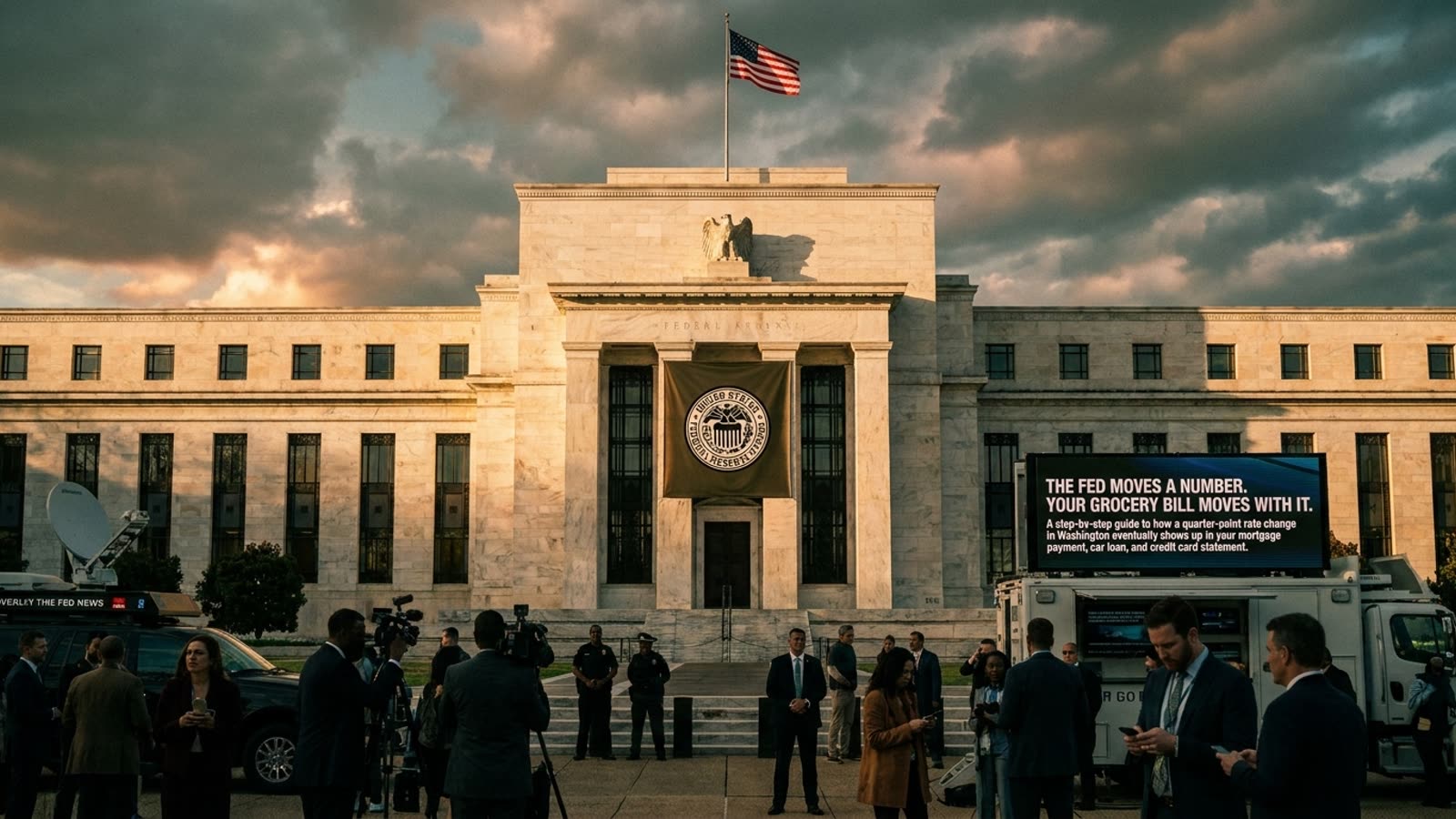
When the Federal Reserve adjusts its benchmark interest rate, the announcement rarely makes the evening news lead. A quarter-point here, a half-point there—the increments sound almost trivial, the language deliberately soporific. Yet that single number, set by a committee in a marble building in Washington, quietly rearranges the finances of every household in America within months. Understanding the transmission mechanism is not merely academic; it is the difference between financial planning and financial guessing.
The journey from Fed policy to your kitchen table is shorter than most people assume, and more consequential than almost anyone realizes.
The overnight rate and the daisy chain
The Federal Reserve does not directly set the interest rate on your mortgage or your credit card. What it controls is the federal funds rate—the interest banks charge each other for overnight loans. This rate matters because it establishes the floor for virtually all other borrowing costs in the economy. When the Fed raises this rate, banks must pay more to access short-term capital, and they pass that cost downstream with remarkable efficiency.
Within days of a Fed move, the prime rate—the benchmark most banks use for consumer lending—adjusts in lockstep. Credit cards, home equity lines of credit, and many adjustable-rate loans are explicitly pegged to prime, meaning your minimum payment can rise before you have even processed the news. Fixed-rate products like traditional mortgages take longer to respond, but they respond nonetheless, as lenders reprice new loans to reflect their own increased cost of funds.
Where the household feels it first
The most immediate impact lands on revolving debt. The average American household carrying credit card balances will see their interest charges climb within one or two billing cycles of a rate hike. For a family with a modest balance, a full percentage point increase might add only a few dollars per month. For households carrying larger balances, the math becomes punishing quickly.
Adjustable-rate mortgages and HELOCs follow close behind. These products typically reset annually or even monthly, meaning homeowners can watch their housing costs rise without any change in the underlying property value. The fixed-rate mortgage holder is insulated from immediate pain, but anyone shopping for a new home or looking to refinance discovers that the same house now costs substantially more to finance.
Auto loans, personal loans, and student debt with variable rates complete the picture. The cumulative effect across all these categories can easily absorb hundreds of dollars per month from a household budget—money that would otherwise flow to savings, consumption, or debt reduction.
The invisible second-order effects
Beyond direct borrowing costs, rate changes ripple through the economy in subtler ways. Higher rates strengthen the dollar, which can lower import prices but also squeeze export-dependent industries and the workers they employ. Businesses facing higher financing costs may delay expansion, freeze hiring, or raise prices to protect margins. Landlords refinancing properties at higher rates often pass the cost to tenants.
Savers, theoretically, benefit—higher rates should mean better returns on savings accounts and certificates of deposit. In practice, banks are notoriously slow to raise deposit rates while being almost instantaneous in raising lending rates. The asymmetry is a quiet transfer of wealth from borrowers to bank shareholders.
Our take
The Fed's policy apparatus is designed to be boring, and that is probably wise. But the boredom masks a profound intervention in household economics. Every rate decision is a redistribution—from borrowers to savers, from the leveraged to the liquid, from the young (who borrow to build) to the old (who lend from accumulated capital). Understanding this does not make the next rate hike hurt less, but it does clarify who is writing the check and who is cashing it. Financial literacy, in this narrow sense, is simply knowing which side of the trade you are on.