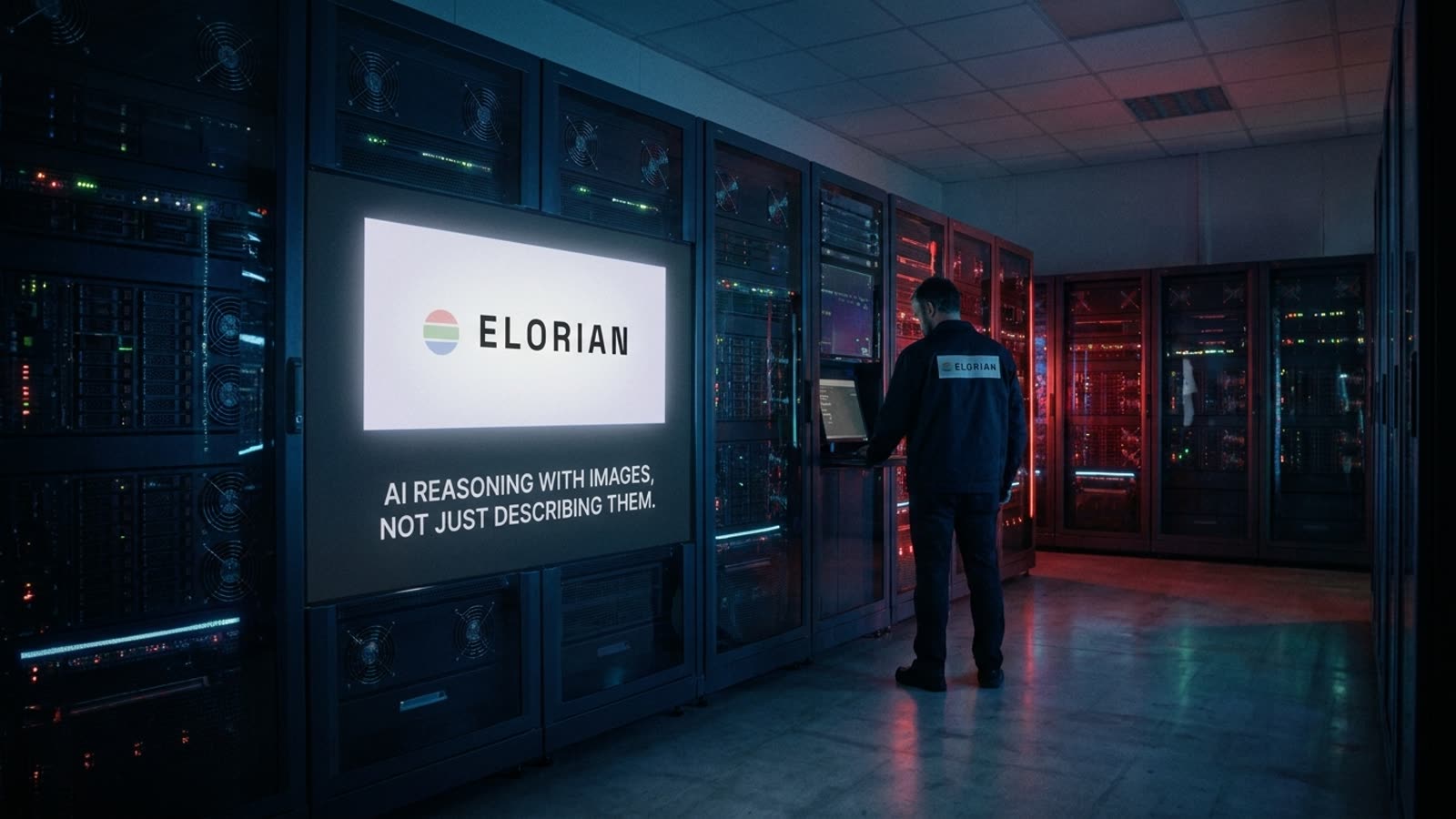
Most AI systems look at images the way a tourist looks at a foreign menu: they can describe what they see, but they don't really understand what it means. Elorian, a startup emerging from stealth this week, argues this limitation isn't a feature gap — it's a fundamental architectural flaw that's been holding back the entire field.
The company's debut model doesn't simply caption images or answer questions about them. Instead, it processes visual information as a primary reasoning substrate, treating pixels with the same logical weight that language models give to words. The difference sounds academic until you consider the applications: a radiologist's AI assistant that doesn't just flag anomalies but explains why a shadow's position relative to bone structure suggests a specific diagnosis, or an engineering tool that can trace causal relationships across schematic diagrams.
The vision-language gap
Current multimodal AI — the kind powering GPT-4V, Gemini, and Claude's vision capabilities — bolts image understanding onto language models like a sidecar. Images get encoded into tokens that the language model can reference, but the reasoning itself happens in linguistic space. Elorian's approach, according to technical documentation released alongside the announcement, maintains separate but interconnected reasoning pathways for visual and textual information, allowing the model to draw inferences that neither modality could support alone.
The implications extend beyond accuracy metrics. When AI systems reason about images rather than with them, they inherit all the biases and limitations of language-first thinking. A chart becomes a description of a chart; a photograph becomes a caption. Elorian's bet is that genuine visual reasoning requires treating images as first-class logical objects.
The competitive landscape shifts
The timing is deliberate. OpenAI, Google, and Anthropic have all released increasingly capable vision models over the past eighteen months, but the architecture remains fundamentally text-centric. Elorian is positioning itself not as a competitor to these giants but as a specialist — the company you call when generic multimodal isn't enough.
Early partnerships reportedly include medical imaging firms and industrial inspection companies, sectors where the difference between "describing what's in an image" and "reasoning about what an image means" translates directly to liability and lives. The startup has been notably quiet about funding, though the technical talent involved — several researchers previously at DeepMind and Meta's FAIR lab — suggests serious backing.
Our take
The AI industry has spent two years treating vision as a checkbox feature: can your model see? Yes or no. Elorian's argument — that how a model sees matters as much as whether it sees — is the kind of foundational critique that either fizzles into academic obscurity or reshapes an entire product category. The medical and industrial applications alone justify the approach. Whether Elorian can execute before the giants simply absorb the insight into their next architecture remains the only question that matters.