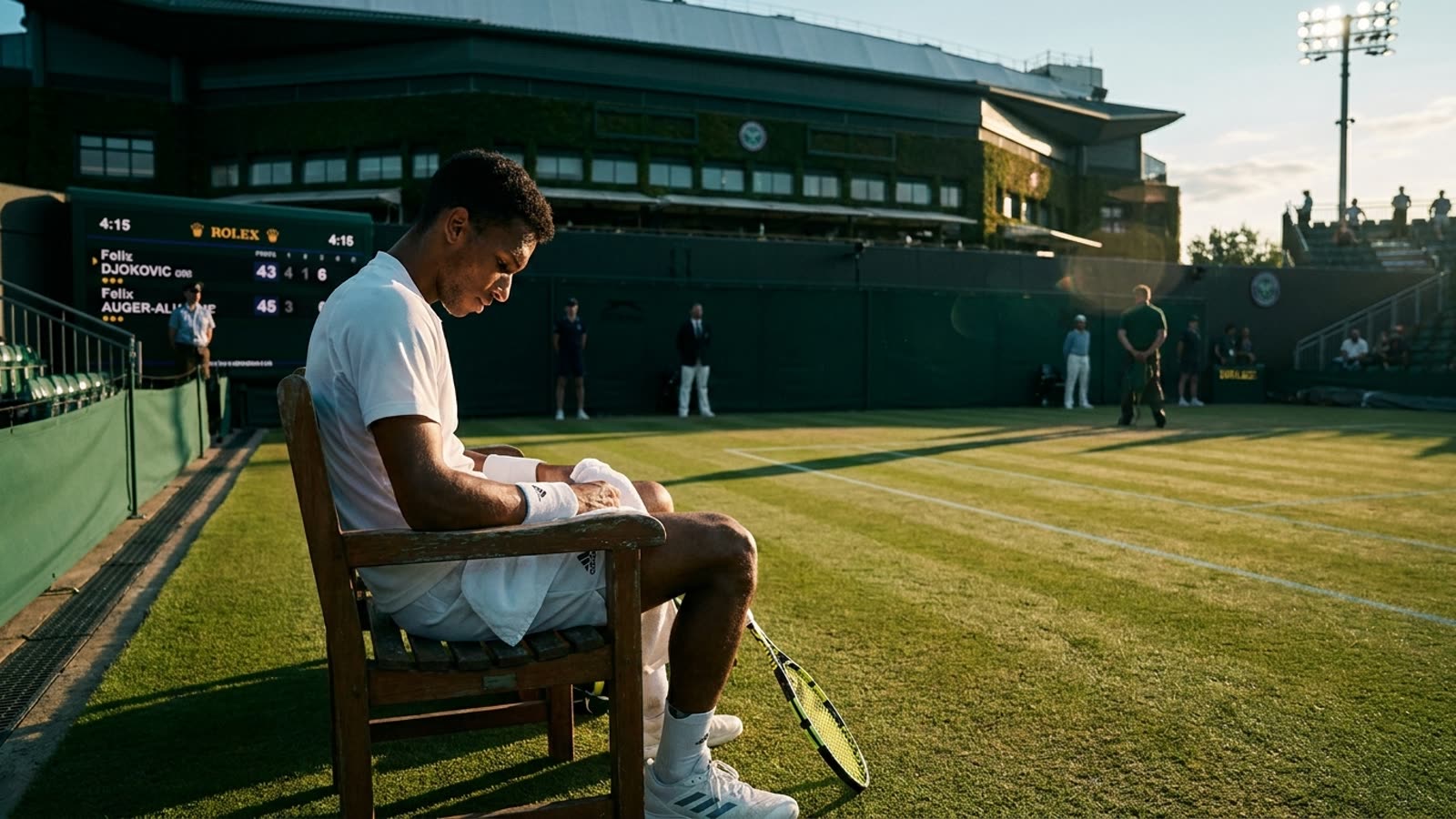
The scoreboard at the All England Club read something like a taunt: five hours and fifteen minutes, five sets, and at the end of it, the 39-year-old walked off Centre Court having outlasted a man twelve years his junior. Novak Djokovic's victory over Felix Auger-Aliassime was not merely a win; it was a referendum on the state of men's tennis and a reminder that the sport's supposed next generation remains stuck in an interminable holding pattern.
Djokovic has now reached another Wimbledon quarterfinal — his 60th Grand Slam quarterfinal appearance, for those keeping count — at an age when most players are teaching at country clubs or commentating from air-conditioned booths. The match featured the full Djokovic repertoire: the elastic defense, the surgical returns, and that peculiar ability to find his best tennis precisely when lesser competitors would crumble.
The youth movement that never arrived
Auger-Aliassime is 25, blessed with a thunderous serve and the kind of athletic profile that scouts dream about. He has been "the future of tennis" for half a decade now. And yet here he was, watching Djokovic dig out of impossible positions, unable to land the knockout blow across more than five hours of opportunities. The Canadian joins a long list of talented younger players — Tsitsipas, Zverev, Medvedev, Sinner, Alcaraz — who have all, at various moments, been anointed as the men who would finally dethrone the Big Three. The coronations keep coming; the actual regime change does not.
What makes Djokovic's longevity so confounding is that it defies every reasonable expectation about athletic decline. At 39, reaction times slow, recovery takes longer, and the accumulated mileage of two decades on tour should exact its toll. Instead, Djokovic appears to have reverse-engineered aging itself, his game growing more efficient even as his body theoretically deteriorates.
The mental fortress
The five-hour-fifteen-minute duration tells only part of the story. Within that marathon were dozens of micro-moments where matches are typically decided — break points, tiebreaks, momentum swings after bathroom breaks. Djokovic won enough of these to matter. His younger opponent, despite superior footspeed and a bigger serve, could not match the Serbian's composure when points became expensive.
This is the gap that talent alone cannot bridge. Auger-Aliassime has the strokes; what he lacks is whatever psychological firmware allows Djokovic to treat a fifth-set tiebreak at Wimbledon like a Tuesday practice session. It is not coachable in any conventional sense, and it is why the generational transfer of power in men's tennis keeps getting delayed.
Our take
Djokovic's continued excellence is both thrilling and slightly depressing. Thrilling because witnessing athletic greatness at 39 is genuinely rare; depressing because it suggests the sport's younger talents are missing something fundamental. At some point, Father Time will collect his due. But after five hours and fifteen minutes on grass, that day looks no closer than it did a decade ago. The next generation should stop waiting for Djokovic to decline and start figuring out how to beat him while he is still, improbably, at his best.