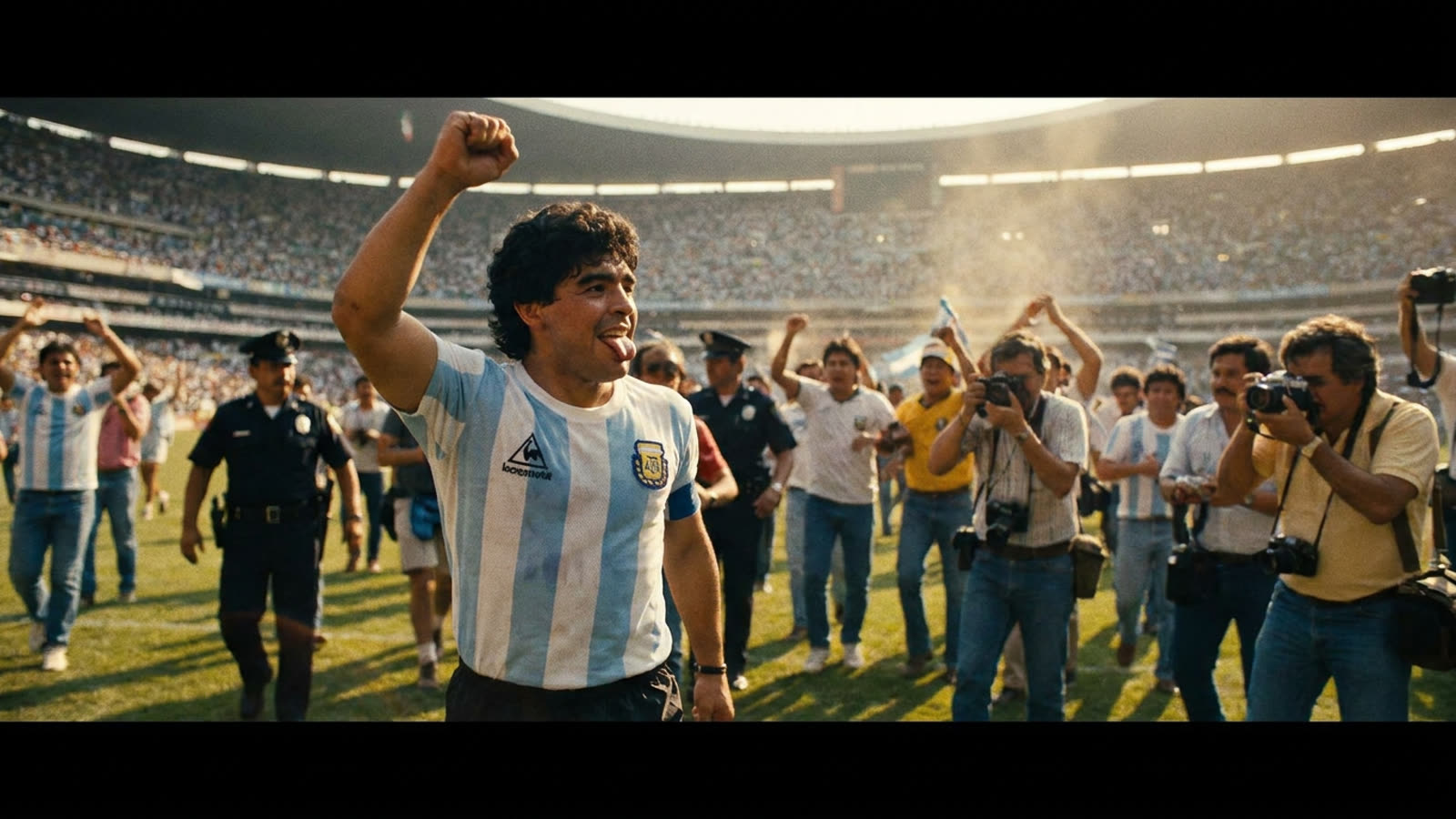
In the space of four minutes on a June afternoon in Mexico City, Diego Armando Maradona committed what may be football's most brazen act of gamesmanship and then, almost immediately, its most sublime act of individual brilliance. The sequence remains singular in sport: a crime followed by a miracle, both authored by the same man, both decisive, both somehow inseparable from his legend. No athlete has ever so nakedly embodied the tension between transgression and transcendence.
The 1986 World Cup quarter-final against England was never just a football match. It arrived four years after the Falklands War, and while FIFA insisted sport and politics remain separate, nobody on the pitch or in the stands believed it. Argentina's players spoke openly about avenging a military humiliation. England's squad understood they were proxies for something larger. Into this cauldron walked a stocky, 25-year-old playmaker from the slums of Buenos Aires who had already been kicked out of one World Cup in disgrace and was determined to win this one by any means available.
The punch heard round the world
The first goal was a lie. Maradona rose with England goalkeeper Peter Shilton, and his left fist, not his head, redirected the ball into the net. The Tunisian referee saw nothing. Maradona knew exactly what he had done and chose to celebrate anyway, sprinting toward the corner flag with an expression of theatrical innocence that has become iconic in its audacity. When pressed afterward, he offered the phrase that would follow him forever: the Hand of God. It was blasphemy dressed as humility, and it worked.
What makes the moment endure is not the cheating itself—football has seen worse—but Maradona's refusal to apologize, then or ever. He understood something essential about sporting mythology: the public does not demand saints, only characters. The handball became part of his persona, evidence of his willingness to do whatever winning required. In Argentina, it was celebrated as cunning against the English establishment. In England, it remains an open wound. Both reactions suited Maradona perfectly.
Sixty yards of absolution
Four minutes later, he offered something that required no interpretation. Receiving the ball in his own half, Maradona embarked on a run that would be replayed more than any other in football history. He beat five English players—some of them twice—before rounding Shilton and scoring into an empty net. The goal was so preposterously beautiful that it retroactively complicated the moral calculus of the match. How could you condemn a man capable of this?
The Goal of the Century, as it was later named, was not merely athletic. It was aesthetic, a piece of improvised art that seemed to bend physics and time. Maradona's low center of gravity, his preternatural balance, his ability to change direction without losing speed—all of it was on display in a sequence that lasted roughly ten seconds but contained a career's worth of evidence for his genius. England's defenders were not incompetent; they were simply playing a different sport than the man with the ball.
Our take
Maradona died in late 2020, and the tributes that followed were notably unburdened by the usual qualifications. The drug addiction, the tax evasion, the erratic behavior—all of it was acknowledged and then set aside, because what remained was those four minutes in Mexico City. Sport rarely offers such clean parables, and this one endures because it captures something true about how we consume athletic greatness. We want our heroes flawed, because perfection is boring and because flaws make the brilliance feel more human. Maradona gave us both in the same afternoon, and we have been arguing about the proportions ever since. That argument is the legacy.