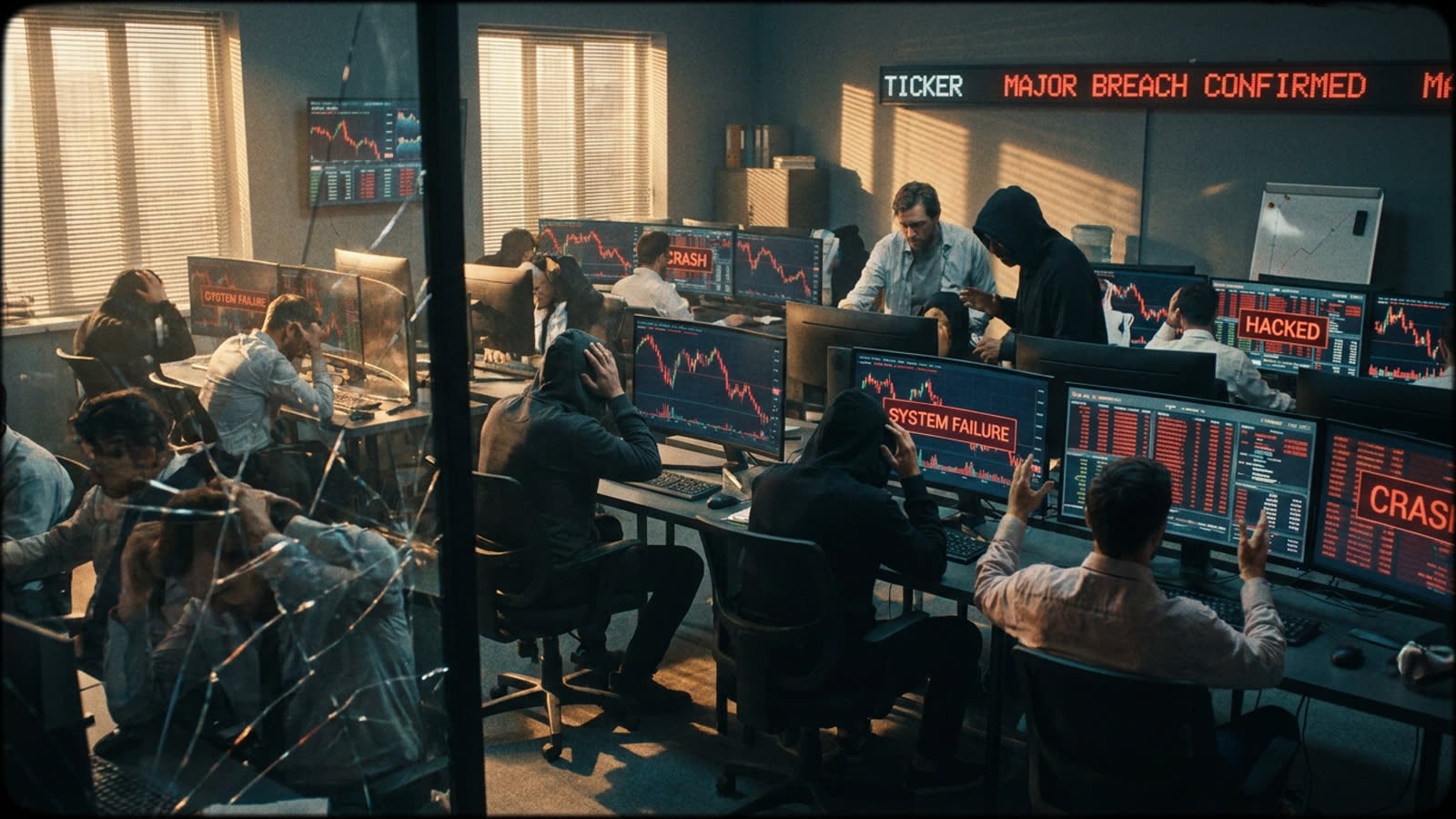
The cryptocurrency industry has a peculiar relationship with catastrophe. Unlike traditional finance, where a major security breach typically ends in regulatory intervention, criminal prosecution, and institutional death, crypto exchanges have repeatedly demonstrated that surviving a hack is less about preventing it than about what you do in the seventy-two hours after.
This distinction matters because it reveals something fundamental about how trust actually works in decentralized finance — and why some platforms emerged stronger from their worst moments while others vanished entirely.
The anatomy of survival
Consider the contrast between Mt. Gox and Bitfinex. Mt. Gox, once handling the majority of global Bitcoin trading, collapsed in 2014 after losing hundreds of thousands of Bitcoin. The exchange filed for bankruptcy, users waited years for partial recovery through legal proceedings, and the incident became shorthand for crypto's Wild West era.
Bitfinex faced a similarly devastating breach in 2016, losing a substantial portion of customer Bitcoin. The response was radically different: the exchange socialized the losses across all users through a haircut mechanism, issued tokens representing the debt, and over subsequent years repurchased those tokens at face value. Users who held through the crisis were eventually made whole. The exchange continued operating.
The pattern repeats. Binance absorbed a significant hack in 2019 by covering losses entirely through its emergency fund, a reserve specifically created for such scenarios. Users noticed nothing beyond a temporary withdrawal suspension. The incident barely dented the platform's dominance.
Why insurance funds became existential
These cases established an unwritten rule: major exchanges now maintain substantial reserves explicitly earmarked for breach recovery. The logic is coldly commercial. An exchange's primary asset is user trust, measured in deposit volume. A hack that results in user losses destroys that trust permanently. A hack that results in full recovery, paradoxically, can strengthen it — demonstrating both financial depth and institutional commitment.
This explains why exchange security spending has bifurcated. Prevention matters, but the truly existential investment is in the aftermath infrastructure: insurance funds, rapid response teams, and the liquidity to absorb worst-case scenarios without touching user balances.
Smaller exchanges, unable to maintain such reserves, face a structural disadvantage that compounds over time. Users rationally migrate toward platforms that can credibly promise recovery, concentrating volume among fewer, larger players. The security landscape thus drives centralization even within an industry philosophically committed to its opposite.
The uncomfortable math
None of this eliminates the underlying risk. Exchange insurance funds are opaque, their adequacy unaudited by any consistent standard. A sufficiently large breach could exceed any reserve. And the concentration of assets on a handful of platforms creates systemic vulnerabilities that would alarm any traditional financial regulator.
Yet the empirical record suggests something counterintuitive: crypto's security problem may be less severe than its reputation implies, not because breaches are rare, but because the industry has developed informal mechanisms for absorbing them. The question is whether those mechanisms scale — and whether users understand that their safety depends less on cryptographic guarantees than on the balance sheet of a private company.
Our take
The crypto industry accidentally invented a form of deposit insurance, funded by trading fees and administered by the very institutions that created the risk. It is imperfect, unregulated, and entirely voluntary. It also works more often than it should. The lesson is not that exchanges are safe — they manifestly are not — but that survival in crypto has always been less about avoiding disaster than about having the resources to buy your way out of it. Users would be wise to remember that distinction before choosing where to park their assets.