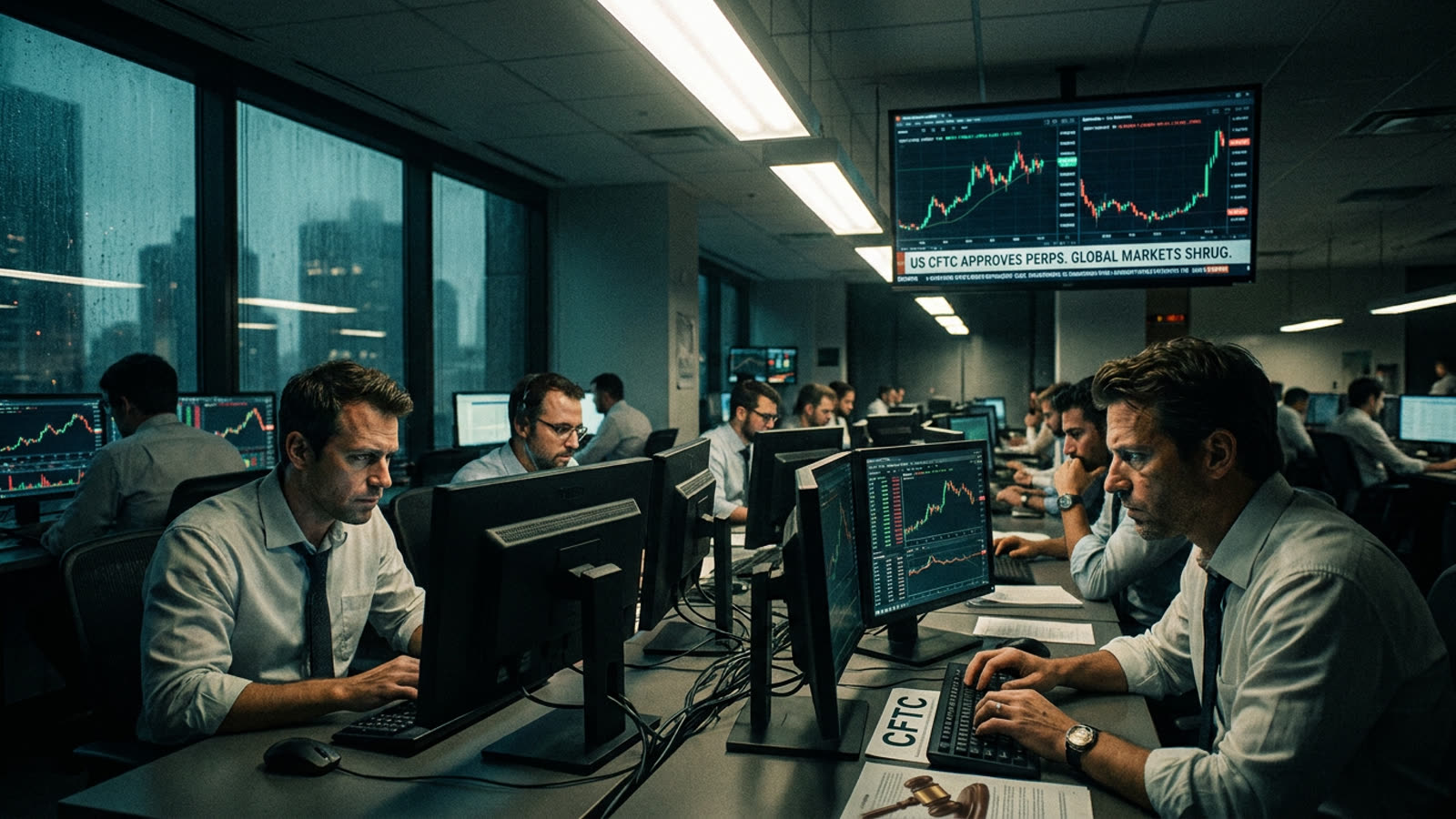
For years, American crypto traders have performed an elaborate dance: VPNs, offshore accounts, and a willful blindness to the terms-of-service violations required to access perpetual futures—the leveraged, no-expiry contracts that dominate global crypto volume. This week, the Commodity Futures Trading Commission ended the charade, granting Kalshi and Coinbase approval to offer crypto perpetuals to US customers. The decision is less a bold leap forward than a belated acknowledgment that prohibition was creating more problems than it solved.
Perpetuals account for roughly 75% of all crypto derivatives volume globally, with offshore venues like Binance, Bybit, and OKX processing hundreds of billions in notional value monthly. American exchanges, confined to quarterly futures and spot markets, have watched this liquidity migrate overseas while collecting a fraction of the fees. The CFTC's move doesn't suddenly make the US the center of crypto derivatives trading—it simply removes one of the more conspicuous competitive disadvantages.
The regulatory mechanics
Kalshi, primarily known as a prediction market, received approval for Bitcoin perpetuals under its existing derivatives exchange license. Coinbase's approval runs through its Bermuda-based international arm, with the CFTC blessing the product for US-eligible customers. Both will operate under position limits and margin requirements that offshore competitors largely ignore, meaning the products will likely attract institutional and retail traders seeking regulatory clarity rather than maximum leverage.
The timing is notable. Acting CFTC Chair Caroline Pham has spent months signaling a more accommodating posture toward crypto derivatives, and the agency's recent statements suggest 24/7 trading—another offshore staple—may be appropriate for digital assets even as it remains impractical for traditional markets. The approvals represent the first concrete deliverables of this philosophical shift.
What changes, what doesn't
For sophisticated traders already accessing offshore perpetuals, the domestic versions offer compliance peace of mind but little else. Leverage will be lower, fees may be higher, and liquidity will take time to build. For the broader market, the approvals matter more as signal than substance: the US regulatory apparatus is finally treating crypto derivatives as a legitimate product category rather than a vector for fraud.
Coinbase shares rose modestly on the news, though the company's derivatives revenue will remain a rounding error against its spot trading and custody businesses for the foreseeable future. Kalshi gains a product that complements its prediction market offerings, potentially creating interesting arbitrage opportunities between event contracts and crypto perpetuals.
Our take
The CFTC's perpetuals approval is the regulatory equivalent of a city finally paving a road that residents have been driving on for years anyway. It's welcome, overdue, and unlikely to dramatically alter trading patterns in the short term. The real question is whether this signals a broader détente between US regulators and the crypto industry, or merely a tactical concession while the SEC continues its enforcement-first approach elsewhere. For now, American traders can access perpetuals without pretending to be in Singapore. That's progress, even if it's the kind that mostly highlights how far behind we'd fallen.