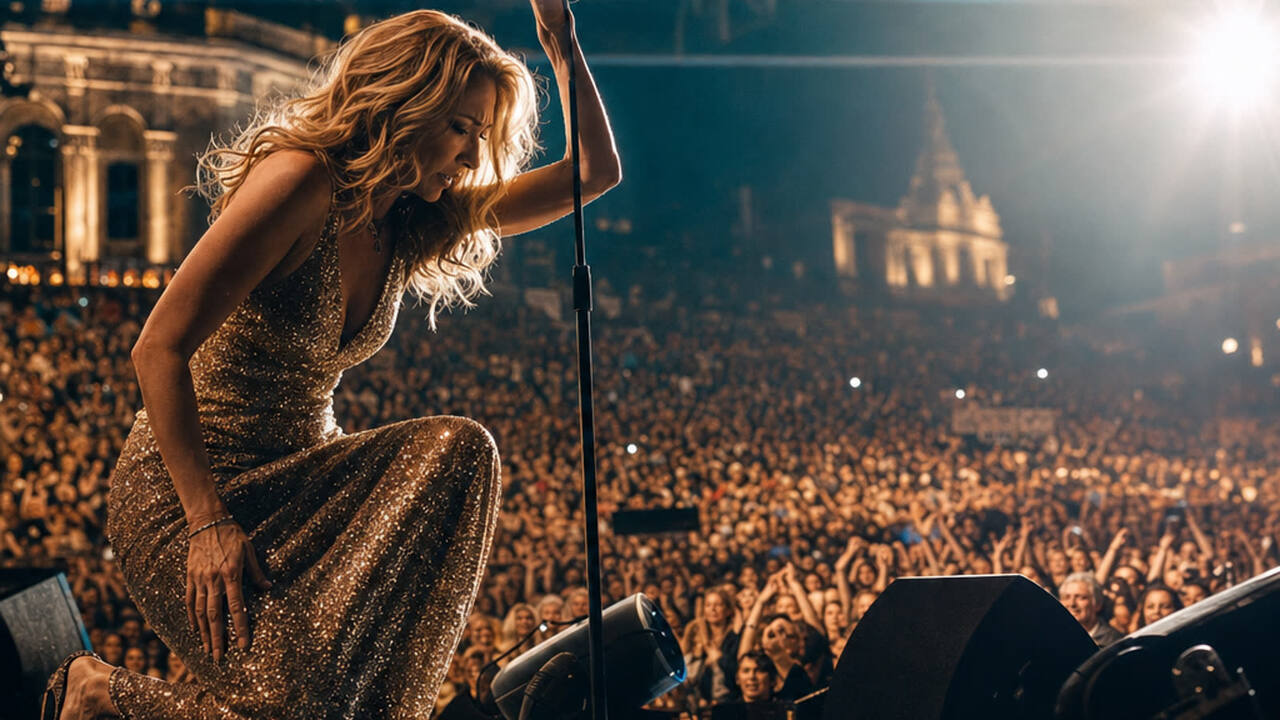
A concert fall is usually tabloid fodder—a GIF, a meme, a moment of celebrity vulnerability packaged for consumption. When Céline Dion stumbled during her performance in France this week, the footage circulated with predictable speed. But context transforms everything: this is a woman who, two years ago, could barely walk unaided due to stiff person syndrome, a rare neurological condition that causes progressive muscle rigidity and spasms. That she was on a stage at all is the story. That she jumped back up and finished the set is merely the punctuation.
Dion's return to touring in 2026 has been framed as a triumph of will over biology, which is both accurate and insufficient. The 58-year-old announced her diagnosis in December 2022, then largely disappeared from public view as the disease progressed. Stiff person syndrome affects roughly one in a million people; it has no cure, only management. For a performer whose entire identity was built on physical command—the voice, yes, but also the theatrical presence, the ability to hold an arena through sheer force of being—the condition represented an existential threat.
The calculus of returning
What's interesting about Dion's comeback isn't the inspirational narrative, though that's certainly how it's being sold. It's the calculation involved. She could have retired gracefully, preserved the legend, avoided exactly the kind of moment that happened this week. Instead, she chose to perform knowing that her body might betray her publicly, that the internet would capture every stumble, that the discourse would oscillate between sympathy and speculation about whether she should have stayed home.
This is a different kind of celebrity risk than we're accustomed to analyzing. Most stars manage their public image through careful curation—controlled appearances, strategic vulnerability, the illusion of access. Dion is doing something closer to the opposite: performing her fragility in real time, making the struggle itself part of the show.
The economics of spectacle
Her European tour dates have sold remarkably well, suggesting audiences are buying more than nostalgia. There's something almost gladiatorial about watching someone with a degenerative condition attempt feats that would challenge a healthy performer. Whether that's inspiring or exploitative depends on your perspective and, perhaps, on whether Dion herself seems to be enjoying it. By all accounts, she does.
The fall in France reportedly lasted seconds. She was helped up, steadied herself, and continued. The crowd, according to attendees, responded not with the awkward silence of witnessed embarrassment but with something closer to a roar.
Our take
We've become so accustomed to celebrities managing their decline through strategic absence that Dion's approach feels almost radical. She's not pretending to be invincible; she's not hiding until she can fake it. She's simply performing, with all the risk that entails. The fall wasn't a failure—it was evidence that she's actually trying, which is more than most of us can say about anything.