There is a photograph from the 2010 World Cup semifinal that tells you everything you need to know about Carles Puyol. He has just headed Spain into the final against Germany, and his teammates are sprinting toward him in delirious celebration. But look at Puyol's face: it is not joy, exactly. It is something closer to furious vindication, the expression of a man who has willed something into existence through sheer bloody-mindedness.
Puyol was never going to be the player who made you gasp. He shared a dressing room with Ronaldinho, with Messi, with Xavi and Iniesta — artists who could make a football do things that seemed to violate physics. Puyol's gift was different and, in its way, rarer. He understood that someone had to do the unglamorous work of making sure those artists had a canvas on which to paint.
The anti-galáctico
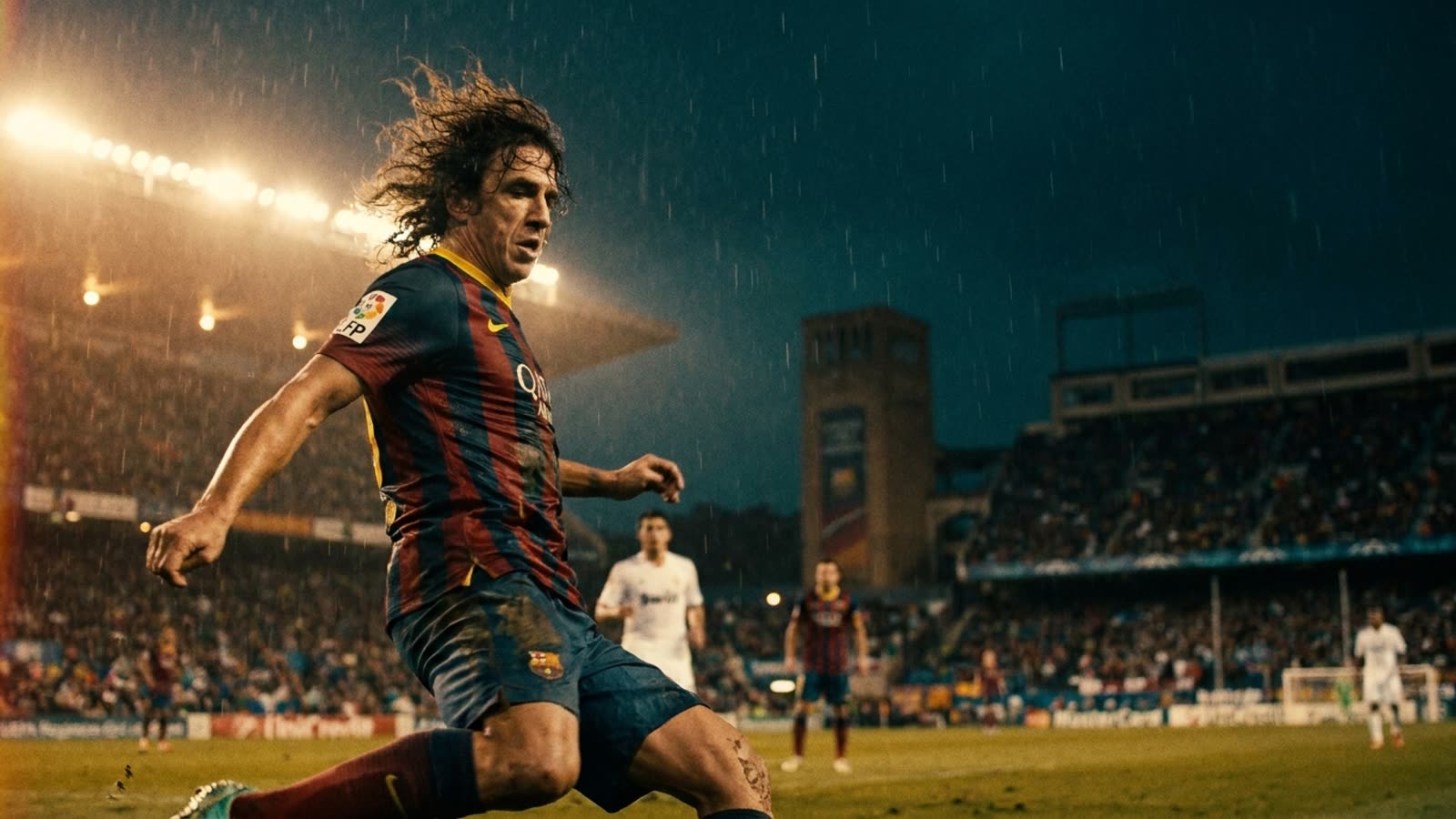
In an era when defenders were increasingly valued for their ability to play out from the back — ball-playing centre-halves became the fashion — Puyol was something of an anachronism. He could pass well enough, but that was not the point. The point was that when Thierry Henry was bearing down on goal, or when Didier Drogba was backing into the box, Puyol would be there, throwing his body in the way, that mane of hair flying like a battle standard.
His partnership with the elegant Carles Puyol at Barcelona created one of football's great contrasts. Where Piqué was languid and technical, Puyol was chaos and commitment. Together they formed a defensive unit that conceded just 21 goals in La Liga during the 2010-11 season, a record that still stands.
The captain's armband as covenant
Puyol wore Barcelona's captaincy for nearly a decade, and he treated it less as an honor than as a sacred obligation. The stories are legion: Puyol training harder than anyone else, Puyol refusing to let younger players slack, Puyol playing through injuries that would have sidelined more sensible men. When he finally retired in 2014, his body essentially gave out from years of punishment absorbed on behalf of the team.
The most telling moment of his captaincy came not in a match but in its aftermath. When Barcelona won the Champions League in 2009, completing an unprecedented treble, Puyol insisted that the entire squad lift the trophy together. No individual glory. The collective above all.
Our take
Modern football has become obsessed with metrics and market valuations, with expected goals and progressive carries. Puyol would have rated poorly on many of these measures. What the spreadsheets cannot capture is the way a team performs when it knows, with absolute certainty, that its captain will run through a wall for them. Leadership in sport is often discussed in vague, mystical terms. Puyol made it concrete: show up first, leave last, and never ask anyone to do something you would not do yourself. That his peak coincided with the greatest era in Spanish football history was not a coincidence. It was, in part, causation.