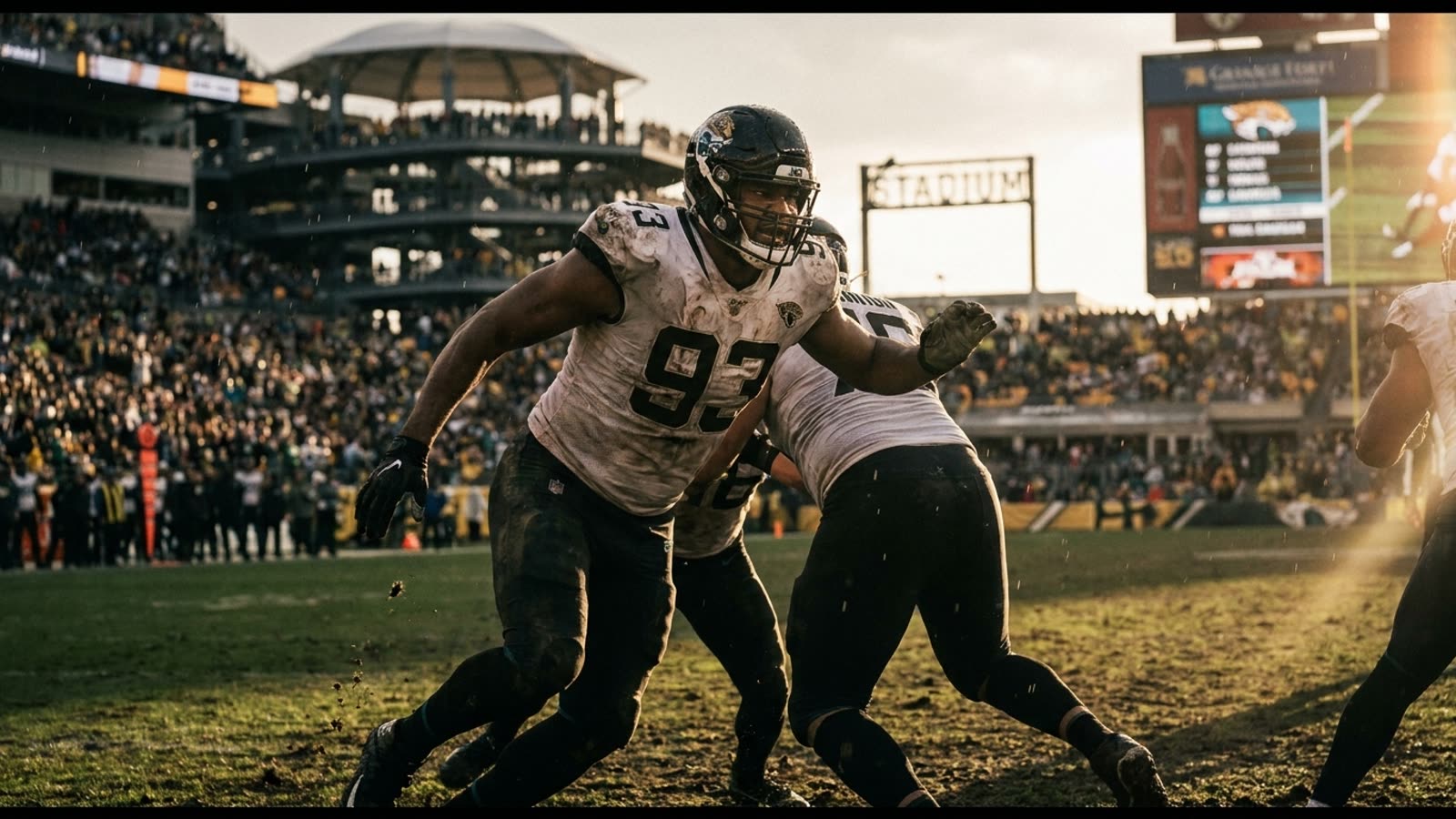
In an era when NFL careers average just over three years and defensive linemen are considered ancient at 32, Calais Campbell continues to defy actuarial tables with the casual indifference of someone who simply forgot to age.
The Miami Dolphins defensive end, who turned 40 last September, has played 18 NFL seasons — a tenure that spans the entire smartphone era. He entered the league when the iPhone was new, George W. Bush was president, and most of his current teammates were learning to read. That he remains not merely employed but effective is the sort of statistical anomaly that makes sports scientists reach for their spreadsheets.
The architecture of longevity
Campbell's durability isn't accidental. At 6'8" and roughly 300 pounds, he possesses the frame of a small building and has treated it accordingly. His offseason regimens have become the stuff of NFL legend: yoga sessions, plant-forward nutrition phases, sleep optimization protocols that would satisfy any Silicon Valley biohacker. He reportedly spends more on body maintenance than some players earn.
But the physical preservation is only half the equation. Campbell has survived by evolving his game — transitioning from a dominant pass-rusher who could collapse pockets single-handedly to a savvy veteran who wins with positioning, film study, and an encyclopedic knowledge of offensive line tendencies. He's become the defensive line equivalent of a chess grandmaster who compensates for slower reflexes with deeper pattern recognition.
The Walter Payton factor
Campbell's off-field work has earned him the Walter Payton NFL Man of the Year Award, the league's most prestigious honor for community service. His CRC Foundation has invested millions in education and youth development programs across multiple cities. In an NFL increasingly defined by controversy, Campbell represents something rarer than athletic longevity: sustained moral seriousness.
This combination — elite performance plus genuine civic contribution — has made him a unicorn in professional sports. Most athletes choose one lane or the other. Campbell has somehow maintained both while playing the most violent position in America's most violent major sport.
Our take
Calais Campbell won't play forever, though at this point one hesitates to bet against him. What he's demonstrated is that athletic careers need not follow the brutal trajectory we've come to accept as inevitable. With sufficient resources, intelligence, and discipline, the body can be maintained far longer than conventional wisdom suggests. Campbell is less a football player at this point than a proof of concept — evidence that the expiration dates we assign to athletes are often more cultural assumption than biological necessity. When he finally retires, he'll leave behind not just a Hall of Fame résumé but a template for everyone who follows.