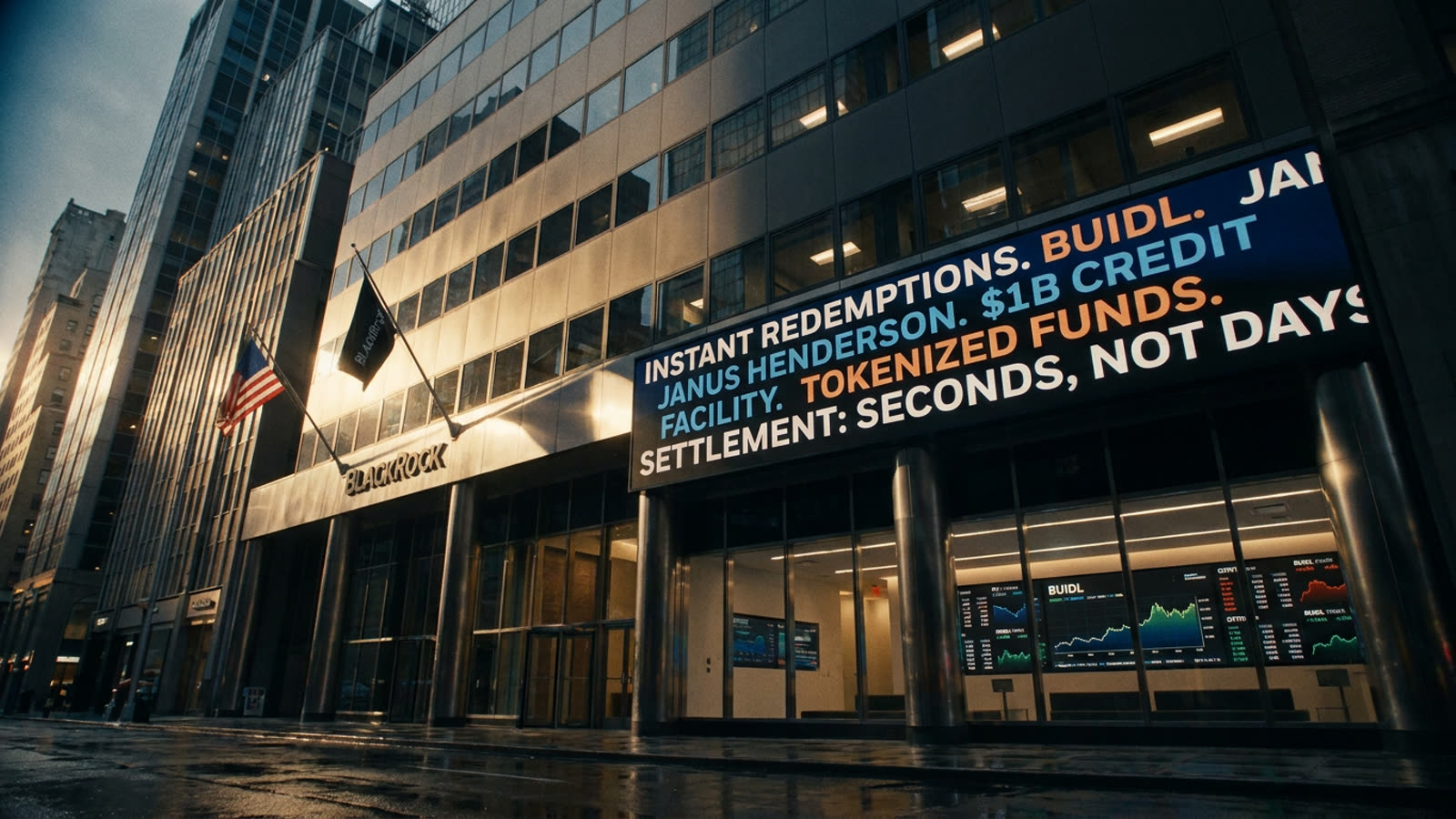
The promise of tokenized assets has always been speed—money that moves at the pace of the internet rather than the glacial crawl of traditional finance. Until now, that promise has been largely theoretical. BlackRock's BUIDL fund, the largest tokenized Treasury product at over $2.5 billion in assets, still required investors to wait days for redemptions, the same timeline they'd face with a conventional money market fund. The blockchain was just expensive window dressing.
Grove's new $1 billion credit facility changes the math entirely. Investors in BUIDL and Janus Henderson's tokenized money market funds can now redeem instantly into stablecoins, with Grove providing bridge liquidity while the underlying settlement completes in the background. It's a simple financial engineering trick, but it solves the problem that made institutional investors skeptical of tokenization's value proposition.
The liquidity problem, solved
Tokenized funds have attracted serious institutional capital—BUIDL alone has grown from nothing to billions in under two years—but they've struggled to demonstrate why the blockchain rails matter. If you still have to wait for T+2 settlement, why bother with the added complexity and cost of on-chain infrastructure?
Grove's facility provides the missing piece: a liquidity layer that absorbs the timing mismatch between instant blockchain transactions and the slower pace of underlying asset settlement. The credit facility essentially fronts the redemption, allowing investors to receive stablecoins immediately while Grove waits for the Treasury securities to settle. For institutional treasurers managing daily cash positions, this transforms tokenized funds from a curiosity into a genuine operational improvement.
Why this matters beyond crypto
The facility represents a maturation of the tokenized asset ecosystem that extends well beyond cryptocurrency enthusiasts. BlackRock didn't enter this market to appeal to DeFi natives; it entered because tokenization could eventually reduce costs and increase efficiency across the $100 trillion-plus global asset management industry.
But that thesis required solving the redemption problem. A tokenized fund that settles slowly is just a regular fund with extra steps. A tokenized fund with instant liquidity is something genuinely new—a cash-equivalent instrument that can move between counterparties at any hour, settle across borders without correspondent banking delays, and integrate directly with the growing ecosystem of on-chain financial applications.
Janus Henderson's participation signals that this isn't a BlackRock idiosyncrasy. Multiple major asset managers now see tokenization as a competitive necessity rather than an experiment.
Our take
This is the most significant development in institutional tokenization since BUIDL launched. The technology was never the hard part—it was making the user experience actually superior to traditional alternatives. Grove's facility does exactly that, and it creates a template for other tokenized products to follow. We're still years away from tokenized assets becoming the default infrastructure for asset management, but the gap between "interesting experiment" and "obviously better" just narrowed considerably. The next question is whether regulators will keep pace, or whether compliance uncertainty becomes the new bottleneck.