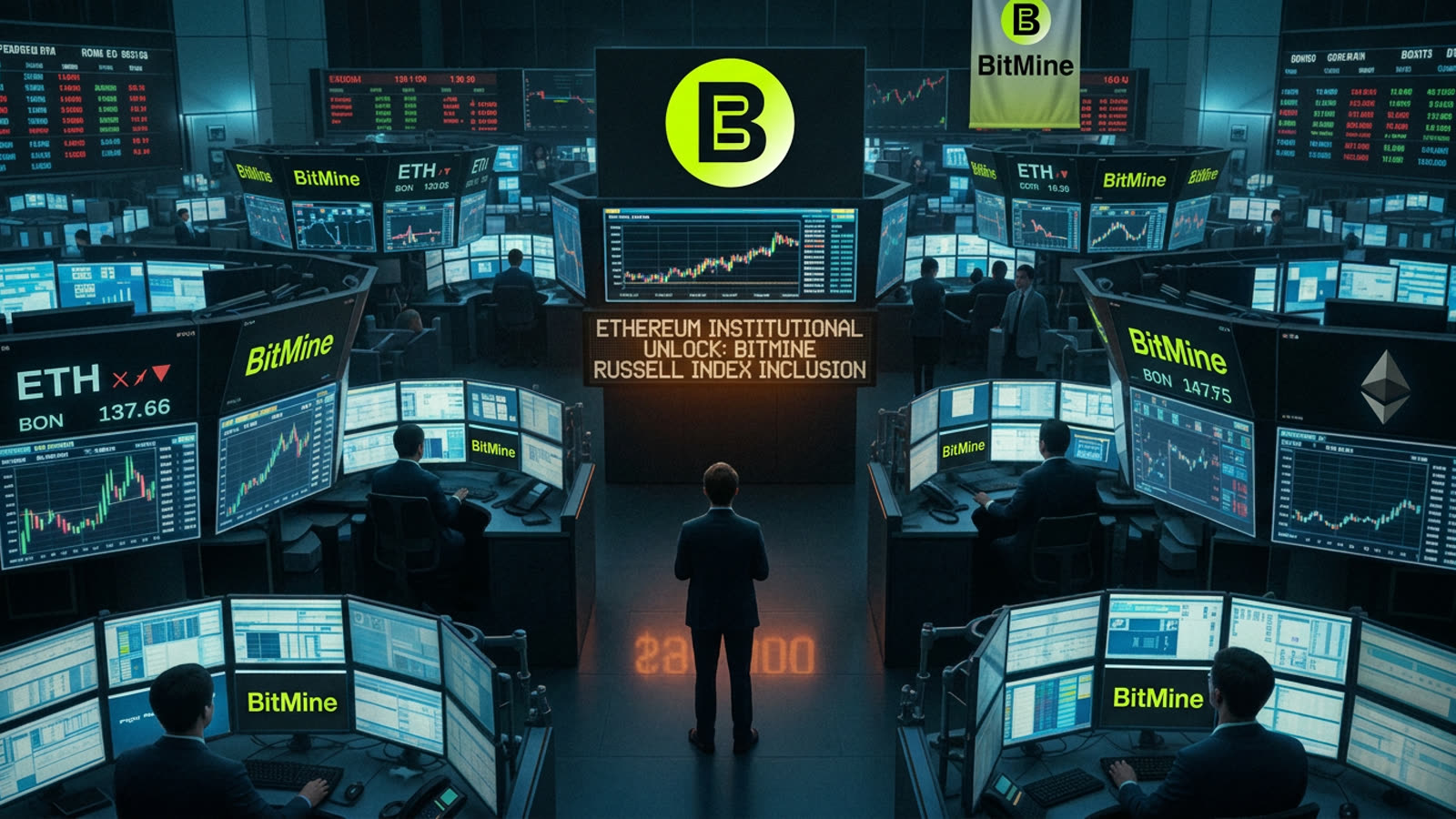
The Bitcoin treasury strategy—buy the asset, hold it on balance sheet, watch passive index funds amplify your stock's liquidity—has minted fortunes and spawned imitators. Now the playbook may be crossing the aisle to Ethereum, and the catalyst is a company most investors have never heard of.
BitMine, an Ethereum-focused mining and staking operation, has qualified for inclusion in the Russell 2000 and Russell 3000 indexes following the annual reconstitution process. Fundstrat's Tom Lee, speaking this week, outlined why the seemingly procedural update matters: index inclusion forces passive vehicles to buy shares regardless of fundamentals, creating sustained bid pressure that can transform a thinly traded name into a liquid vehicle for institutional Ethereum exposure.
The MicroStrategy precedent
MicroStrategy's transformation from an enterprise-software afterthought into a de facto Bitcoin ETF proxy remains the ur-text for crypto treasury bulls. The company's aggressive BTC accumulation, combined with its presence in major indexes, created a feedback loop: rising Bitcoin lifted the stock, which attracted index flows, which improved liquidity, which enabled more convertible-debt issuance to buy more Bitcoin. At its peak, MicroStrategy traded at a substantial premium to its net asset value—a premium investors paid for liquidity and leverage.
BitMine's ambitions are more modest but structurally similar. The company holds Ethereum on balance sheet and operates staking infrastructure, giving it operating exposure to ETH beyond mere spot holdings. Index inclusion, Lee argues, could provide the liquidity runway that lets BitMine scale its treasury strategy without crushing its own stock price on every purchase.
Why Ethereum treasury plays have lagged
Bitcoin's fixed supply and narrative simplicity made it the obvious first mover for corporate treasuries. Ethereum's more complex economics—staking yields, burn mechanisms, smart-contract utility—require more sophisticated investor education. And until recently, the regulatory environment for Ethereum exposure was murkier than for Bitcoin, discouraging public-company experimentation.
The approval of spot Ethereum ETFs last year removed some of that friction, but ETFs are passive instruments. A treasury company can offer leverage, operational upside, and—crucially—index-fund tailwinds that pure ETFs cannot. BitMine's Russell eligibility is the first real test of whether Ethereum can support the same reflexive capital-formation loop that Bitcoin has enjoyed.
Our take
The bull case is elegant: passive flows beget liquidity, liquidity begets financing capacity, financing capacity begets more ETH accumulation, and the cycle repeats. The bear case is equally straightforward—Ethereum's price has underperformed Bitcoin for much of the past year, and a treasury strategy amplifies drawdowns as surely as it amplifies rallies. BitMine is not MicroStrategy, and Ethereum is not Bitcoin. But if Lee is right, the company may not need to be either. It just needs to be first.