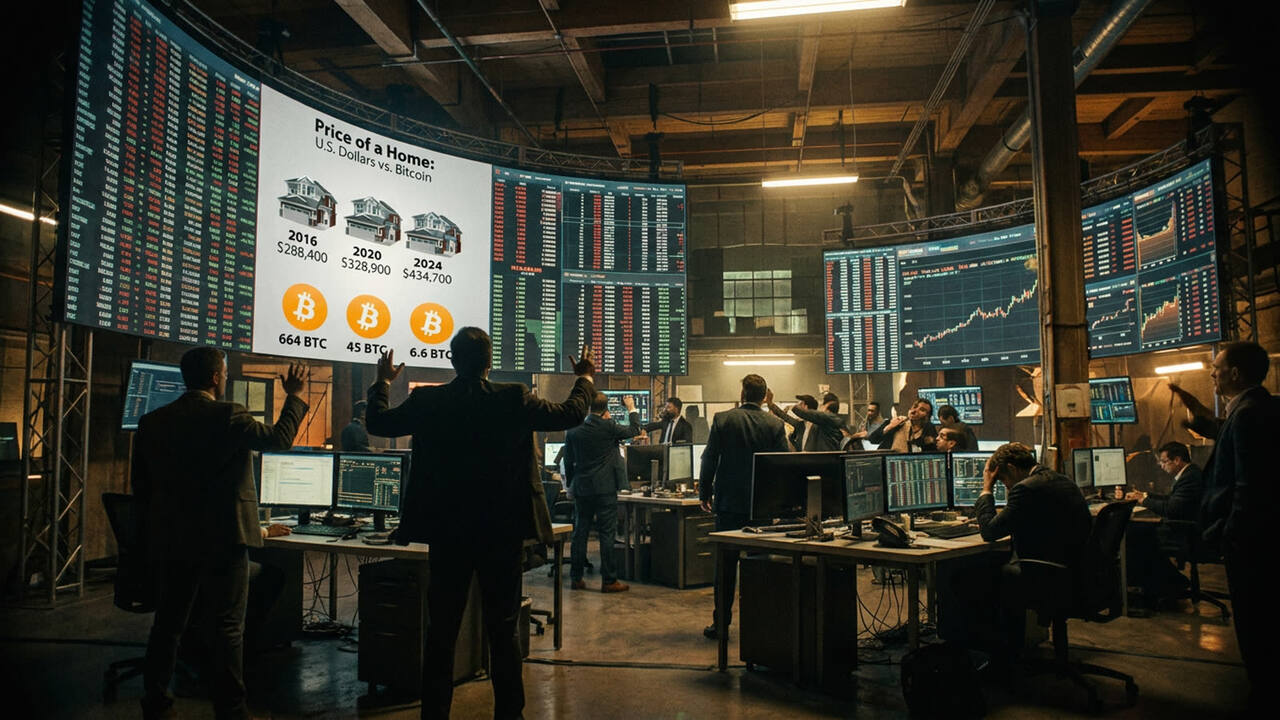
When you price a median American home in bitcoin instead of dollars, something remarkable happens: that $450,000 house suddenly costs just 7.14 BTC. More striking still, the same house would have cost 900 BTC in 2011. This isn't bitcoin appreciating so much as it is the dollar collapsing in slow motion.
The accidental truth-teller
Real estate platforms experimenting with bitcoin pricing likely intended it as a marketing gimmick to attract crypto-wealthy buyers. Instead, they've created an inadvertent monetary telescope that brings the distant reality of currency debasement into sharp focus. When priced in a fixed-supply asset rather than an infinitely printable one, the true trajectory of purchasing power becomes impossible to ignore.
The mathematics are sobering. Since bitcoin's emergence as a liquid market in 2010, housing priced in BTC has fallen by more than 99%. This mirrors almost perfectly what has happened to the dollar's purchasing power against hard assets over longer timeframes, compressed into a decade and a half. Gold tells a similar if less dramatic story: the median home that cost 350 ounces in 1970 now requires over 180 ounces.
Central banks hate this one simple trick
The Federal Reserve and its global counterparts have spent decades perfecting the art of monetary illusion. Official inflation statistics focus on consumer prices while systematically understating or excluding asset price inflation. The result is a two-tier system where wage earners believe inflation is 2-3% annually while asset owners surf waves of 10-15% appreciation.
Pricing homes in bitcoin strips away this carefully constructed facade. It reveals that the primary function of modern central banking isn't price stability but wealth transfer from savers to debtors, from wage earners to asset holders. The political implications are explosive, which explains why no government statistics agency will ever adopt such transparent benchmarking.
Our take
The real estate industry's flirtation with bitcoin pricing is more subversive than its practitioners likely realize. By accident or design, they've created a monetary memento mori that reminds us daily of our currency's mortality. As more assets get priced in bitcoin—from cars to artwork—the comfortable fiction of dollar stability becomes harder to maintain. Central bankers who spent careers managing perception rather than money supply may soon discover that mathematical truth has an annoying tendency to assert itself.