Bitcoin's most consequential feature is also its most overlooked. While headlines fixate on price swings and regulatory battles, the cryptocurrency's defining innovation quietly ticks along in the background: a predetermined supply schedule that no government, corporation, or consortium can alter.
The mechanism is called the halving, and understanding it is essential to understanding why Bitcoin behaves the way it does.
The mathematics of artificial scarcity
When Satoshi Nakamoto designed Bitcoin, the anonymous creator embedded a simple rule into the protocol. Miners who validate transactions and secure the network receive newly created bitcoin as a reward. But that reward gets cut in half approximately every four years—or more precisely, every 210,000 blocks.
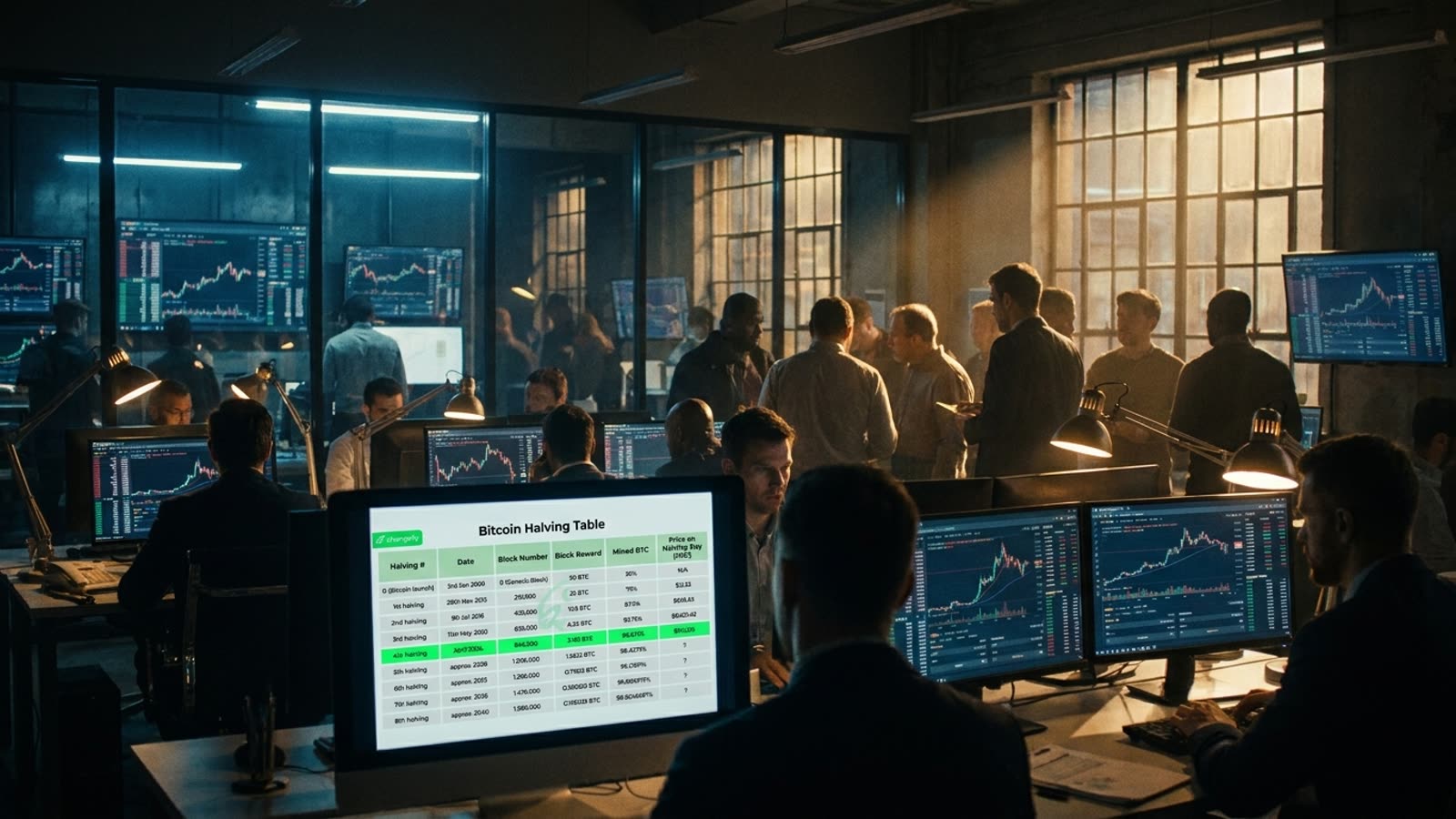
At Bitcoin's 2009 launch, miners earned 50 BTC per block. After the first halving in 2012, that dropped to 25. Then 12.5 in 2016. Then 6.25 in 2020. The most recent halving in 2024 reduced the reward to 3.125 BTC. This continues until roughly 2140, when the final fraction of the 21 million total bitcoin will be mined.
The elegance lies in the predictability. Unlike central banks, which adjust money supply based on economic conditions and political pressures, Bitcoin's issuance schedule was fixed at inception. Every participant knows exactly how much new supply will enter circulation and when.
The price cycle debate
Historically, each halving has preceded a substantial bull run—sometimes by months, sometimes by more than a year. This pattern has spawned an entire industry of analysts who treat halvings as predictive events, mapping previous cycles onto future price projections with varying degrees of rigor.
The bull case is straightforward: if demand remains constant while new supply gets cut in half, prices should rise. Miners, who must sell some bitcoin to cover operational costs, suddenly have half as much to sell. The math, proponents argue, is inescapable.
Skeptics counter that markets are forward-looking. If everyone knows the halving is coming, the price adjustment should happen in advance. The post-halving rallies, they suggest, may be coincidence, or the result of broader macroeconomic conditions, or simply self-fulfilling prophecies driven by collective belief in the pattern.
The honest answer is that the sample size—four halvings to date—is too small to establish causation with statistical confidence. Correlation exists. Causation remains contested.
What happens when the rewards run out
The halving mechanism creates an eventual problem. As block rewards approach zero, miners must increasingly rely on transaction fees to sustain their operations. Whether those fees will prove sufficient to maintain network security is an open question that Bitcoin's community has debated since the early days.
Optimists point to rising transaction volumes and the development of second-layer solutions like the Lightning Network, which could generate substantial fee revenue. Pessimists worry about a security budget crisis, where insufficient miner compensation leaves the network vulnerable to attack.
This reckoning is still decades away, but the halving schedule ensures it will arrive. The same predictability that makes Bitcoin's monetary policy appealing also makes its long-term sustainability a known unknown.
Our take
The halving is neither magic nor irrelevant. It is a deliberate design choice with real economic consequences and genuine uncertainty about its long-term implications. The crypto industry's tendency to treat it as either a guaranteed catalyst for gains or a meaningless technical detail both miss the point. What Nakamoto built was an experiment in programmed scarcity—one that has performed remarkably well for fifteen years but remains, in the grand scheme of monetary history, extremely young. The next halving will come around 2028. Whether the pattern holds will tell us something important about whether markets can truly price in the predictable.