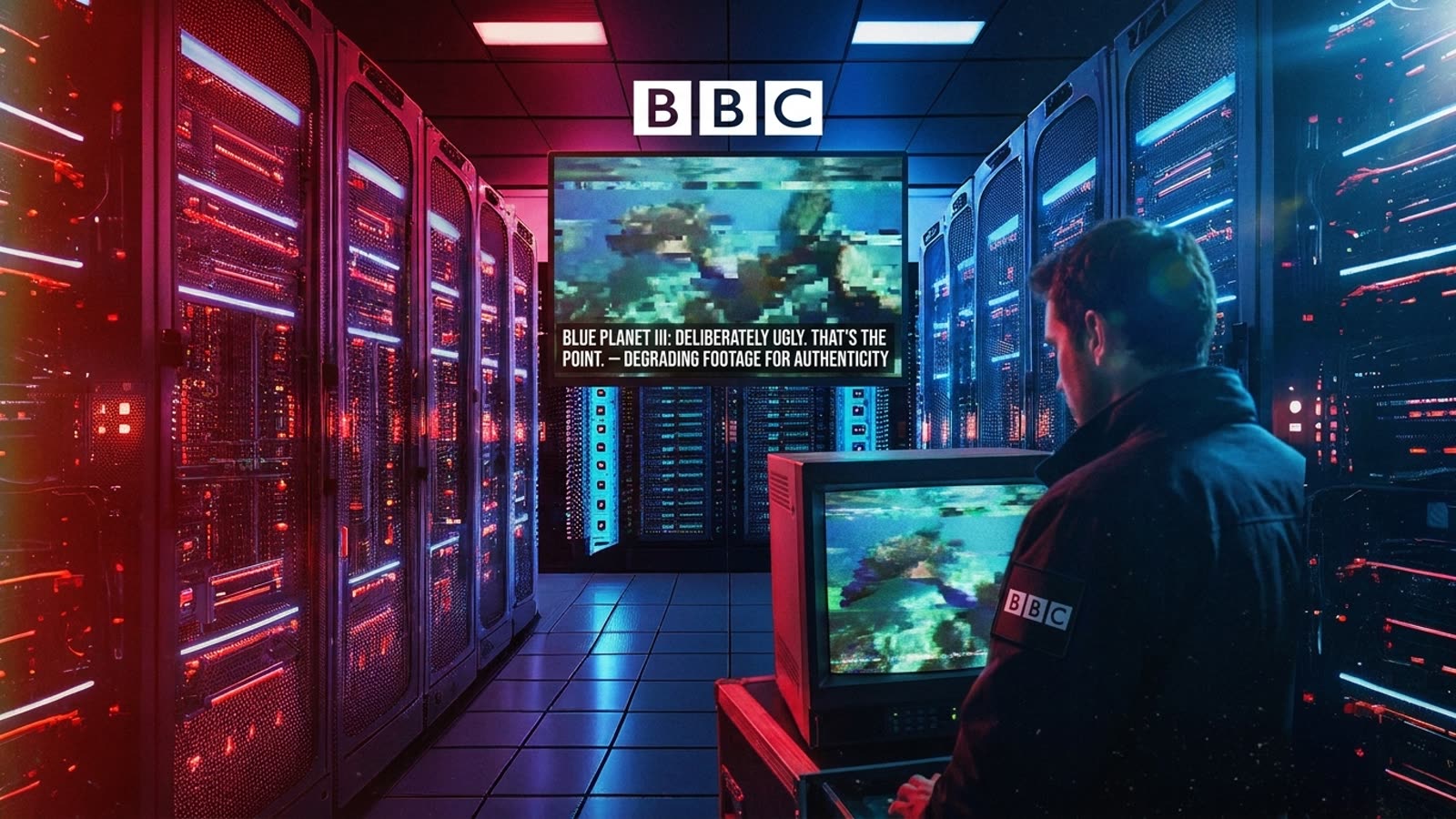
When the most prestigious wildlife documentary franchise on Earth decides that pristine 8K imagery is now a liability rather than an asset, something fundamental has shifted in how we consume visual truth.
Blue Planet III, the latest installment of David Attenborough's oceanic opus, arrives with a counterintuitive production mandate: make it look worse. Producers have confirmed that the series deliberately incorporates cloudier, grainier, less technically polished footage — not because the BBC's camera technology has regressed, but because perfect images now read as suspicious. In an era when generative AI can conjure photorealistic whales breaching at sunset in seconds, the accidental wobble of a handheld underwater camera has become a certificate of authenticity.
The paradox of too-good-to-be-true
Nature documentaries have spent decades in an arms race toward visual perfection. Planet Earth pioneered aerial stabilization; Blue Planet II deployed deep-sea submersibles capturing creatures never before filmed. Each generation promised sharper, more impossible shots. Now that trajectory has collided with a world where AI image generators can produce marine life indistinguishable from reality — at least to casual viewers scrolling on phones.
The BBC's solution is essentially a visual watermark of imperfection. Footage that looks "more organic," as producers put it, signals human presence behind the lens. A slight haze in the water column, a momentary loss of focus, the natural grain of low-light conditions — these artifacts now function as proof of labor, evidence that someone actually descended to the ocean floor rather than typing a prompt.
The authentication problem expands
This is not merely a documentary concern. The same logic is creeping into journalism, courtroom evidence, and social media verification. When any image can be fabricated, the metadata of imperfection becomes currency. We are entering an era where visual polish is inversely correlated with trust — a complete inversion of the twentieth-century assumption that higher production values meant higher credibility.
For the BBC, the stakes are existential. Nature documentaries depend on wonder, and wonder depends on belief. If viewers suspect they are watching a sophisticated animation, the emotional contract breaks. Attenborough narrating a procedurally generated octopus is just a video game with better voice acting.
Our take
There is something melancholy about a civilization so saturated in synthetic imagery that authenticity must be performed through deliberate degradation. The BBC is not wrong — cloudier footage probably does reassure audiences, for now. But this is a temporary fix. Generative models will learn to simulate imperfection just as easily as they simulate perfection. The real solution is not aesthetic but infrastructural: cryptographic provenance, chain-of-custody metadata, camera hardware that signs footage at capture. Until then, we are left with the absurd spectacle of the world's best nature filmmakers intentionally making their work look worse, hoping that ugliness still reads as truth.