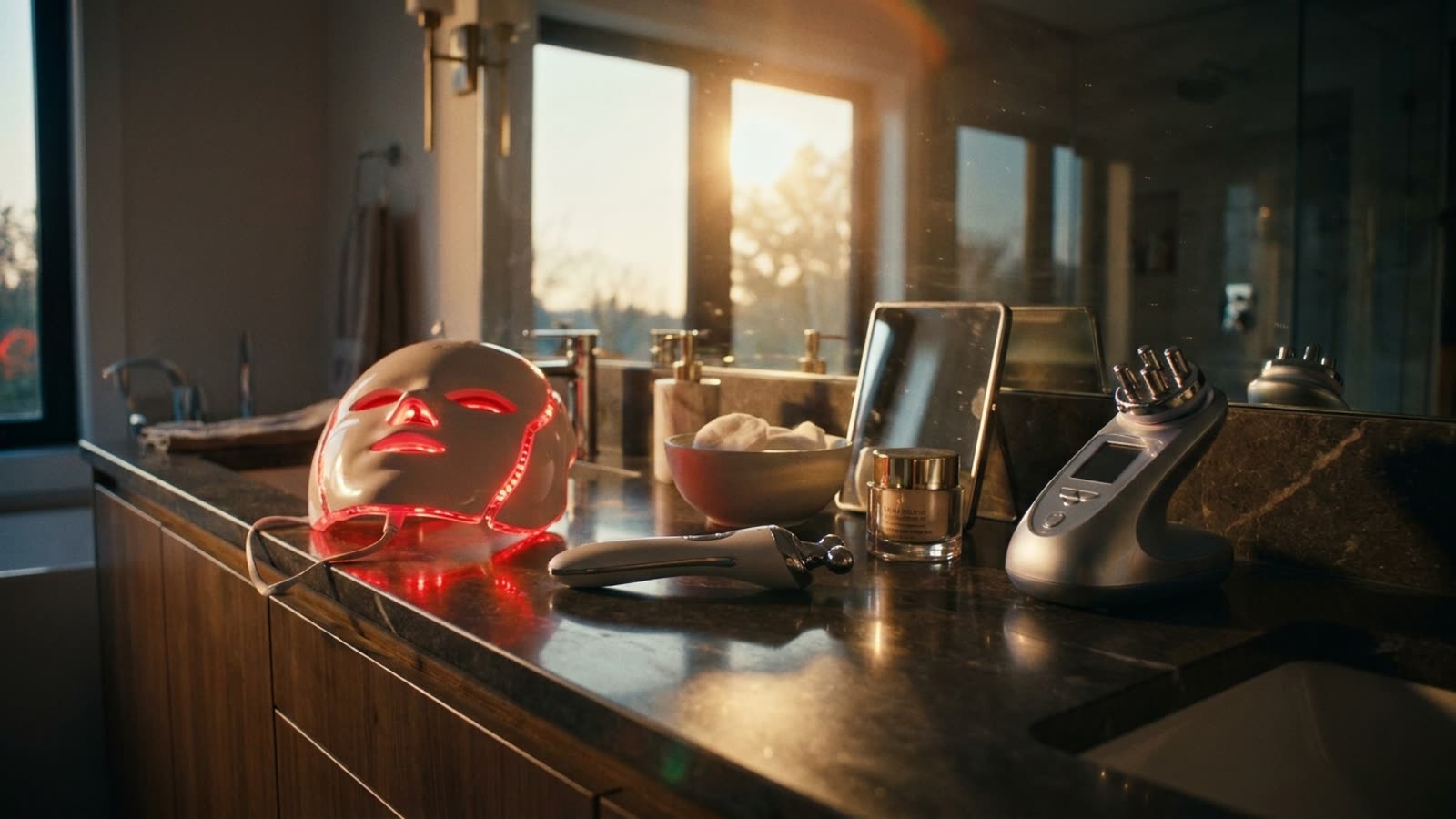
The beauty industry has always sold hope in a jar, but the latest vessels are considerably more ambitious: handheld devices promising to deliver treatments once available only in medical offices. LED panels that claim to stimulate collagen. Microcurrent tools marketed as "non-surgical facelifts." Radiofrequency wands that purport to tighten skin from the comfort of your sofa. The global at-home beauty device market, valued at roughly $15 billion, is projected to nearly double by 2030. The question nobody seems able to answer definitively is whether any of it actually works.
The democratization argument
Proponents frame the shift as overdue accessibility. Professional treatments—think in-office laser resurfacing or clinical-grade LED therapy—can run into thousands of dollars per session, require multiple appointments, and remain geographically concentrated in major cities. At-home devices, even premium ones retailing for $300 to $600, represent a fraction of that cost and eliminate the scheduling friction. For consumers in underserved markets or those with limited mobility, the appeal is obvious. Brands like Therabody, NuFace, and CurrentBody have built substantial followings by promising spa-grade results without the spa.
The technology itself has improved. Early consumer LED devices were often too weak to penetrate skin meaningfully; newer iterations claim clinical-level irradiance. Microcurrent tools have become more sophisticated in their waveform delivery. Some radiofrequency devices now incorporate temperature sensors to prevent burns—a tacit acknowledgment that earlier models could, and did, cause injury.
The skeptic's case
Dermatologists remain divided, and the more cautious among them are blunt. "There's a fundamental physics problem," says Dr. Ranella Hirsch, a Boston-based dermatologist. "To get meaningful results, you often need energy levels that would be unsafe for unsupervised home use. So manufacturers dial things down, and then you're paying for a very expensive placebo." The FDA classifies most of these devices as low-risk "wellness" products, meaning they face minimal scrutiny before reaching shelves. Clinical studies, when they exist, are frequently funded by manufacturers and conducted on small sample sizes over short durations.
There's also the compliance problem. Professional treatments work partly because they're administered by trained practitioners who can calibrate intensity, duration, and technique. Consumers using devices inconsistently—or incorrectly—may see diminished results or, worse, adverse effects. Reports of burns, hyperpigmentation, and nerve damage, while not widespread, have surfaced in dermatology literature and on social media.
The regulatory vacuum
The FDA's current framework wasn't designed for this hybrid category of products that sit somewhere between cosmetics and medical devices. In the European Union, stricter CE marking requirements have kept some devices off the market, but enforcement remains patchy. Industry groups have called for clearer guidelines, though their motives are mixed: established players would benefit from barriers that exclude cheaper, lower-quality competitors flooding in from overseas.
Meanwhile, influencer marketing has outpaced regulatory oversight. A device endorsed by a celebrity with millions of followers can sell out before any independent review is published. By the time skeptical coverage appears, the news cycle has moved on.
Our take
The at-home beauty device boom is neither the revolution its marketers claim nor the scam its harshest critics suggest. It's something more mundane: a market expanding faster than the evidence base supporting it. Some devices, used correctly and consistently, may offer modest benefits. Others are expensive nightstand clutter. The burden of discernment has been offloaded entirely onto consumers, most of whom lack the scientific literacy to evaluate competing claims. Until regulators catch up—or the industry self-regulates more meaningfully—caveat emptor remains the only reliable skincare advice.