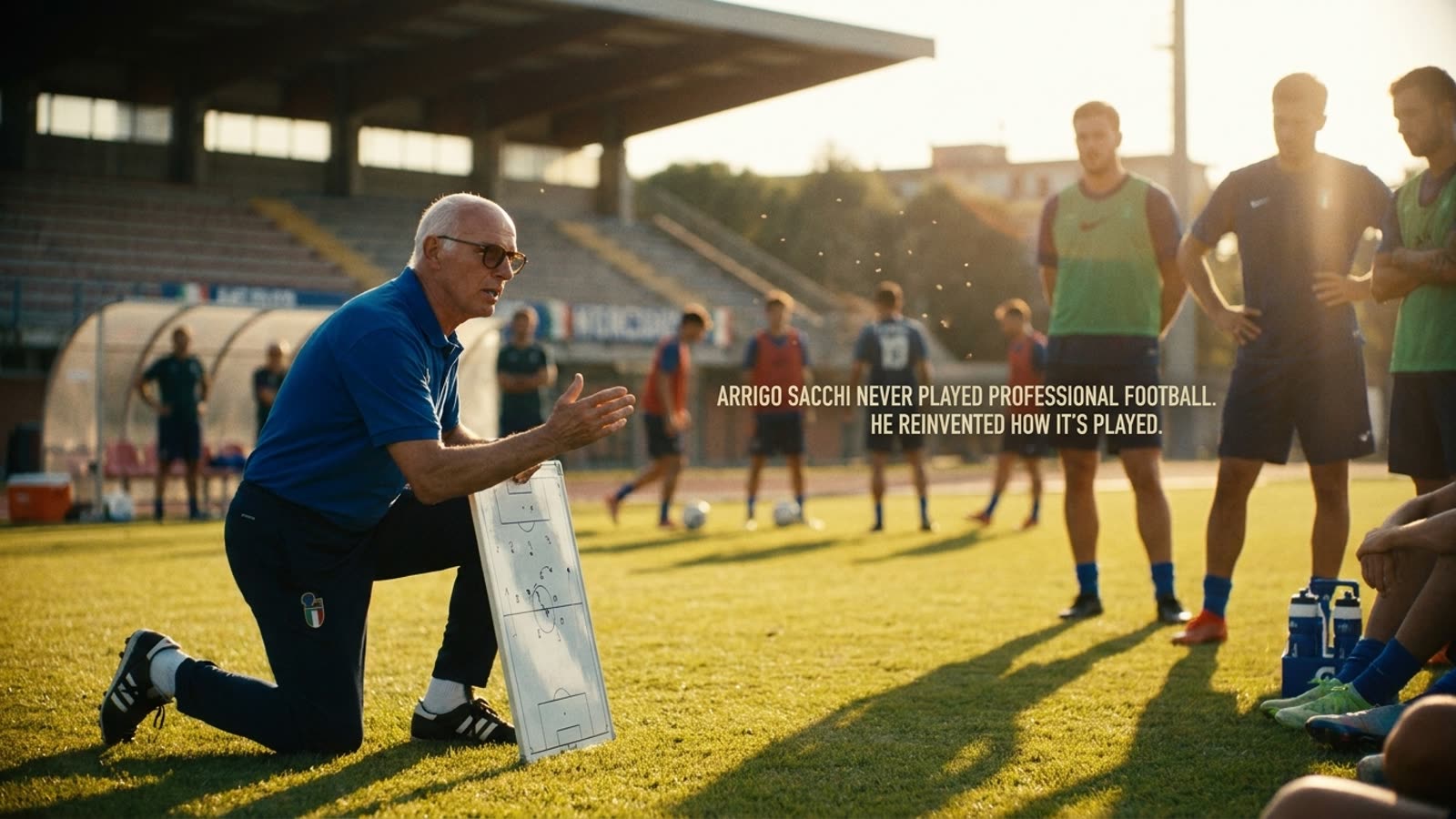
When Arrigo Sacchi took charge of AC Milan in 1987, a journalist asked how he could presume to coach at the highest level without having played professionally. His response has become football's most quoted riposte: "I never realized that to be a jockey you had to be a horse first."
The quip was characteristically sharp, but it undersold the revolution Sacchi was about to unleash. Within two years, his Milan would win consecutive European Cups, demolish Real Madrid 5-0 in a semifinal that traumatized Spanish football, and establish a tactical blueprint that coaches from Pep Guardiola to Jürgen Klopp would spend decades refining. The shoe salesman from Fusignano didn't just win trophies — he changed what winning looked like.
The system over the stars
Sacchi inherited a squad featuring Marco van Basten, Ruud Gullit, and Franco Baresi, but his genius lay in making them components of something larger than themselves. Italian football in the 1980s worshipped the libero and catenaccio, defensive systems built around individual brilliance and reactive containment. Sacchi demanded the opposite: a high defensive line, coordinated pressing, and players who moved as a single organism regardless of who held the ball.
His training sessions were legendary for their obsessiveness. Sacchi would drill his back four to move in perfect synchronization, maintaining distances of precisely 25 meters across and 30 meters deep. He rehearsed pressing triggers until they became instinctive — the moment a midfielder's head dropped to control a pass, four red-and-black shirts would converge. "Football is played with the brain," he insisted, and his Milan played as if sharing one.
The European devastation
The 1989 European Cup final against Steaua Bucharest finished 4-0, but the scoreline flattered the Romanians. Milan completed the tournament having conceded just two goals in nine matches while playing a brand of attacking football that seemed to belong to a different sport than their opponents. The following year's final, another 1-0 victory over Benfica, was more prosaic but no less dominant.
Yet the match that defined Sacchi's Milan came in the 1989 semifinal against Real Madrid. The Spanish giants arrived at the San Siro as favorites; they left having suffered their worst European defeat in decades. Van Basten scored a hat-trick, but the real story was how Milan's pressing suffocated a midfield featuring Hugo Sánchez and Bernd Schuster. Real's players later described feeling hunted, unable to find space that had always existed before.
The inheritance
Sacchi's tenure at Milan lasted only four seasons before he moved to the Italian national team, but his influence proved permanent. His assistant, Fabio Capello, would win four Serie A titles using modified versions of the system. More significantly, a young Barcelona reserve player named Pep Guardiola watched Sacchi's Milan and recognized something essential about how football could be organized.
The through-line from Sacchi's San Siro to Guardiola's Barcelona to Klopp's Liverpool is direct and acknowledged. High pressing, defensive lines that squeeze space, the insistence that defending and attacking are not separate activities but the same activity performed at different moments — these are now orthodoxies. Before Sacchi, they were heresies.
Our take
Sacchi's legacy transcends his trophy cabinet, impressive as it is. He proved that football coaching is an intellectual discipline, not merely an extension of playing experience. In an era when former stars are handed managerial jobs as retirement gifts, Sacchi remains the patron saint of the outsider who sees what the insiders cannot. The horse, it turns out, rarely makes the best jockey.