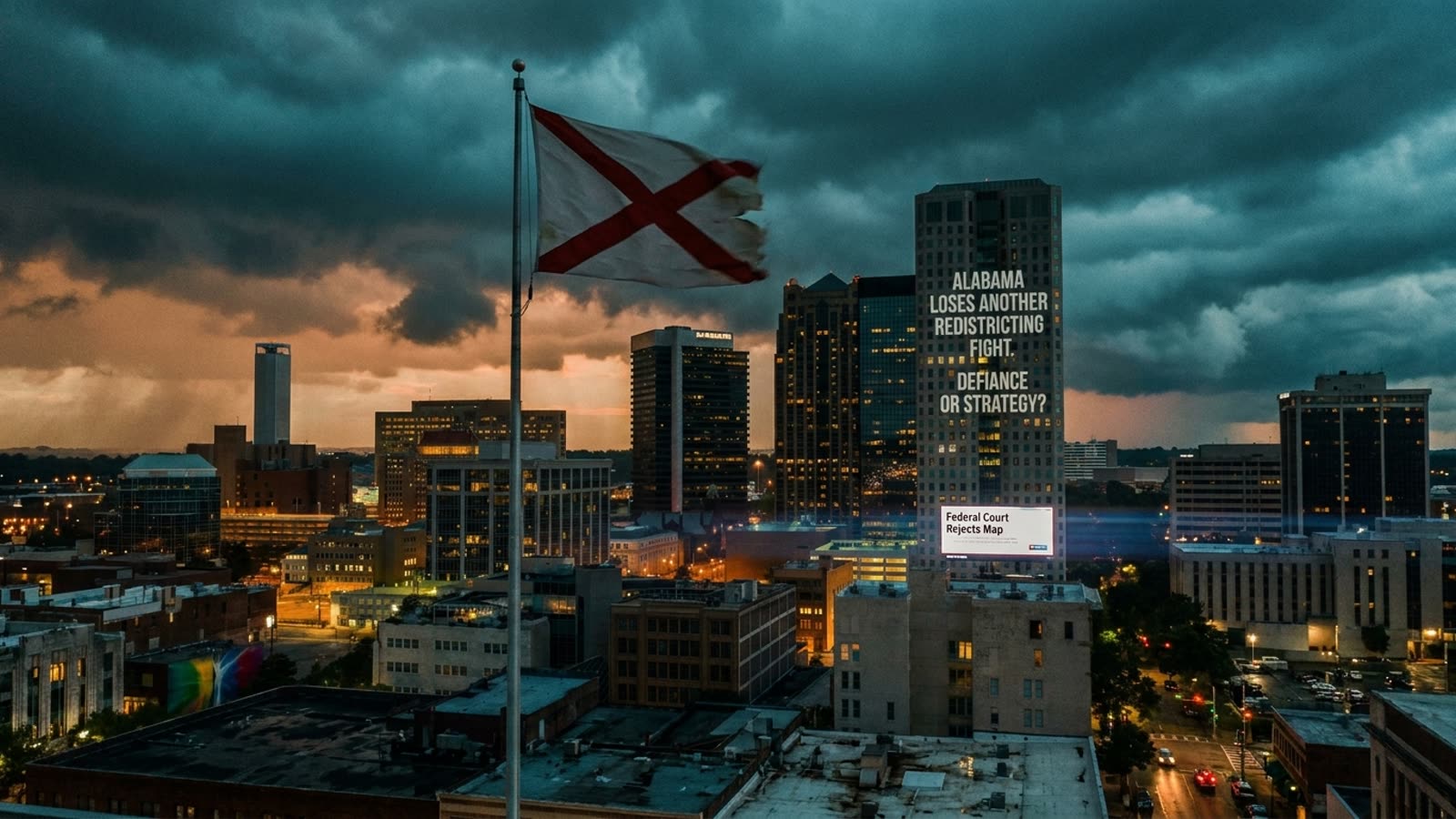
Alabama's Republican-controlled legislature has now had three separate opportunities to draw a congressional map that complies with the Voting Rights Act, and it has failed each time. The latest rejection, handed down by a three-judge federal panel this week, found that the state's House districts continue to dilute Black voting power in violation of Section 2. At a certain point, incompetence becomes indistinguishable from intent.
The ruling follows a pattern that has become grimly familiar. In 2023, the Supreme Court surprised observers by affirming a lower court's finding that Alabama needed a second majority-Black congressional district. The state responded with a map that critics said changed almost nothing. Courts agreed. Now, after yet another legislative attempt, judges have once again concluded that Alabama's lines fail to provide Black voters—who make up roughly 27 percent of the state's population—with fair representation.
The legal math that Alabama keeps getting wrong
The Voting Rights Act does not require proportional representation, but it does prohibit maps that systematically submerge minority communities into white-majority districts where their preferred candidates cannot win. Alabama currently has seven congressional seats. Under any reasonable interpretation of the law, at least two of those should be majority-Black or Black-opportunity districts. The state has consistently drawn maps with just one.
What makes Alabama's position particularly weak is that the Supreme Court already told them the answer. The 2023 ruling in Allen v. Milligan was not ambiguous. Chief Justice Roberts, writing for a 5-4 majority that included Justice Kavanaugh, explicitly rejected Alabama's argument that race-neutral principles alone should govern redistricting. The state has spent the years since essentially arguing that the Court did not mean what it said.
Defiance as political strategy
The cynical reading—and it is difficult to avoid—is that Alabama's repeated failures are not failures at all. Every rejected map buys time. Every appeal delays implementation. The 2024 elections were conducted under maps that courts had already found discriminatory. If the state can drag proceedings past 2026, it will have successfully run out the clock on another cycle.
This is not a novel tactic. Southern states have a long history of treating adverse court rulings as opening bids rather than final judgments. The difference now is that the Supreme Court's conservative majority has shown little appetite for aggressive Voting Rights Act enforcement beyond Milligan. Alabama may be betting that the judicial winds will shift before meaningful consequences arrive.
Our take
There is something almost admirable about Alabama's commitment to losing the same lawsuit repeatedly. Most litigants would find the experience humiliating; Montgomery seems to view it as a cost of doing business. The state is not confused about what the law requires—it simply does not wish to comply, and has calculated that the penalties for noncompliance are tolerable. That calculation may prove correct, which says less about Alabama's cleverness than about the atrophied state of voting rights enforcement in America. The courts can tell a state what to do. Making it actually do it is another matter entirely.