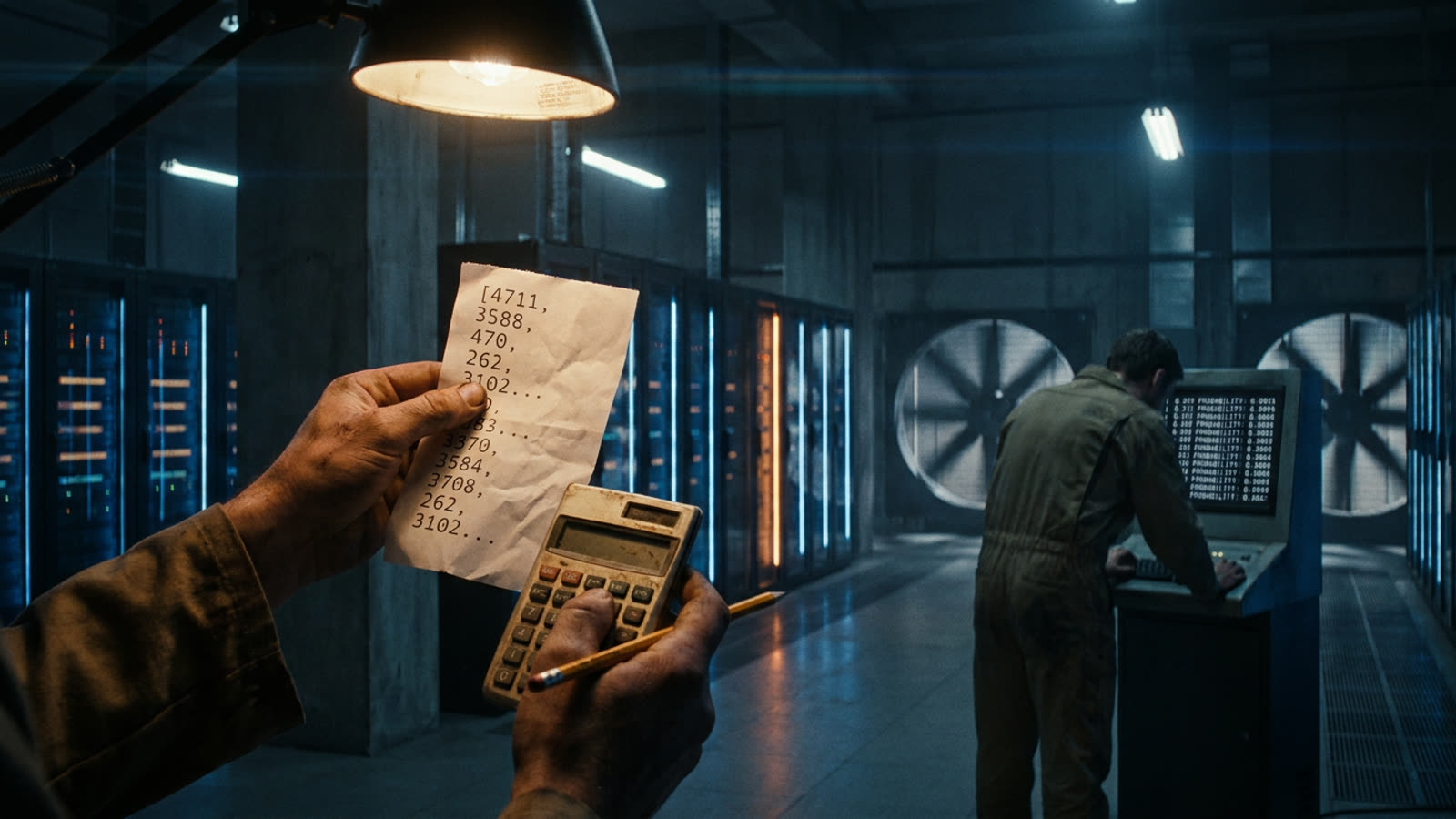
For more than half a century, weather forecasting has followed a particular liturgy: gather observations from satellites, buoys, and radiosondes; feed them into physics-based models that simulate atmospheric dynamics; run these simulations on some of the world's most powerful supercomputers; then have human meteorologists interpret the outputs and craft forecasts. The process is elegant, expensive, and increasingly under siege from an unexpected direction.
Machine learning models trained on historical weather data are now matching or exceeding the accuracy of traditional numerical weather prediction (NWP) systems on many standard benchmarks — and they're doing it in minutes rather than hours, on hardware that costs a fraction as much. The implications extend far beyond operational efficiency.
The physics-free forecast
Traditional NWP models are monuments to human understanding. They encode the Navier-Stokes equations, thermodynamic principles, radiative transfer theory — the accumulated knowledge of atmospheric science translated into millions of lines of code. Running a global forecast requires solving these equations across a three-dimensional grid covering the entire atmosphere, a computational task so demanding that only a handful of national weather services can afford the necessary supercomputers.
The new AI models take a radically different approach. Systems like Google DeepMind's GraphCast and Huawei's Pangu-Weather learn patterns directly from decades of historical weather data without explicitly encoding physical laws. They treat forecasting as a pattern-completion problem: given the atmospheric state now, what does the atmosphere typically look like in six hours, or three days, or a week? The models have no understanding of why pressure gradients create wind or why warm air rises. They simply recognise that certain configurations tend to evolve in certain ways.
This should be unsettling. Weather is a chaotic system where small errors compound rapidly. A model that doesn't understand the underlying physics might hallucinate impossible atmospheric states or fail catastrophically in novel conditions. Yet on standard verification metrics, the AI systems keep winning.
What meteorologists actually do now
The profession is adapting in ways both pragmatic and philosophical. At major forecasting centres, AI outputs are increasingly treated as another ensemble member — one more voice in the chorus of model guidance that human forecasters synthesise. The AI is particularly valued for its speed: when a hurricane threatens landfall, having a skillful forecast in three minutes rather than three hours matters enormously.
But the deeper shift concerns the nature of expertise itself. A traditional meteorologist's value lay partly in understanding why models erred — recognising when the physics was being misrepresented, when observations were corrupted, when local effects would override synoptic patterns. That understanding came from years of studying atmospheric dynamics. The AI models offer no such interpretability. They are black boxes that happen to be right more often than not.
Some meteorologists are becoming AI interpreters, developing intuitions about when the machine learning models struggle — extreme events outside the training distribution, rapid intensification of tropical cyclones, mesoscale phenomena the coarse training data couldn't capture. Others are focusing on the parts of forecasting that remain stubbornly human: communicating uncertainty to the public, understanding what communities actually need to know, translating probabilistic guidance into actionable decisions.
The limits that matter
The AI models have genuine weaknesses that temper the revolution. They struggle with events that are rare in the historical record — the kind of unprecedented extremes that climate change is making less unprecedented. They can't easily incorporate new observation types or adapt to a changing climate without retraining. And they inherit whatever biases exist in the data they learned from, including the historical undersampling of weather in the Global South.
More fundamentally, these models don't extend our understanding. A physics-based model that fails teaches us something about the atmosphere; an AI model that fails teaches us only that we need more data or different architecture. For a field that has always been intertwined with atmospheric science research, this is a genuine loss.
Our take
The weather forecasting revolution is a preview of a pattern that will repeat across many expert professions: AI systems that outperform humans on measurable outcomes while offering none of the understanding that traditionally justified expertise. Meteorologists are handling this better than most, perhaps because they've always been comfortable with uncertainty and ensemble thinking. The profession won't disappear, but it will be unrecognisable in a decade. The question isn't whether to embrace the AI — that ship has sailed — but whether we can preserve the scientific culture that made accurate forecasting possible in the first place. Pattern-matching works until the patterns change.