The profession of weather forecasting was, until recently, one of the last holdouts against algorithmic displacement. Unlike stock trading or legal research, predicting the atmosphere seemed irreducibly physical — a matter of solving differential equations describing fluid dynamics across a three-dimensional grid of the planet. You needed supercomputers, yes, but you also needed meteorologists who understood why a low-pressure system might stall over the Gulf Coast or why the jet stream was behaving strangely this winter.
That assumption has begun to crack. Over the past several years, machine learning models trained on decades of historical weather data have started matching and occasionally beating the gold-standard numerical weather prediction systems that took half a century to develop. The implications for the roughly 10,000 professional meteorologists in the United States alone — and their counterparts worldwide — are only beginning to come into focus.
The old physics, the new patterns
Traditional weather forecasting works by dividing the atmosphere into a grid of cells, then using the laws of thermodynamics and fluid mechanics to simulate how temperature, pressure, humidity, and wind will evolve over time. This approach, pioneered in the mid-twentieth century and refined ever since, requires enormous computational resources because the equations must be solved repeatedly at each grid point. The European Centre for Medium-Range Weather Forecasts and the American Global Forecast System represent the pinnacle of this method.
Machine learning models take a fundamentally different approach. Rather than simulating physics, they learn statistical relationships between past atmospheric states and what followed. Feed such a model enough historical data — satellite imagery, surface observations, upper-air soundings — and it begins to recognize patterns that precede certain outcomes. A particular configuration of sea surface temperatures and upper-level winds might reliably produce heavy rainfall in a specific region three days later.
The unsettling part for meteorologists is that these models often cannot explain why they make a given prediction. They are pattern-matching engines of extraordinary sophistication, but they lack the causal understanding that a trained human brings. When a machine learning model predicts an unusual storm track, a meteorologist cannot interrogate its reasoning the way they might trace through the output of a physics-based simulation.
What changes at the forecast desk
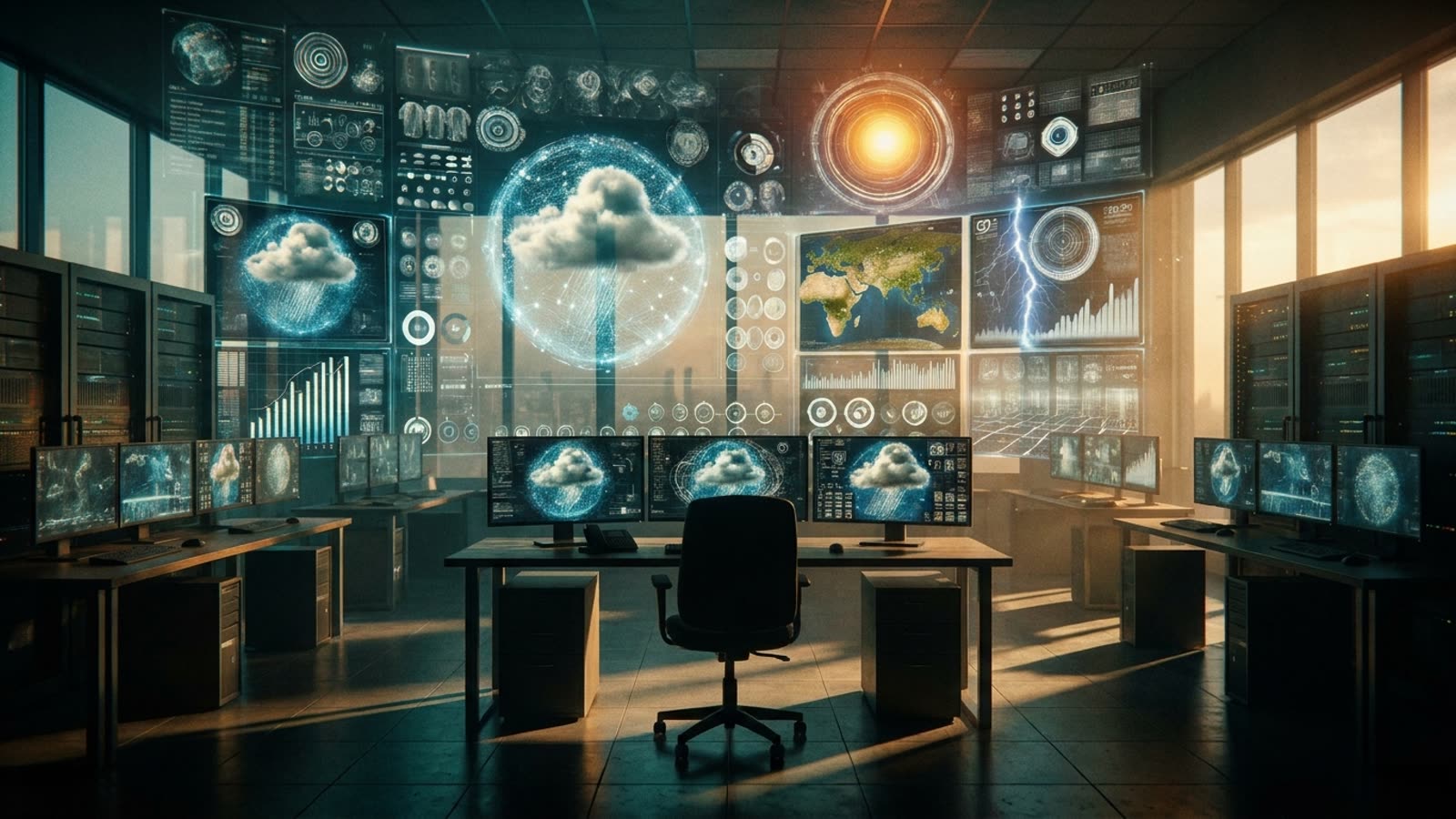
The day-to-day reality for working meteorologists has not yet transformed dramatically, but the trajectory is clear. Many forecasters now consult AI-generated guidance alongside traditional model output, treating it as another ensemble member to weigh. The skill lies in knowing when to trust the new tools and when to override them — a judgment call that still requires deep atmospheric knowledge.
Broadcast meteorologists face a different calculus. Their value has always been partly communicative: translating technical forecasts into actionable information for the public. That role remains, but the underlying analysis they perform is increasingly augmented by systems that can process more data faster than any human. Some see this as liberation from drudgery; others sense the early stages of professional erosion.
The private weather industry — companies serving agriculture, energy, logistics, and insurance — has moved faster. For these clients, accuracy is money, and if a machine learning model can squeeze out an extra day of useful forecast skill for a shipping company rerouting around a storm, the technology will be adopted regardless of whether humans understand its internals.
Our take
Weather forecasting offers a preview of how AI will reshape professions that seem too complex or too physical for automation. The machines are not replacing meteorologists wholesale; they are changing what meteorological expertise means. The forecasters who thrive will be those who learn to collaborate with systems they cannot fully audit, contributing judgment where algorithms offer only probability. It is an uncomfortable partnership, but probably an enduring one — the atmosphere, after all, still does what it wants.