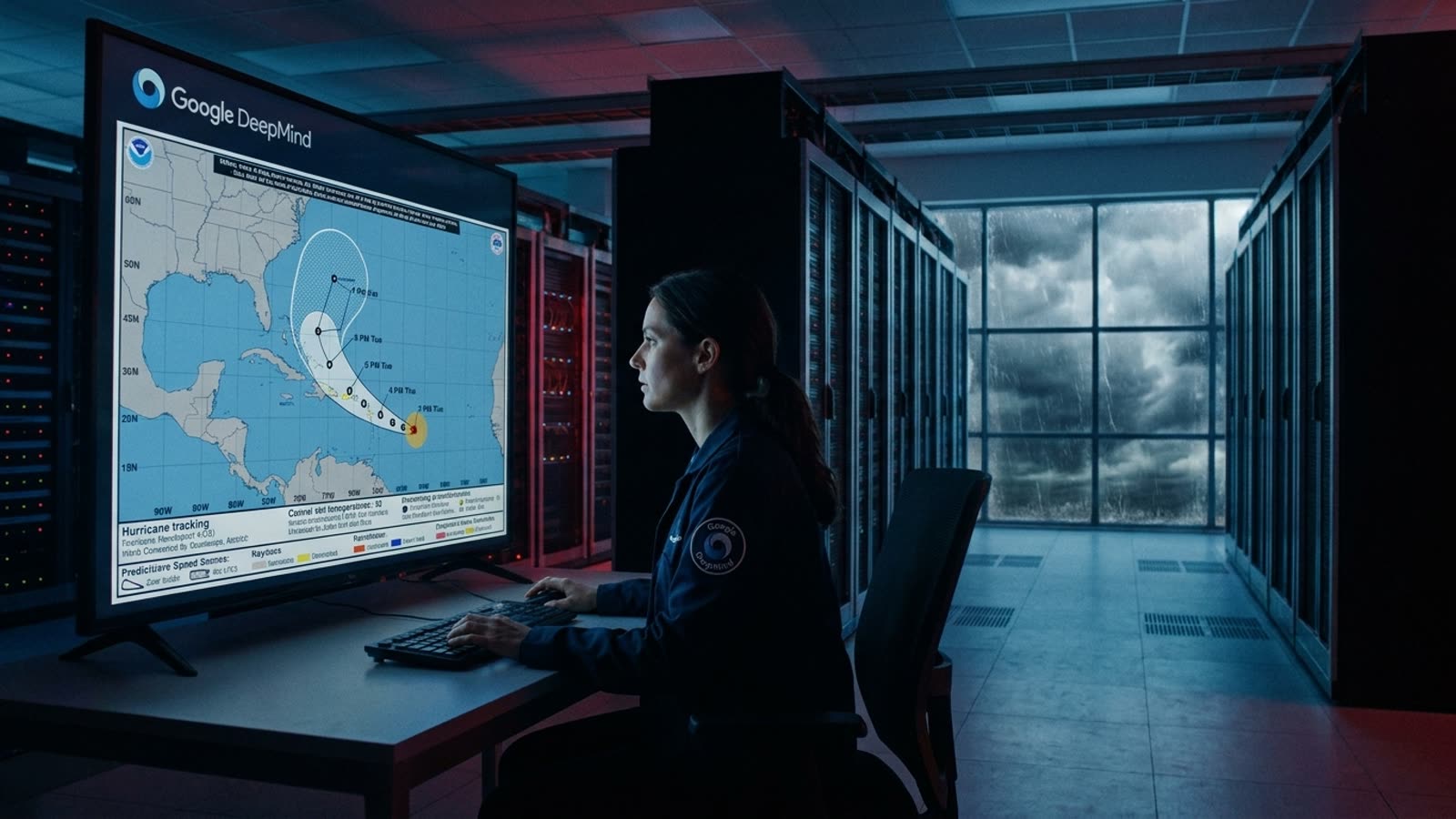
The AI applications that dominate headlines—chatbots that write poetry, image generators that conjure photorealistic fantasies—share a curious trait: they're impressive but not essential. Meanwhile, a quieter revolution has unfolded in one of humanity's oldest scientific pursuits, and it may represent artificial intelligence's most consequential achievement to date.
Weather forecasting, that ancient obsession of farmers and sailors, has been fundamentally transformed by machine learning. The change happened gradually, then all at once, and most people never noticed.
From equations to patterns
Traditional weather prediction relies on numerical weather prediction models—massive systems of differential equations that simulate atmospheric physics. These models divide the atmosphere into a three-dimensional grid and calculate how temperature, pressure, humidity, and wind will evolve at each point. The approach works, but it demands staggering computational resources. Running a ten-day global forecast can require hours on supercomputers consuming megawatts of electricity.
Machine learning models take a radically different approach. Rather than simulating physics from first principles, they learn patterns from decades of historical weather data. Feed them the current state of the atmosphere, and they predict future states directly—not by solving equations, but by recognizing how similar atmospheric configurations have evolved in the past.
The results have been remarkable. Google's GraphCast model, trained on four decades of reanalysis data, can produce ten-day forecasts in under a minute on a single machine. Huawei's Pangu-Weather achieves comparable accuracy. Both match or exceed traditional models on many metrics while using a fraction of the energy.
Why weather worked
Weather forecasting turns out to be an ideal problem for AI in ways that chatbot applications are not. The training data is abundant, high-quality, and objectively verifiable—we know whether it actually rained in Paris on any given Tuesday. The physics, while complex, is deterministic at the scales that matter for forecasting. And crucially, the problem has clear success metrics: either your hurricane track prediction was accurate or it wasn't.
This stands in sharp contrast to large language models, where "success" is often subjective and hallucinations can masquerade as confident expertise. A weather model cannot fabricate a typhoon that never existed; the historical record provides an unforgiving ground truth.
The practical implications extend beyond convenience. More accurate hurricane track forecasts mean smaller evacuation zones, reducing the economic disruption of false alarms while ensuring genuine threats receive appropriate response. Better precipitation predictions help farmers time planting and irrigation. Improved wind forecasts allow grid operators to integrate renewable energy more efficiently.
The limits of learned physics
The revolution is not without caveats. Machine learning models trained on historical data struggle with unprecedented events—the kind of extreme weather that climate change is making more frequent. They can interpolate brilliantly within the distribution of their training data but may falter when the atmosphere enters genuinely novel territory.
Hybrid approaches are emerging to address this limitation, combining the pattern recognition of neural networks with the physical constraints of traditional models. The goal is systems that learn efficiently from data while respecting the fundamental laws that govern atmospheric behavior.
Our take
The weather forecasting breakthrough offers a useful corrective to AI discourse dominated by chatbots and image generators. The most valuable applications of machine learning may not be the most entertaining ones. They're the ones that solve well-defined problems with abundant data and clear success criteria—problems where AI's pattern-matching prowess complements rather than replaces human judgment. Weather prediction suggests that artificial intelligence's greatest contributions might arrive not with fanfare but with quietly improved forecasts, better-timed evacuations, and lives saved by predictions that proved accurate when it mattered most.