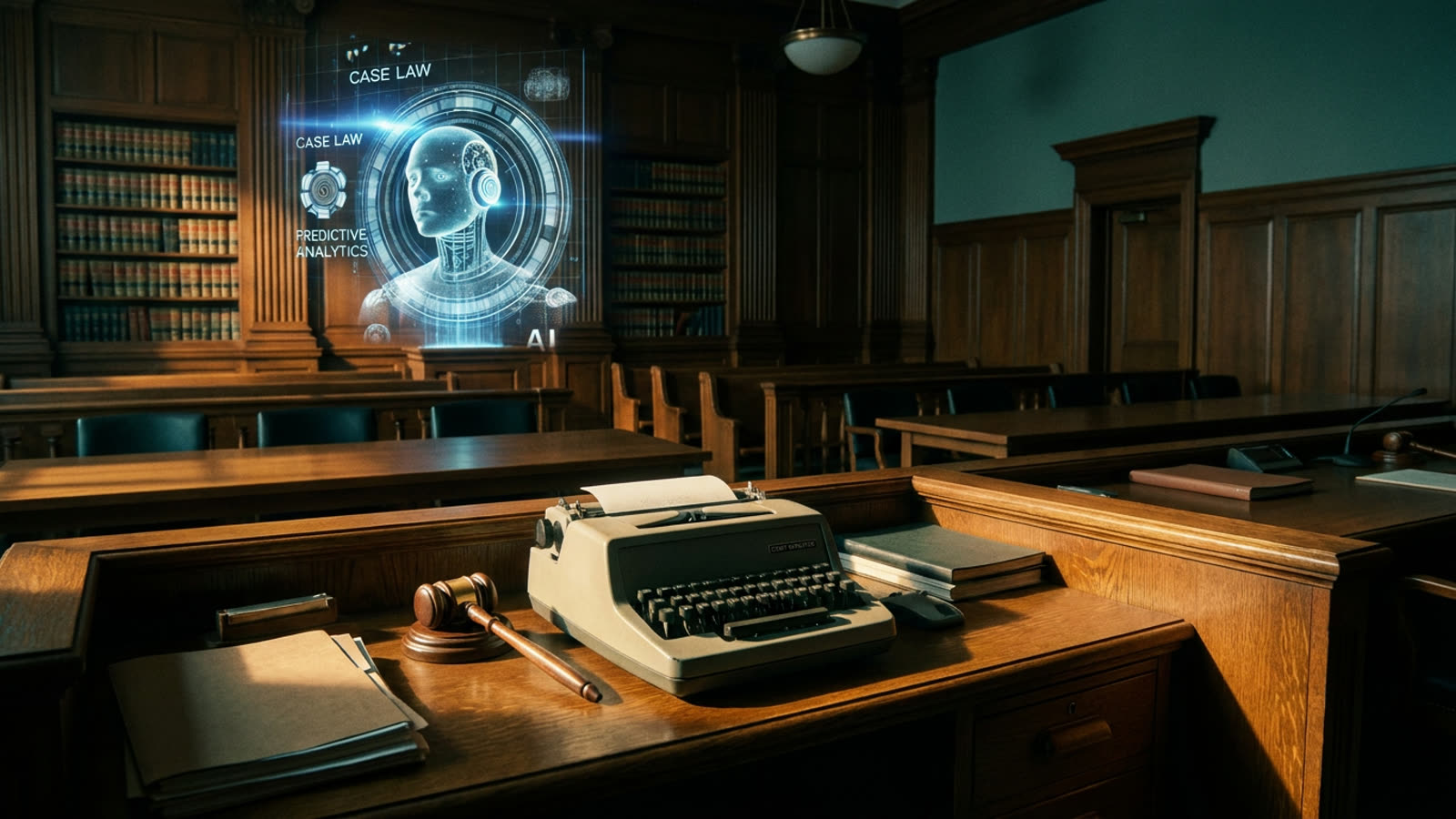
For more than a century, the court reporter has occupied a peculiar position in the American legal system: invisible yet indispensable, producing the verbatim record upon which appeals rise and fall, contracts bind, and testimony becomes permanent. The stenotype machine, with its cryptic chord-based input, required years of training to master and created a professional guild that seemed immune to automation. That immunity has expired.
Modern automatic speech recognition has crossed a threshold that matters. In controlled conditions, the best systems now achieve word error rates below five percent on clear speech — comparable to human transcriptionists working from audio recordings. More significantly, these systems have learned to handle the specific challenges of legal proceedings: overlapping speakers, technical terminology, proper nouns, and the peculiar rhythms of examination and cross-examination. The question is no longer whether AI can transcribe court proceedings, but whether it can do so reliably enough to satisfy the exacting standards of the legal record.
The economics of obsolescence
Court reporting has long faced a supply crisis. The National Court Reporters Association has warned for years that retirements outpace new entrants, with training programs closing and fewer young people willing to invest in mastering a skill that takes three to five years to develop. This shortage created a seller's market: experienced court reporters in major metropolitan areas can command substantial hourly rates, and freelance deposition reporters often earn more than the attorneys examining witnesses.
AI transcription inverts this equation entirely. The marginal cost of machine transcription approaches zero once systems are deployed. Courts facing budget pressures and scheduling backlogs see an obvious solution. Several state court systems have already begun pilot programs using AI transcription for lower-stakes proceedings, with human review reserved for complex or high-profile cases. The pattern is familiar from other industries: automation enters through the low end, improves, and gradually ascends.
What machines still miss
The strongest argument for human court reporters is not accuracy but judgment. A skilled reporter does more than transcribe — she manages the record. When speakers talk over each other, she requests clarification. When testimony becomes inaudible, she notes it immediately rather than leaving gaps to be discovered later. When a witness spells an unusual name, she captures it correctly the first time. She reads back testimony when requested, often from memory, and can distinguish between a witness who said "I did" and one who said "I did?" The punctuation matters. The meaning changes.
AI systems struggle with precisely these edge cases. They cannot interrupt proceedings to request clarification. They have difficulty with strong accents, mumbled speech, and the acoustic chaos of a crowded courtroom. They cannot reliably distinguish between homophone proper nouns without context that may not appear in the audio stream. And they cannot exercise the judgment required when the record itself becomes contested — when attorneys dispute what was actually said and someone must make a determination.
The hybrid future
The most likely outcome is not wholesale replacement but stratification. Routine proceedings — traffic court, small claims, administrative hearings — will increasingly rely on AI transcription with minimal human oversight. High-stakes litigation, criminal trials, and appellate proceedings will retain human reporters, at least for the foreseeable future. The profession will shrink but not disappear, concentrating into a smaller cadre of highly skilled specialists handling the cases where the record truly matters.
This pattern echoes what has happened in translation, medical transcription, and legal research: AI handles volume while humans handle complexity. The stenotype machine will not vanish from courtrooms, but it may become a luxury rather than a necessity — a signal that the proceedings matter enough to warrant human attention to every syllable.
Our take
The court reporter's predicament illuminates something broader about professional work in the age of capable AI. The question is rarely whether machines can do the job — eventually, they usually can — but whether the job contains irreducible elements of human judgment that society decides to preserve. Court reporters have a stronger case than most: the legal record is not merely a transcript but a curated artifact, shaped by thousands of micro-decisions about what to capture and how. Whether that argument prevails against budget pressures and labor shortages will tell us something important about what we value in our institutions of justice.