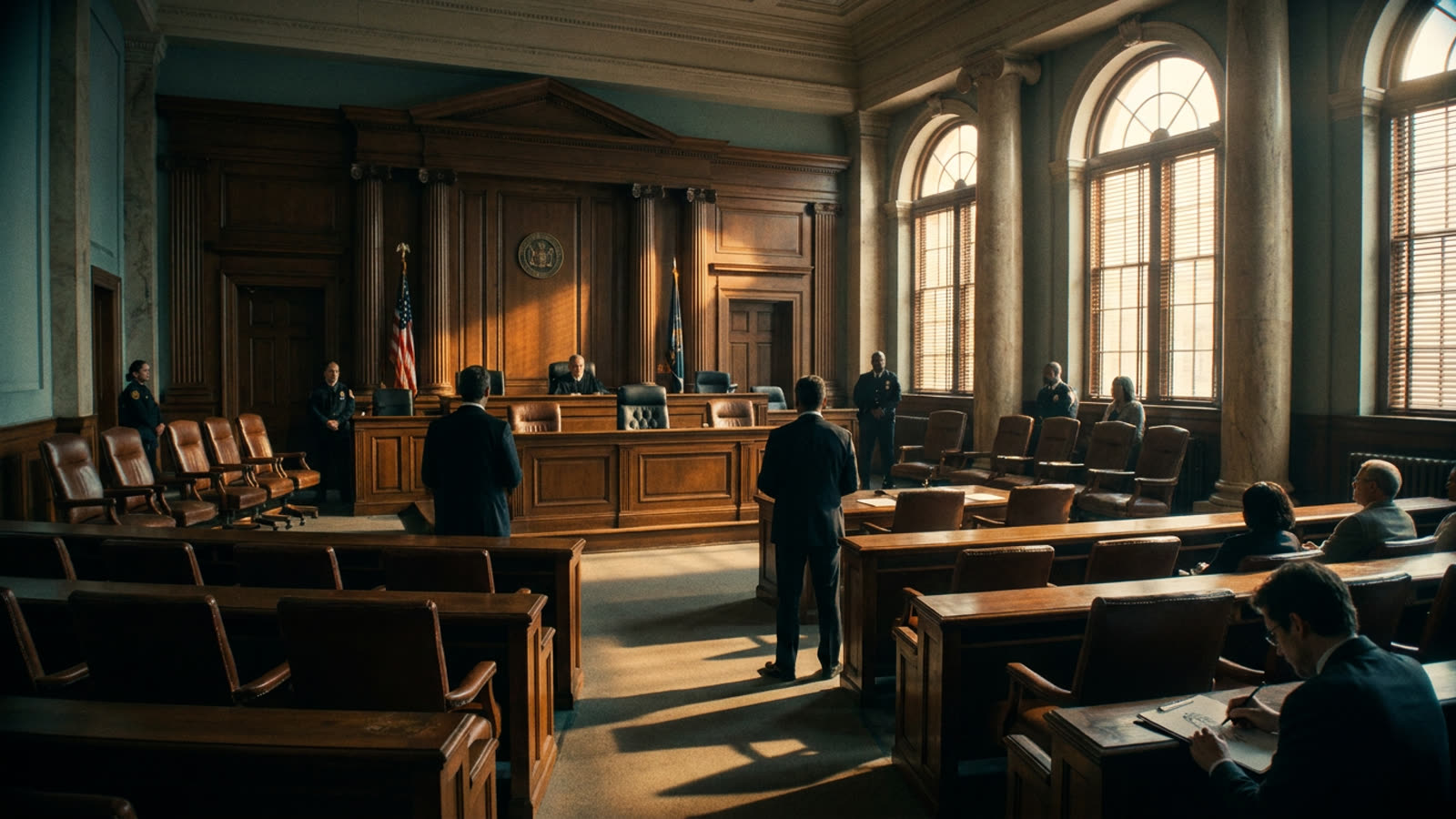
The courtroom sketch artist occupies one of the strangest niches in visual journalism. Cameras are banned from most federal courtrooms and many state proceedings, so these artists—usually numbering fewer than a hundred active professionals in the United States—serve as the public's only visual record of trials that shape law and culture. They work fast, from memory, often completing a portrait in the time it takes a witness to finish a single answer. It is a craft that seems almost designed to resist automation.
And yet AI has arrived in their studios, not as a replacement but as something more interesting: a tool that is subtly reshaping how these artists prepare, practice, and even think about their work.
The memory problem
Courtroom sketching has always been an exercise in controlled chaos. Artists cannot ask subjects to hold still. They cannot take reference photographs. They must absorb a face in seconds, then reconstruct it on paper while simultaneously tracking the emotional tenor of testimony. The best practitioners describe it as a kind of visual shorthand—capturing the essence of a moment rather than its photographic truth.
This is precisely where AI image tools have found an unexpected foothold. Several working courtroom artists now use generative models during preparation, feeding in publicly available photographs of defendants, attorneys, and judges to create synthetic reference images in different lighting conditions and angles. The goal is not to generate the final sketch but to train their own eyes before entering the courtroom. One veteran artist described it as "doing scales before a concert."
The style question
More provocatively, some artists have begun using AI to experiment with stylistic approaches they might never have tried otherwise. Courtroom sketching has a recognizable aesthetic—loose, gestural, often dominated by earth tones—that emerged partly from practical constraints and partly from tradition. AI tools allow artists to see their subjects rendered in radically different styles, from hyperrealistic portraiture to expressionist abstraction, without committing hours to the experiment.
This has sparked quiet debate within the small community. Purists argue that the courtroom sketch's value lies precisely in its handmade imperfection, its evidence of human attention in a moment of legal consequence. Others counter that style has always evolved with technology—from charcoal to pastels to digital tablets—and that AI is simply the latest tool in a long lineage.
What machines still cannot do
The limits remain significant. No AI system can sit in a courtroom and make the instantaneous editorial judgments that define the craft: which moment to capture, which expression reveals character, how to compress hours of testimony into a single image that tells a story. The courtroom sketch is not merely a portrait; it is a piece of journalism, and journalism requires presence, judgment, and accountability.
Moreover, the legal and ethical frameworks around AI-generated courtroom imagery remain entirely unsettled. A sketch created by human hands carries implicit authentication—this artist was there, saw this, rendered it faithfully. An AI-generated image carries no such warranty, and courts have shown little appetite for admitting synthetic visuals into the documentary record.
Our take
The courtroom sketch artist is not going anywhere, but the job is quietly becoming a hybrid practice. AI handles the rote preparation; humans handle the irreducible act of witnessing. This is probably the healthiest possible relationship between the technology and a craft that depends on presence and judgment. The sketch endures because it is evidence of attention, and attention is the one thing machines cannot convincingly fake.