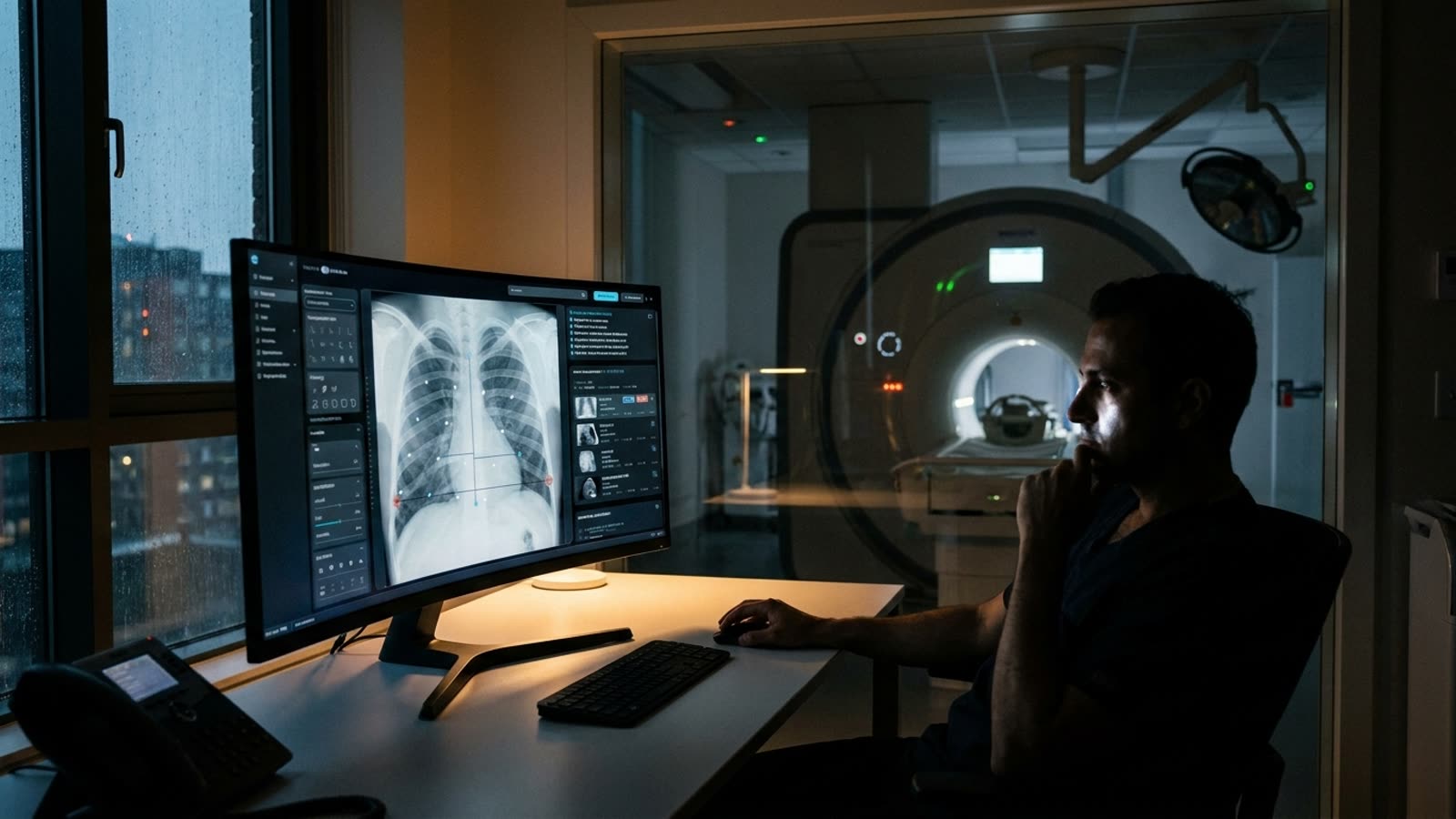
The chest X-ray arrives at 3:47 a.m., uploaded from a rural emergency department three time zones away. Within ninety seconds, software has flagged a suspicious nodule in the upper left lobe, assigned it a probability score, and queued the image for urgent human review. The radiologist who opens the case at dawn will see the AI's annotation first, a glowing circle around tissue that might be nothing or might be everything. She will make the final call. But the algorithm got there first, and that sequence—machine then human—is quietly redefining one of medicine's most cerebral specialties.
Radiology was always going to be the proving ground. The discipline is built on pattern recognition across standardized images, precisely the task at which neural networks excel. Early predictions, some dating back nearly a decade, suggested radiologists would be among the first physicians rendered obsolete. That extinction has not arrived. What has arrived is something more interesting: a profession midway through an identity crisis it did not fully anticipate.
The workflow that changed without a memo
Most major hospital systems in wealthy countries now deploy some form of AI triage in their imaging pipelines. The tools vary—some detect fractures, others flag potential strokes, still others hunt for signs of tuberculosis in resource-limited settings—but the architecture is consistent. Algorithms ingest images, highlight anomalies, and sort cases by apparent urgency. Radiologists then interpret the flagged studies, often without knowing whether they would have spotted the same finding unaided.
This is not replacement; it is reordering. The cognitive sequence has shifted from pure discovery to verification and refinement. Younger radiologists report that their training now includes learning when to trust the machine's judgment and when to override it, a skill set that did not exist a generation ago. The job has become, in part, quality control for software that cannot articulate its reasoning.
The black-box problem in high-stakes medicine
Herein lies the tension. Diagnostic AI systems are trained on millions of images, but their internal logic remains largely opaque. When an algorithm circles a shadow on a mammogram, it cannot say why—only that the pattern statistically resembles patterns previously labeled malignant. Radiologists, by contrast, are trained to narrate their reasoning, to document the features that led them to a conclusion. The legal and ethical frameworks of medicine assume a human who can explain.
This mismatch creates a peculiar professional anxiety. Radiologists increasingly find themselves responsible for judgments they did not initiate and cannot fully interrogate. If the AI misses a tumor and the physician, trusting the negative screen, moves on, who bears the liability? If the AI flags a benign cyst as suspicious and the patient undergoes an unnecessary biopsy, who absorbs the cost—financial and emotional? These questions have no settled answers, and the ambiguity is shaping how radiologists relate to their own expertise.
What the machines still cannot do
For all the sophistication, current AI systems remain narrowly specialized. A tool trained to detect lung nodules knows nothing about the patient's smoking history, family context, or the subtle signs of anxiety visible in how they described their symptoms to the referring physician. Radiologists synthesize clinical narratives; algorithms process pixels. The gap is not trivial.
Moreover, the best diagnostic work often happens at the edges—rare presentations, atypical anatomy, the lesion that does not fit any training distribution. These are precisely the cases where AI confidence scores drop and human judgment becomes indispensable. The profession is not disappearing; it is migrating toward the exceptions, the ambiguities, the moments when pattern recognition alone is insufficient.
Our take
Radiology offers a preview of how AI will infiltrate other knowledge professions: not through dramatic displacement but through quiet renegotiation of what the human is actually for. The radiologist of the near future is less a first-pass scanner and more a contextual interpreter, a liaison between algorithmic suspicion and clinical reality. Whether that represents an elevation or a diminishment depends on whom you ask. What seems certain is that the profession will survive—but the professionals who thrive will be those who learn to collaborate with a colleague that works faster, never tires, and never once explains why it thinks what it thinks.