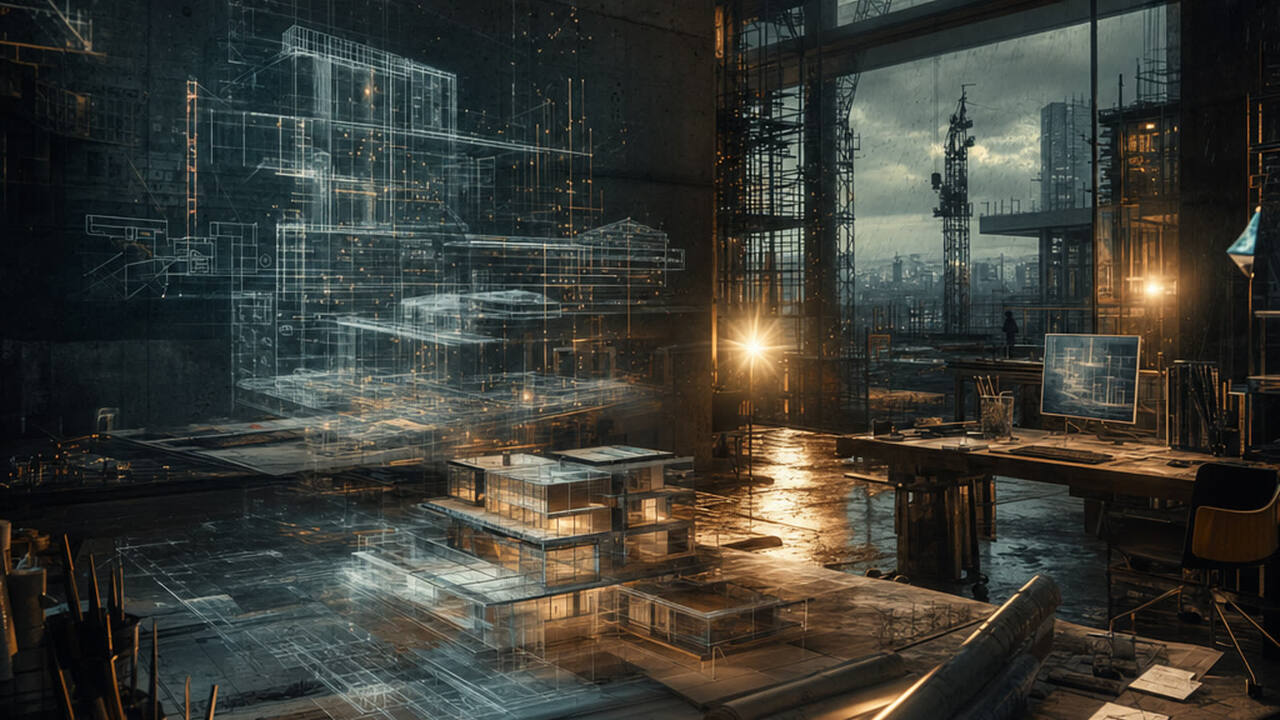
The rendering arrived faster than the coffee. A junior architect at a mid-sized firm in Copenhagen recently described her morning routine: she types a few constraints into a generative design tool—site dimensions, local zoning codes, client's preference for natural light, budget ceiling—and by the time she returns from the break room, the software has produced forty-seven massing options, each structurally plausible, each code-compliant. Her job, increasingly, is to decide which one deserves to exist.
This is not the future. This is Tuesday.
From author to editor
Architecture has always been a profession of constraints. Gravity, budgets, regulations, and client whims conspire to limit what any designer can actually build. But the creative act—the moment when a concept emerges from the fog of possibility—has traditionally belonged to the human mind. That is changing. Generative AI tools now handle the combinatorial grunt work that once consumed weeks of a studio's time. They explore solution spaces that no human team could traverse manually, surfacing options that are mathematically optimal for energy efficiency, structural economy, or pedestrian flow.
The result is a subtle but profound shift in the architect's role. Where once the designer was an author, she is increasingly an editor—selecting, refining, and humanizing proposals that originate in silicon. Some practitioners find this liberating; freed from the drudgery of iteration, they can focus on the ineffable qualities that make a building feel right. Others find it existentially unsettling. If the machine can generate a thousand competent schemes before lunch, what exactly is the architect's value?
The taste problem
The answer, for now, lies in taste. Generative models optimize for measurable criteria, but architecture is not reducible to metrics. A building must satisfy the soul as well as the spreadsheet. It must age gracefully, respond to cultural context, and occasionally break rules in ways that feel inevitable rather than arbitrary. These judgments remain stubbornly human. The AI can propose a façade that maximizes daylight and minimizes material cost; it cannot yet tell you whether that façade will make passersby pause in admiration or hurry past in discomfort.
But taste is a moving target. As architects grow accustomed to machine-generated options, their aesthetic instincts may begin to converge around what the tools make easy. There is already anecdotal evidence of a certain sameness creeping into competition entries—smooth, parametric forms that betray their algorithmic parentage. The risk is not that AI will replace architects, but that it will homogenize them.
The apprenticeship question
Perhaps the deepest concern is pedagogical. Architecture has long been taught through apprenticeship: young designers learn by doing, by making mistakes, by slowly internalizing the intuitions of their mentors. If the early-career tasks are automated, how will the next generation develop judgment? A junior architect who spends her days curating machine outputs may never build the muscle memory that comes from wrestling with a stubborn floor plan by hand. The profession risks producing a cohort of fluent critics who have never truly designed anything themselves.
Our take
Generative AI will not kill architecture; it will reveal what architecture is actually for. If the discipline is merely problem-solving under constraints, the machines will win. If it is something more—a form of cultural expression, a negotiation between human desire and physical reality—then the architect's role will endure, transformed but not diminished. The pencil is learning to think. The question is whether the hand still has something to say.