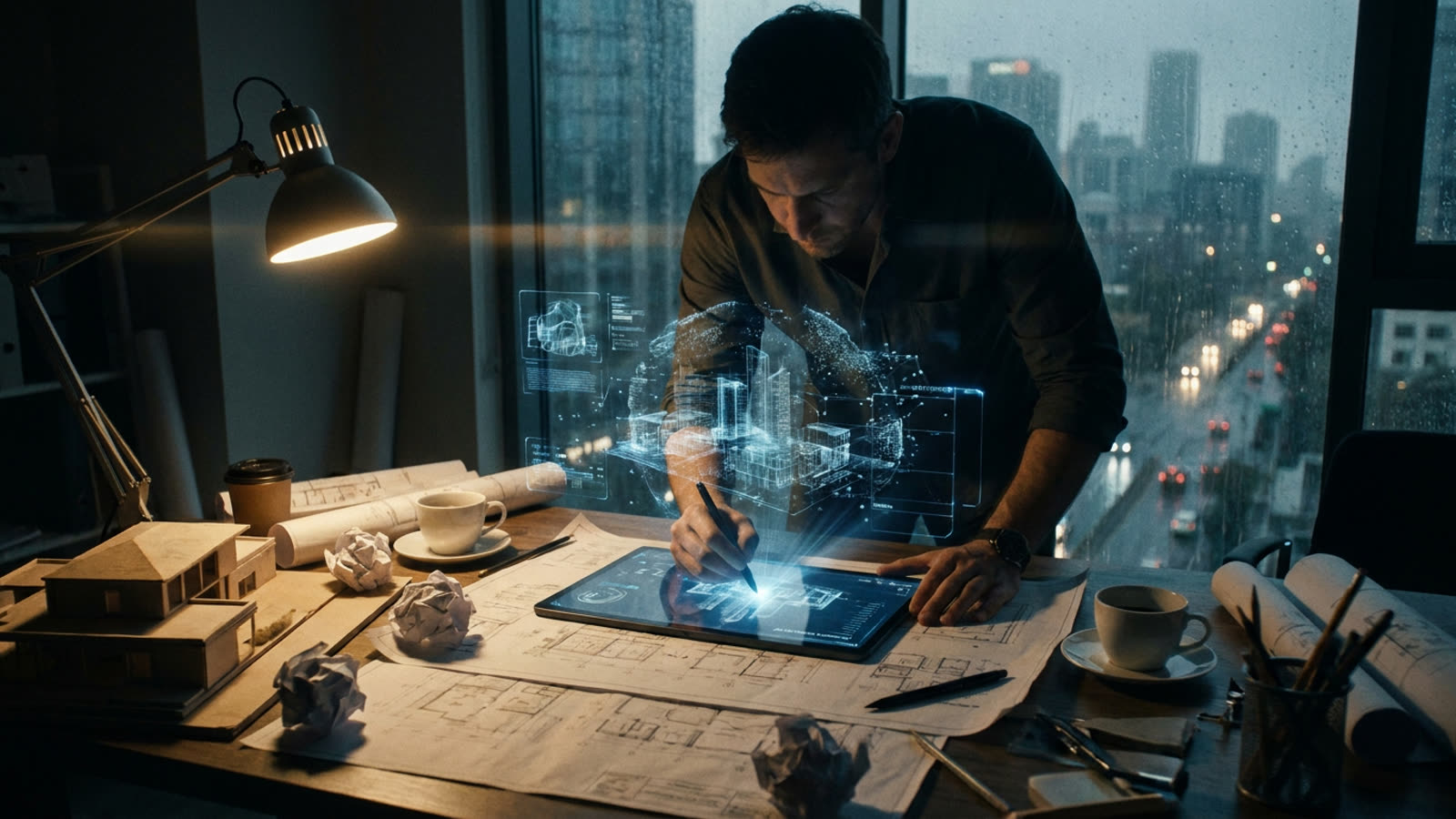
For most of the twentieth century, becoming an architect meant learning to draw. Hours spent over drafting tables, developing the muscle memory to translate spatial imagination into precise lines on paper. Computer-aided design changed the medium but not the fundamental act: architects still drew, just with mice instead of pencils. Generative AI is doing something different. It is making the architect less of a maker and more of a judge.
The shift is happening in studios around the world, often without fanfare. A designer types a description of a residential project—site constraints, budget parameters, stylistic preferences—and receives dozens of massing options in minutes. Another feeds an AI tool the program requirements for a hospital wing and watches it generate floor plan variations that would have taken a junior associate weeks to sketch. The work product looks familiar. The workflow does not.
From generation to selection
The core change is temporal. Traditional architectural design is slow and iterative: sketch, evaluate, revise, repeat. Each option represents hours of human effort, which naturally limits how many alternatives get explored. Generative tools collapse this cycle. When producing a concept takes seconds rather than days, the bottleneck moves from creation to evaluation. Architects find themselves reviewing hundreds of options, developing new skills in rapid assessment and systematic comparison.
This sounds like liberation, and sometimes it is. Firms report exploring design directions they would never have had time to consider. But it also introduces new anxieties. How do you know when you have seen enough options? How do you maintain a coherent design vision when the machine offers infinite variations? Some architects describe a kind of decision fatigue, a paralysis that comes from too much choice rather than too little.
The knowledge question
Architecture has always been a discipline of accumulated knowledge—building codes, structural principles, material properties, historical precedents. Traditionally, this knowledge lived in the architect's head, built up over years of education and practice. AI tools now encode much of this information, surfacing relevant precedents, flagging code violations, suggesting structural solutions.
The optimistic view holds that this frees architects to focus on higher-order concerns: client relationships, spatial experience, cultural meaning. The skeptical view worries about deskilling. If young architects never learn to solve problems manually, do they develop the judgment to evaluate AI-generated solutions? The profession is grappling with what knowledge remains essential when so much can be outsourced.
The liability frontier
Buildings must stand up. They must not catch fire. They must allow people to escape in emergencies. These are not suggestions but legal requirements, and architects stake their professional licenses on meeting them. When an AI tool generates a design, who bears responsibility for its compliance?
The answer, for now, is still the architect. Professional liability has not changed, even as the tools have. This creates an uncomfortable asymmetry: AI accelerates production but does not share accountability. Firms are developing new quality-control protocols, treating AI output as a starting point requiring human verification rather than a finished product. The result is a new layer of checking that partially offsets the efficiency gains.
Our take
Architecture is not dying; it is metamorphosing. The profession that emerges will likely be smaller at the production level and more concentrated at the judgment level. The architects who thrive will be those who develop what might be called curatorial intelligence: the ability to recognize quality among infinite options, to impose coherence on algorithmic abundance, to know when the machine has found something worth building. This is still a creative skill, but it is a different creative skill than the one architecture schools have taught for generations. The pencil is not gone, but it is no longer the point.