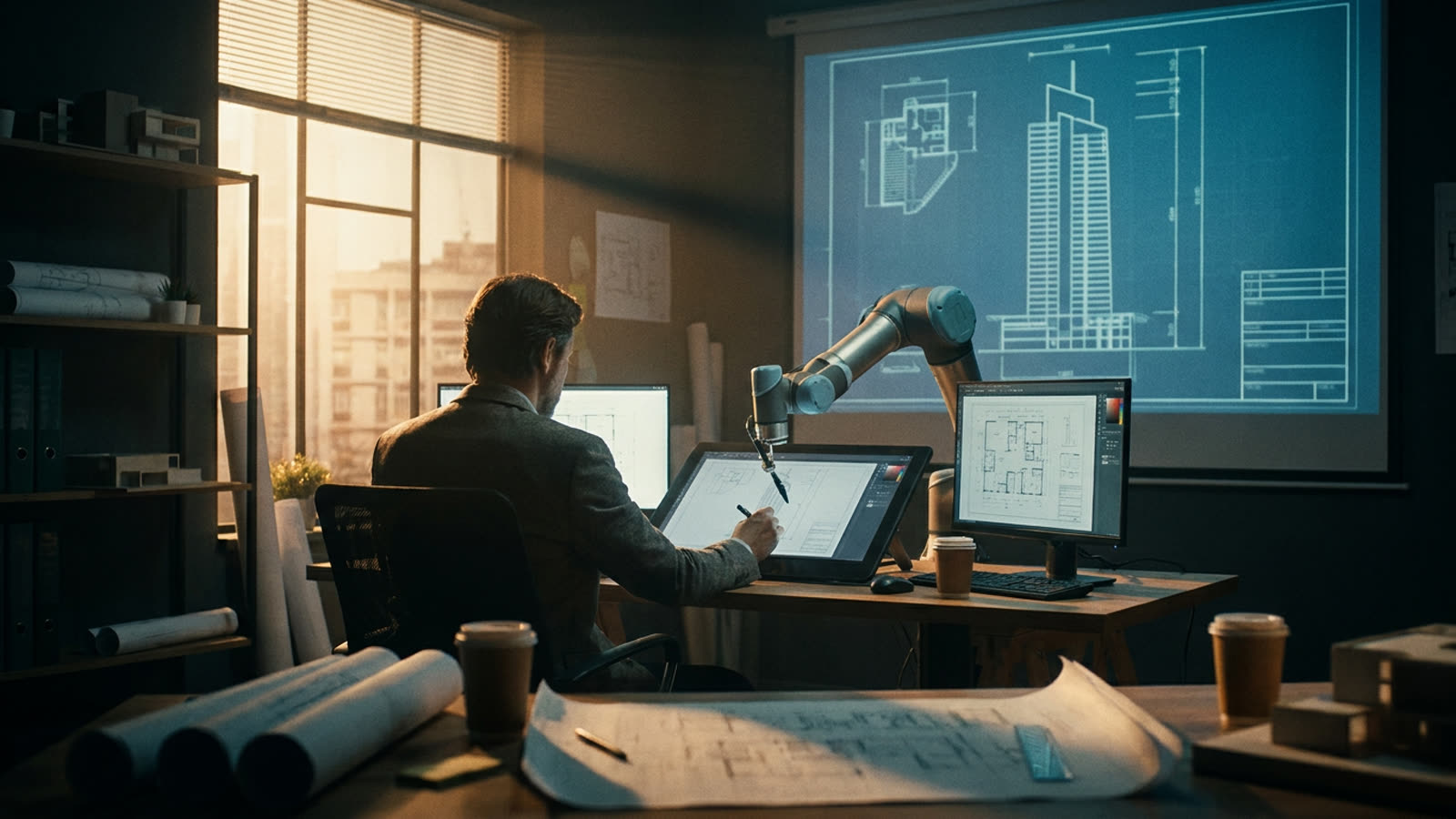
For most of the twentieth century, becoming an architect meant mastering a specific physical grammar: the T-square, the parallel rule, the Rapidograph pen. Then came computer-aided design, which digitized the drafting table but preserved its logic. Now a third transformation is underway, and it may prove more disruptive than either predecessor. Generative AI is turning architecture into a discipline where the primary skill is no longer producing drawings but evaluating them.
The shift is subtle but pervasive. At firms large and small, designers increasingly begin projects by feeding text prompts into AI tools that generate dozens of massing studies, façade variations, or floor plan options in minutes. What once required days of sketching now happens before the first coffee break. The architect's role tilts from creator to curator, sifting through machine-generated possibilities to find the seed of something worth developing.
The economics of iteration
Architecture has always been expensive because it is slow. A single residential project might consume hundreds of hours before a client sees anything resembling a finished design. AI collapses that timeline dramatically. Early-stage conceptualization that once justified substantial fees can now be accomplished in an afternoon, which puts downward pressure on the billing structures that have sustained mid-sized firms for decades.
The winners, at least initially, are clients and the largest practices. Clients get more options faster; mega-firms can absorb AI tools into existing workflows and redeploy junior staff toward higher-value tasks. Smaller studios face a harder calculus. They can adopt the same tools, but doing so erases one of their traditional advantages: the willingness to spend proportionally more time on bespoke design thinking.
What the machine cannot see
For all its speed, generative AI remains architecturally illiterate in important ways. It can produce images that look like buildings but has no understanding of structural loads, building codes, or the way morning light falls through a clerestory window. It cannot walk a site, smell the soil, or sense why a neighborhood feels the way it does. These limitations mean that AI output requires substantial human refinement before it becomes buildable—a fact that preserves the architect's relevance even as it redefines the job.
The more interesting question is cultural. Architecture schools have long treated the iterative struggle of design—the crumpled paper, the sleepless nights—as formative. If students can generate a hundred options before lunch, does that discipline erode? Or does it liberate them to focus on judgment, critique, and the irreducibly human act of deciding what a building should mean?
Our take
Architecture is not about to be automated out of existence, but it is being restructured in ways the profession has barely begun to acknowledge. The pencil was a tool that rewarded patience; the prompt rewards speed and discernment. That is neither tragedy nor triumph—it is simply a new set of constraints, and constraints have always been where good architecture begins. The firms and schools that thrive will be those that treat AI as a collaborator demanding sharper human judgment, not a shortcut that makes judgment optional.