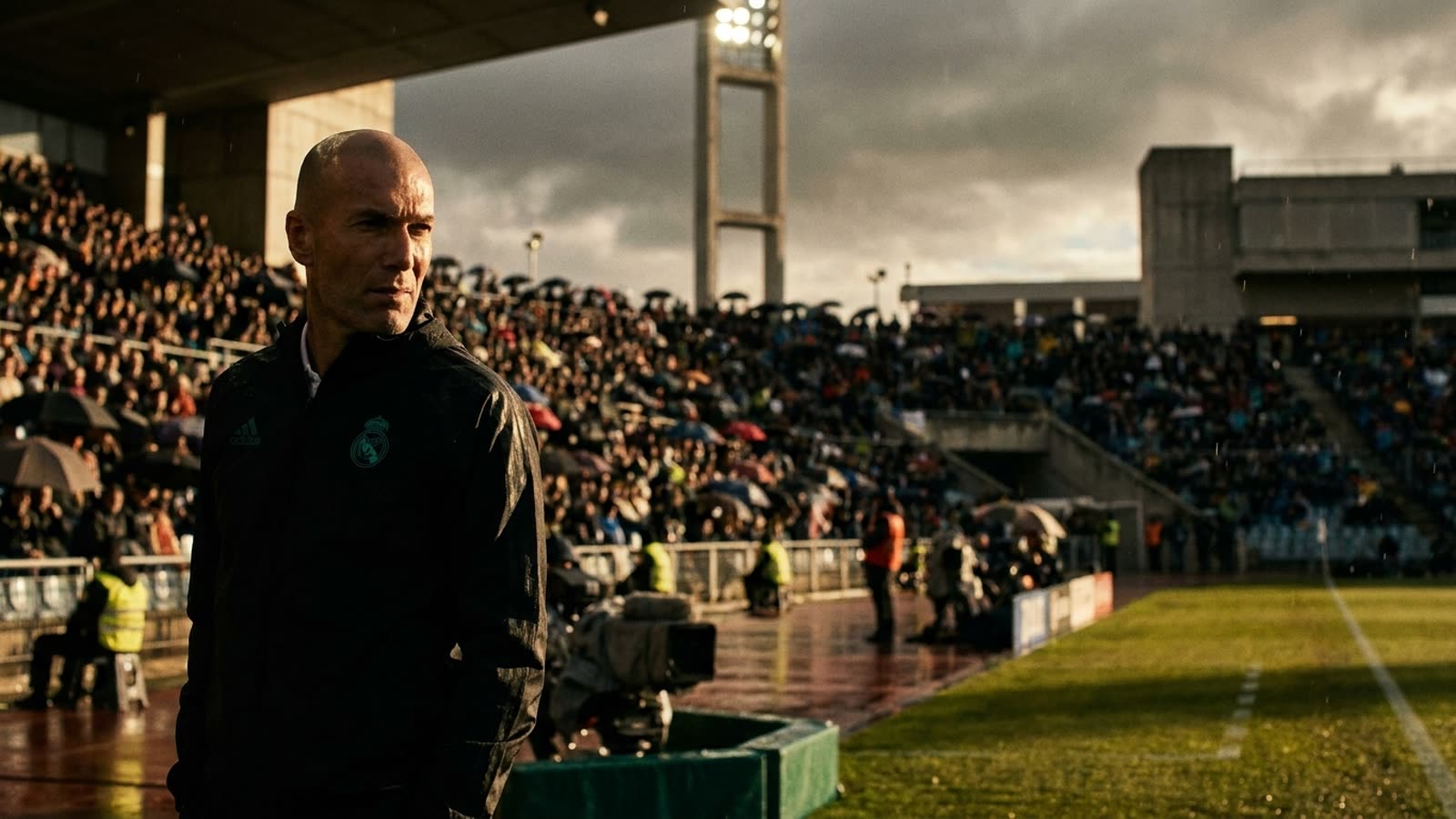
There are exits, and then there is walking off the pitch in a World Cup final, past the trophy you will never touch, because you have just headbutted a man in the chest. Zinedine Zidane's career ended not with a coronation but with a red card, and the image of him descending the tunnel in Berlin — shoulders slightly hunched, face unreadable — has calcified into one of sport's great Rorschach tests.
The facts are not in dispute. Extra time, 1-1 against Italy, Zidane already the author of a nerveless Panenka penalty. Marco Materazzi said something. Zidane turned, walked back, and drove his forehead into Materazzi's sternum with the deliberate force of a man who had made a decision. The fourth official saw it. Red card. France lost on penalties. Zidane retired.
The provocation and its limits
Materazzi later confirmed the insult involved Zidane's sister, though the precise wording has shifted across retellings. The Italian has never shown remorse; Zidane has never claimed his response was proportionate. What makes the incident so endlessly discussed is not the question of who was wrong — both were — but the chasm between stimulus and response. Zidane was thirty-four, had won everything, and was playing the final match of his life. He knew the stakes. He did it anyway.
This is what separates the headbutt from ordinary sporting violence. It was not impulsive in the way a shove in a scrum is impulsive. Zidane disengaged, walked several paces, then returned. There was a pause, a choice, a commitment. The man who had spent two decades controlling tempo on the pitch could not control himself for nine more minutes.
Zidane before the headbutt
To understand the shock, you must remember the player. Zidane was not merely talented; he was elegant in a way that seemed to rebuke the sport's chaos. The roulette, the cushioned first touch, the sense that the ball arrived at his foot already knowing where it would go next. He had scored twice in the 1998 final to deliver France its first World Cup. He had produced perhaps the greatest goal in Champions League history, that volley against Bayer Leverkusen, struck with the outside of his left foot as if physics were a suggestion.
But there had always been another Zidane, glimpsed in red cards and suspensions, a man capable of stamping on a prone opponent or headbutting an adversary in a club match. The violence was never random; it was triggered, personal, retaliatory. Zidane's genius and his temper shared a root: an intensity that made half-measures impossible.
Why it still matters
The headbutt endures because it refuses to be a parable. It is not a story about the dangers of provocation, because Materazzi's words, however vile, did not compel Zidane's skull. It is not a story about redemption, because Zidane has never sought to reframe it as anything other than what it was. It is not even, really, a cautionary tale, because Zidane's post-playing career — successful stints managing Real Madrid, three consecutive Champions League titles — suggests the world forgave him long ago, if it ever blamed him at all.
What it is, perhaps, is a reminder that greatness does not confer immunity from the self. Zidane at his best was a player who seemed to exist outside time, who saw passes before they materialized. Zidane at his worst was a man who could not let an insult pass, even when everything he had worked for hung in the balance. These were not two different people. They were the same person, and that is the uncomfortable truth the headbutt forces us to confront.
Our take
We do not need to excuse Zidane to find the moment fascinating, nor do we need to condemn him to acknowledge its cost. The headbutt was wrong, and it was also, in some irreducible way, honest — a refusal to perform the serene detachment athletes are supposed to embody in crisis. Zidane chose his dignity over his legacy, or at least over one version of it. That he was wrong to do so does not make the choice less human. It makes it more so.