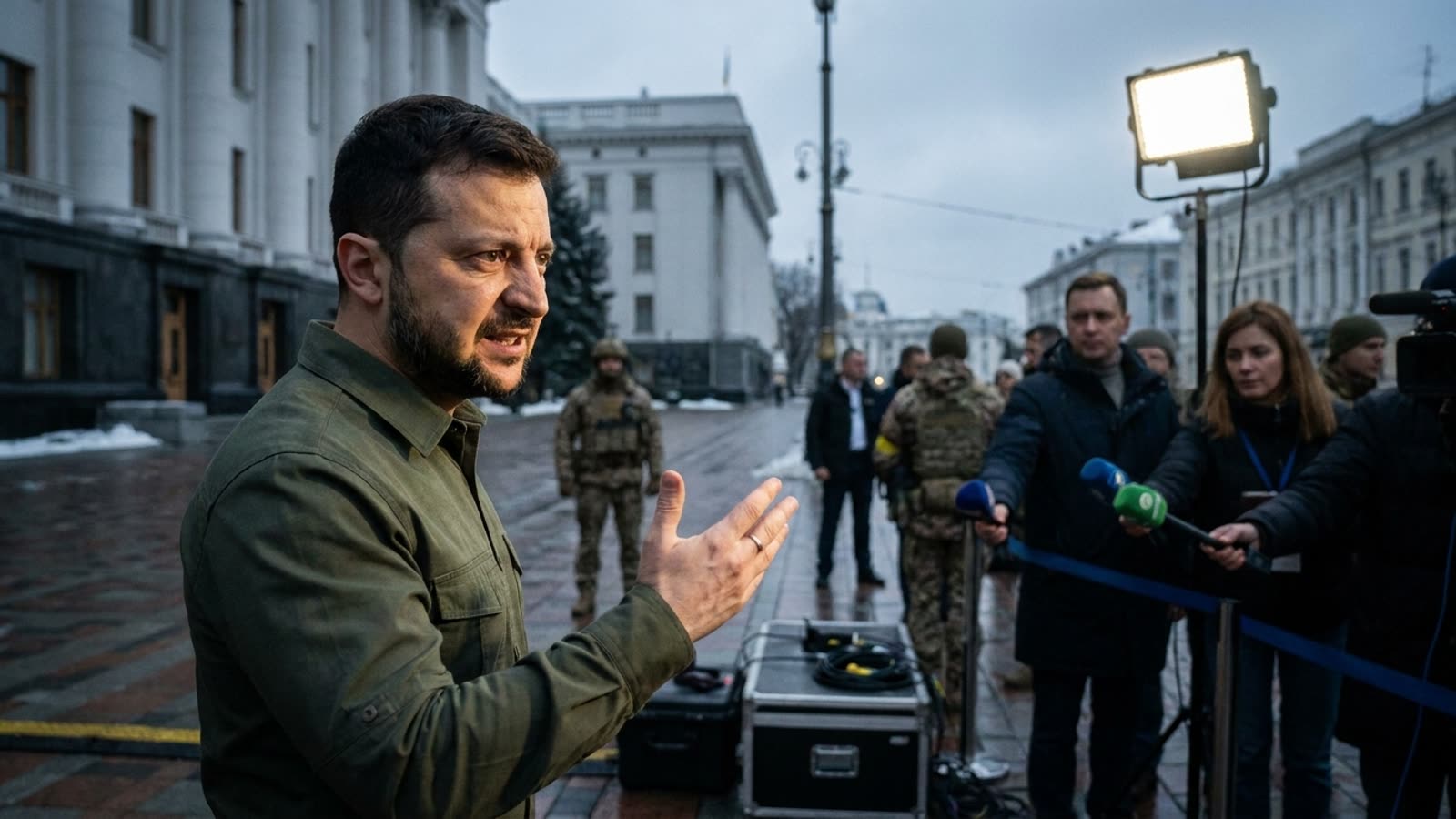
Volodymyr Zelenskyy has finally said aloud what Ukrainian officials have been murmuring for months: associate membership in the European Union is not a reward for three years of war—it is a polite demotion. In an exclusive interview, the Ukrainian president called the proposal "unfair," a diplomatic grenade lobbed directly at the bloc's leadership in Brussels. The timing is no accident. With the Trump administration openly questioning the value of continued support and European capitals hedging their commitments, Zelenskyy is betting that public pressure can accomplish what quiet diplomacy has not.
The gamble is understandable. Ukraine has paid in blood for its European orientation—hundreds of thousands of casualties, cities reduced to rubble, an economy that has contracted by a third. The EU, meanwhile, has offered candidate status, rhetorical solidarity, and now the prospect of a waiting room with no clear exit. Associate membership, as currently conceived, would give Ukraine access to some single-market benefits while denying it voting rights, agricultural subsidies, and the security guarantees that come with full integration. It is, in essence, the participation trophy of geopolitics.
Brussels' institutional bind
The EU's hesitation is not purely cynical. Enlargement is genuinely difficult—the bloc's decision-making apparatus already struggles with 27 members, and adding a country of 40 million with an active war on its territory would strain every institution from the Commission to the Court of Justice. There are legitimate concerns about agricultural competition, labor migration, and the fiscal burden of reconstruction. But these concerns existed before February 2022, and they will exist after the war ends. The question is whether Europe's institutional caution has become an excuse for strategic drift.
The associate membership proposal emerged as a compromise between member states eager to reward Ukraine and those terrified of the commitment full membership would entail. Germany and France have been notably cautious, while Poland and the Baltic states have pushed for faster integration. The result is a lowest-common-denominator solution that satisfies no one—least of all the Ukrainians who were promised a European future in exchange for fighting a European war.
The leverage problem
Zelenskyy's public frustration is strategically risky. Ukraine's negotiating position depends on maintaining Western unity, and openly criticizing EU leadership could alienate the very officials who control the accession timeline. But the Ukrainian president may have calculated that unity is already fraying and that silence has not produced results. The Trump administration's recent overtures to Moscow, combined with European war fatigue, suggest that Kyiv's window for extracting concessions is narrowing.
The deeper problem is structural. Ukraine needs Europe more than Europe needs Ukraine—or at least, more than European politicians believe they need Ukraine in the short term. This asymmetry has always existed, but it becomes more pronounced as the war drags on and Western publics grow weary of the costs. Zelenskyy's leverage was greatest in the first months of the invasion, when Ukrainian resistance exceeded all expectations and Western leaders were eager to be seen on the right side of history. Three years later, the moral clarity has faded, replaced by budget negotiations and election cycles.
Our take
Zelenskyy is correct that associate membership is unfair—a country that has sacrificed more for European values than most EU members deserves better than a consolation prize. But being right is not the same as being effective. The hard truth is that Ukraine's path to full EU membership runs through reconstruction, institutional reform, and the eventual end of active combat—none of which Kyiv can control on its own timeline. Zelenskyy's public break with Brussels is a sign of desperation as much as principle, and desperation rarely improves one's bargaining position.