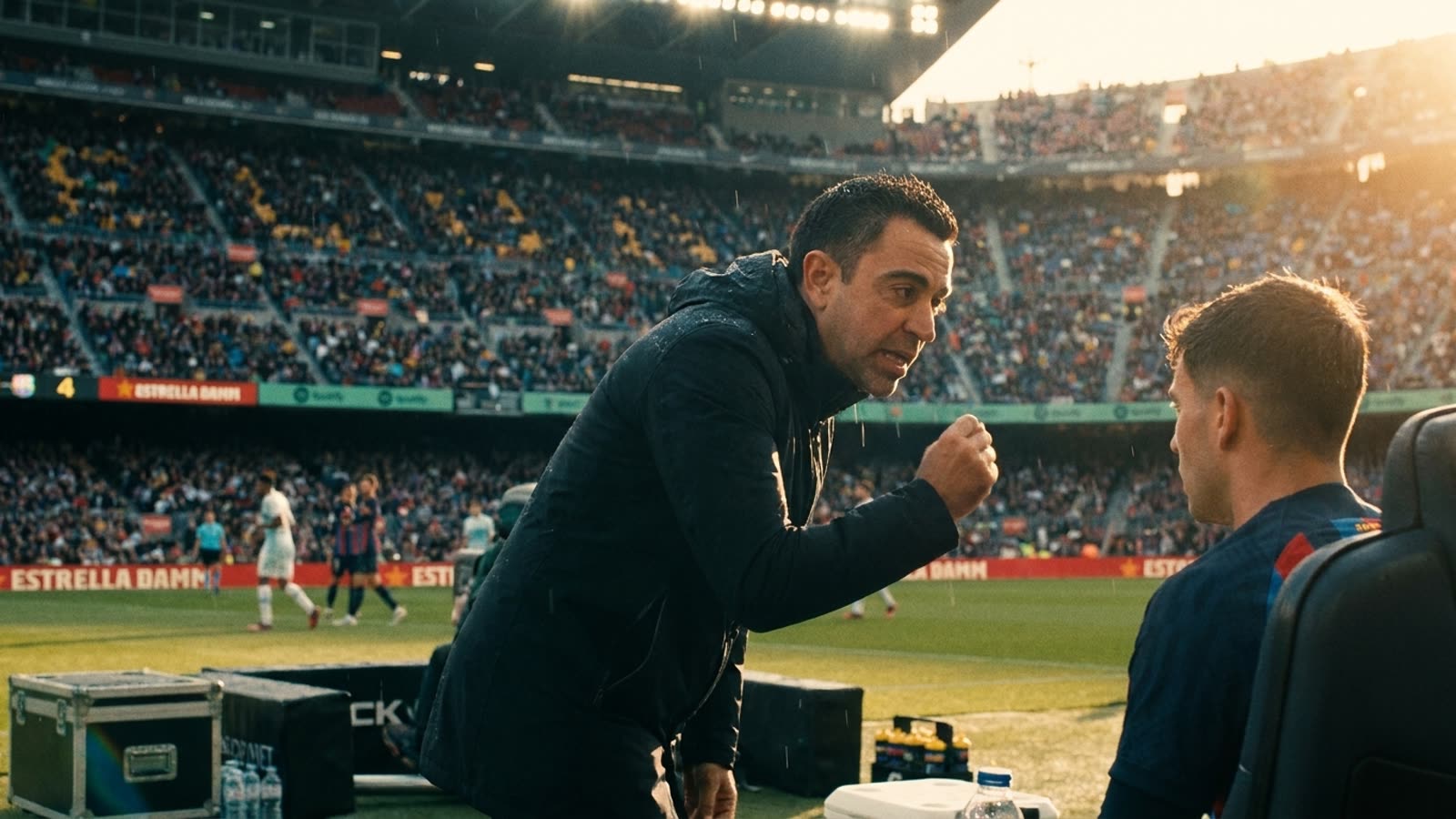
There is a particular kind of genius that looks, from the outside, like nothing is happening at all. Xavi Hernández spent his career receiving the ball, turning his body a few degrees, and passing to a teammate. He did this thousands of times, in matches that Barcelona and Spain won with numbing regularity. Watching him was like watching someone complete a crossword puzzle — technically impressive, perhaps, but where was the drama?
The drama was in what didn't happen. The counterattack that never materialized because Xavi had already recycled possession. The defensive scramble that never occurred because the ball was always moving, always probing, always exactly where it needed to be. His genius was prophylactic: he prevented chaos by imposing order.
The geometry of dominance
Xavi's gift was spatial. He seemed to carry a mental map of the pitch that updated in real time, showing not just where players were but where they would be in two or three seconds. His body orientation — the famous "shoulder check" he performed before receiving the ball — was a data-gathering exercise. By the time the pass arrived, he had already processed his options and selected the optimal one.
This sounds mechanical, and in a sense it was. Xavi reduced football's beautiful chaos to a series of correct answers. But the execution required something beyond mere intelligence: a preternatural calm under pressure, a first touch so reliable it seemed automated, and the arrogance to believe that keeping the ball was always preferable to risking it.
His partnership with Andrés Iniesta at Barcelona, and later with Sergio Busquets in a triumvirate that dominated world football, created a midfield that opponents simply could not press. The ball moved too quickly, the triangles reformed too smoothly, and the possession became suffocating. Teams would chase shadows for entire halves, their pressing triggers never activated because there was never a moment of vulnerability to exploit.
The World Cup as validation
Spain's World Cup triumph in South Africa represented the ultimate vindication of Xavi's philosophy. Here was a team without a traditional target striker, without pace on the wings, without the physical intimidation that had characterized previous champions. What Spain had was Xavi, dictating tempo from the center circle, turning every match into an extended training exercise in positional play.
The final against the Netherlands was ugly, violent, and tense — everything Xavi's football was supposed to eliminate. Yet Spain won because, even amid Dutch provocation, the midfield kept its composure. The winning goal came, fittingly, from Iniesta, but the buildup was pure Xavi: patient, precise, inevitable.
Our take
Xavi's legacy is complicated by the subsequent struggles of both Barcelona and Spain to replicate his success. It turns out that possession football without Xavi is just passing for its own sake — a means mistaken for an end. What he provided was not a system but a sensibility, an understanding of football's geometry that cannot be coached into players who lack his spatial intelligence. The game has moved on, pressing has grown more sophisticated, and pure possession is no longer sufficient. But watching Xavi at his peak remains instructive: a reminder that football, beneath its chaos, has a logic, and that some players can see it more clearly than the rest of us.