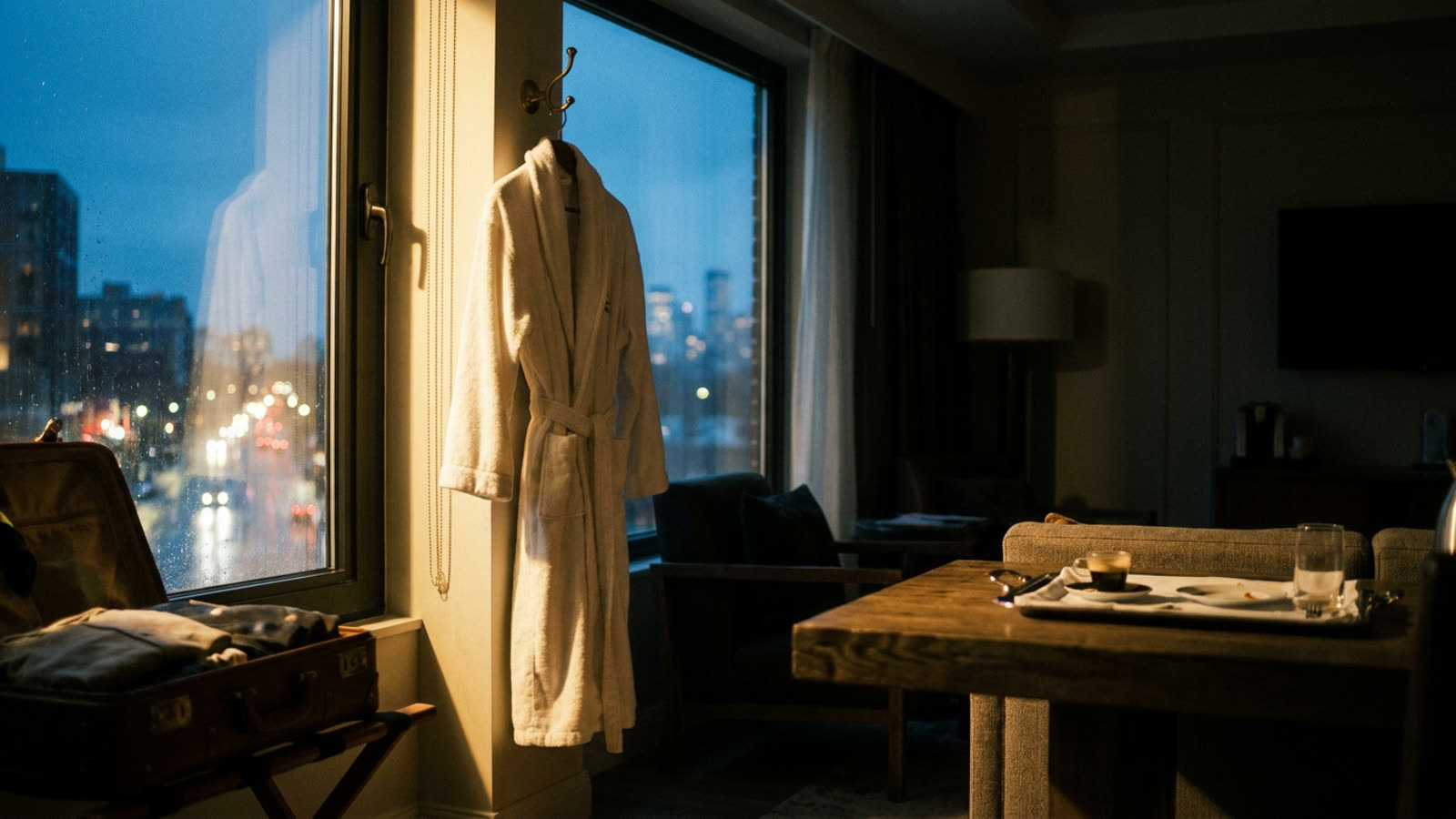
The moment you check into a hotel room that costs more than your first apartment's monthly rent, you will find it waiting: the bathrobe, hung with ceremonial precision, promising transformation from harried traveler into the kind of person who has time to lounge.
This is no accident. The hotel bathrobe has evolved from functional textile to carefully engineered status symbol, and the journey tells us more about contemporary aspiration than any trend report could.
The anatomy of aspiration
The modern luxury hotel robe operates on multiple psychological registers simultaneously. There is the tactile dimension—the weight of the fabric, the density of the terry loops, the particular softness that suggests expense without requiring you to check the thread count. Then there is the visual semiotics: the embroidered crest, the contrast piping, the specific shade of white that photographs well against marble bathrooms.
Hotel groups understood this calculus decades ago. The robe became a loss leader of sorts—an item guests would steal, yes, but also an item they would photograph, post, and associate with the brand long after checkout. Some properties began selling their robes at gift shops, then online, creating an entire ancillary revenue stream from guests chasing the feeling of that first morning in the suite.
The numbers, while closely guarded, suggest robes disappear from luxury properties at rates that would alarm any other retail environment. Hotels adapted by building replacement costs into room rates and by making the robes available for purchase at prices that make the theft seem like a bargain.
The democratization paradox
What happens when everyone can access the symbol? The hotel robe migrated from five-star suites to mid-range chains to Airbnb "superhost" apartments to Amazon's bestseller lists. Today, you can purchase a robe marketed as "hotel quality" for the price of a decent lunch.
This should have diluted the status signal entirely. Instead, something more interesting occurred. The robe bifurcated into tiers: the mass-market version became standard domestic comfort wear, while the genuine article—from specific properties, in specific weights, with specific provenance—became even more valuable as a marker of actual experience rather than mere acquisition.
Social media accelerated this stratification. A robe photographed in a recognizable suite at a recognizable property signals something different than the same garment worn in a suburban bathroom. The object became inseparable from its context, and the context became the real luxury.
The wellness-industrial convergence
The robe's ascent coincided precisely with the mainstreaming of wellness culture. As self-care transformed from occasional indulgence to moral imperative, the bathrobe became its uniform. To be photographed in a robe, holding a green juice, perhaps with a face mask applied, was to demonstrate not laziness but enlightened prioritization.
Spas understood this immediately. The robe became the first ritual of the spa experience—the shedding of street clothes as symbolic shedding of external stress. Luxury wellness retreats began commissioning proprietary robes as part of their brand identity, understanding that guests would wear them for the duration of their stay and associate the garment with the transformation they had paid handsomely to undergo.
Our take
The hotel bathrobe is, ultimately, a permission slip. It grants the wearer license to slow down, to prioritize comfort, to exist temporarily outside the productivity demands of ordinary life. That this permission must be purchased—through room rates, through retail, through the cultural capital of posting from the right location—says everything about how we have commodified even the simple act of relaxation. The robe is not the luxury. The robe is the receipt.