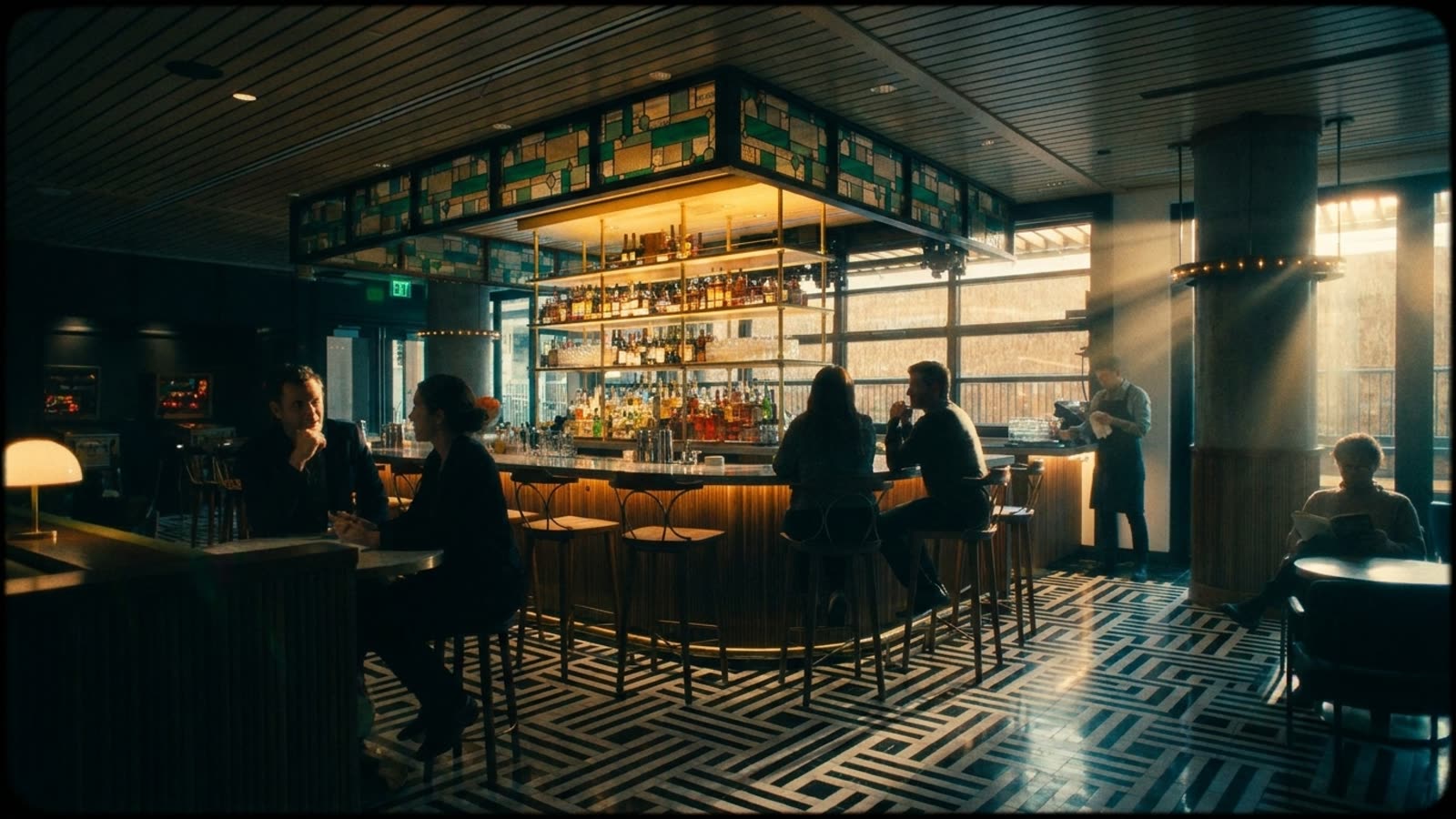
The lobby bar of a great hotel is one of the few remaining spaces in modern life where strangers still make eye contact, where a business deal can begin over a martini with someone you met twenty minutes ago, and where the fundamental human need for ambient company is treated as something worth paying for. This is not nostalgia. It is architecture.
The sociologist Ray Oldenburg coined the term "third place" to describe the cafés, barbershops, and public squares that exist between home and work — spaces essential to civic life and personal sanity. His thesis, articulated in the late twentieth century, now reads like an autopsy report. The coffee shop has become a laptop farm where conversation is discouraged. The neighborhood bar has been replaced by algorithmically optimized concepts that close within three years. The public square is a food court. But the hotel bar endures, largely because its economics are different from everything around it.
The subsidy of transience
A hotel bar does not need to maximize revenue per square foot in the way a standalone restaurant must. It exists to serve a captive audience of guests, to signal the property's taste level to potential bookers, and to create the impression of life in what would otherwise be a corridor. This changes everything. The lighting can be dim. The music can be low. The staff can tolerate a single guest nursing a glass of wine for ninety minutes, because that guest might be deciding whether to book the ballroom for a wedding.
This structural subsidy produces an atmosphere that is nearly impossible to replicate in a freestanding venue. The Bemelmans Bar at the Carlyle in New York, the American Bar at the Savoy in London, the Bamboo Bar at the Mandarin Oriental in Bangkok — these spaces share a quality of unhurried permanence. They are designed to make you feel that you have arrived somewhere, not that you are being processed through somewhere.
The democracy of the transient
Hotel bars also benefit from a peculiar social chemistry. Their clientele is, by definition, unmoored. Business travelers, tourists, people between flights or between lives — the hotel bar gathers strangers who have temporarily shed their usual contexts. This creates a permission structure for conversation that has largely vanished from urban life. You can speak to the person next to you without the interaction being freighted with the suspicion that attaches to approaching strangers in most other settings.
The novelist Joseph O'Neill captured this in his observation that hotels are "machines for generating stories." The bar is where those stories begin, or where they are told to someone who will never be seen again — which is sometimes the same thing.
Our take
The hotel bar's survival is not an accident of real estate economics. It is a reminder that certain human needs — for beauty, for serendipity, for the company of strangers in a space that respects the transaction — are durable enough to outlast whatever concept is currently being pitched to venture capitalists. The best hotel bars understand that they are selling time as much as alcohol, and that the right room can make an hour feel like a small vacation from ordinary life. In an era that has optimized the spontaneity out of nearly everything, this is worth more than the price of a drink.