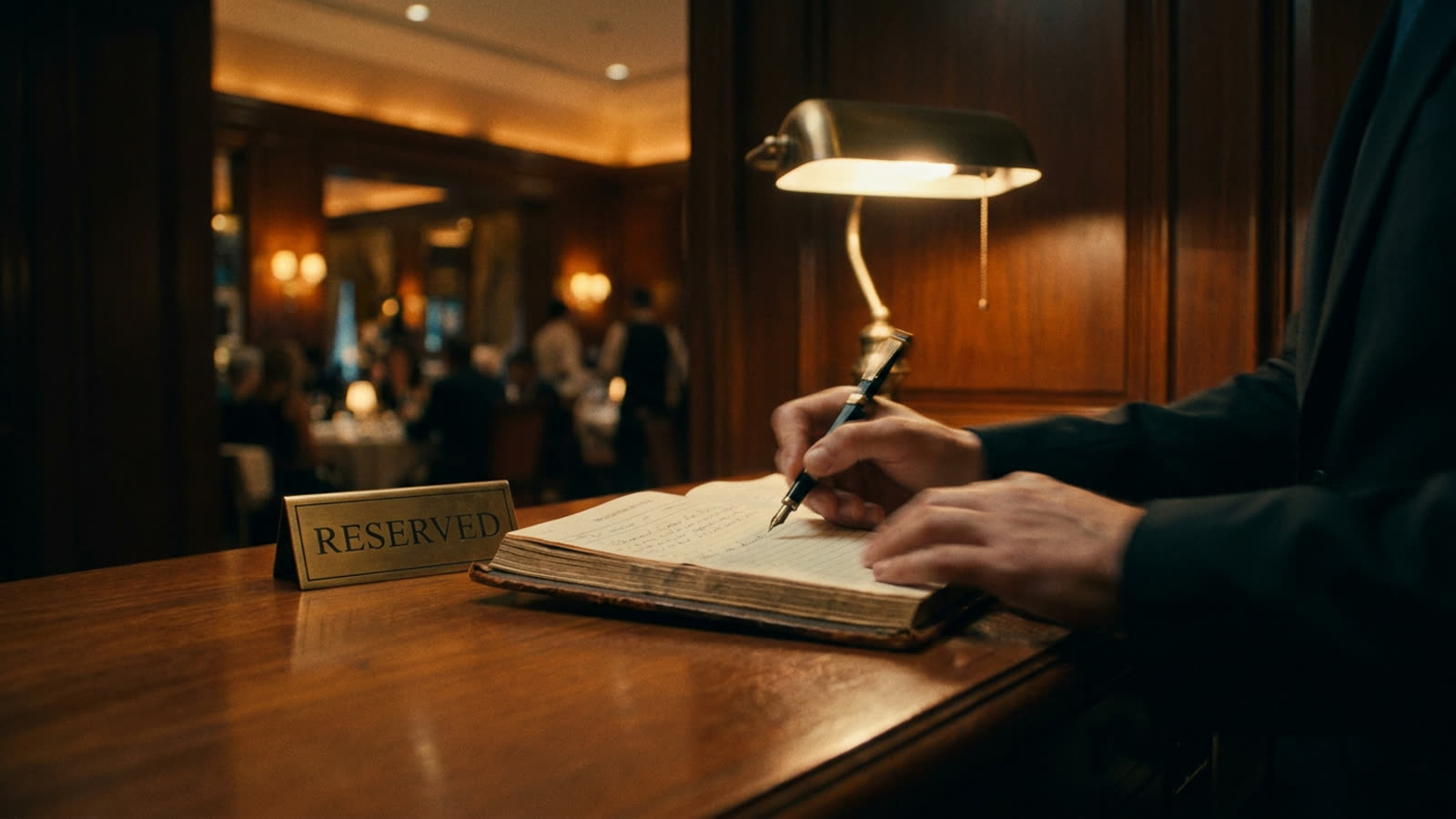
Walk into certain dining rooms — the kind where the maître d' remembers your anniversary and your aversion to cilantro — and you will find something conspicuously absent from the host stand: a tablet. Instead, there sits a leather-bound book, its pages dense with pencil notations, arrows, and the occasional cryptic symbol. This is not nostalgia. This is strategy.
The restaurant reservation has become, in most establishments, a problem to be optimized. Platforms like Resy and OpenTable have transformed the simple act of booking a table into a data-harvesting operation, complete with no-show penalties, dynamic pricing experiments, and the quiet commodification of your dining preferences. For the vast majority of restaurants, this makes sense. Margins are thin, cancellations are costly, and software promises efficiency.
But efficiency is not hospitality. And the establishments that understand this distinction — the ones that have maintained waiting lists measured in months rather than minutes — tend to keep their reservations in ink.
The information that paper preserves
A digital reservation system captures what you tell it: party size, time, dietary restrictions if you remember to note them. A paper book, maintained by the same person over years, captures something else entirely. It records the handwriting of the person who took the call, which means it records who spoke to the guest and what mood they detected. It preserves cross-outs and rewrites, which means it preserves the negotiation — the guest who asked for eight o'clock, was offered nine-thirty, and settled for eight-forty-five at the bar.
This is institutional memory in its most literal form. The maître d' at a legendary Parisian three-star can flip back through volumes and see not just that you dined there in a previous decade, but who seated you, what you celebrated, and whether you lingered. Software can store this data, theoretically. But software does not thumb through it before service, building a mental map of the evening's emotional landscape.
The friction is the feature
There is another, less sentimental reason for the paper holdouts: friction reduces frivolity. When booking a table requires a phone call during specific hours, speaking to a human being, and often waiting on hold, the reservation becomes a commitment rather than a whim. The no-show rate at restaurants that require voice contact hovers in the low single digits. At app-based restaurants, it can exceed fifteen percent on busy nights.
This is not an argument against technology. It is an argument for understanding what technology optimizes and what it erodes. The frictionless reservation is optimized for volume and convenience. The paper reservation is optimized for intention and relationship. Both are valid. But they serve different ends.
Our take
The leather book on the host stand is not a rejection of modernity. It is a statement about what kind of business the restaurant believes itself to be in. The places that still use paper have decided, correctly, that hospitality is a craft practiced between humans, and that the tools of that craft should reflect its values. In a decade, when every other transaction in our lives has been reduced to a tap, the phone call to book a table will feel less like an inconvenience and more like a privilege. The best restaurants already know this.