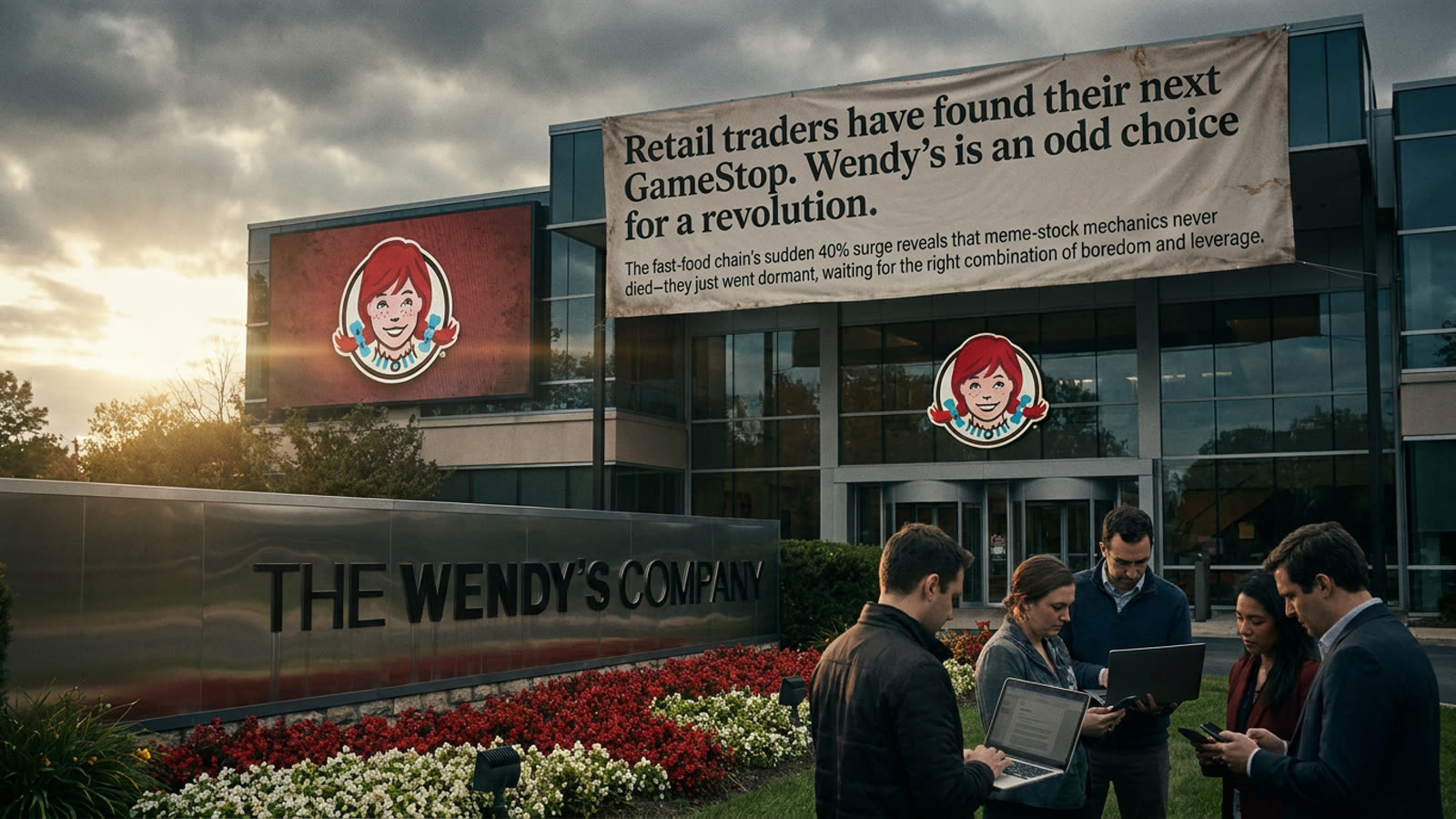
The meme-stock phenomenon was supposed to be a 2021 artifact, a pandemic-era curiosity filed alongside sourdough starters and Tiger King. Yet here we are in mid-2026, watching Wendy's—a perfectly ordinary quick-service restaurant chain—spike more than 40% in a matter of days on no fundamental news whatsoever, propelled by the same Reddit forums and options-market mechanics that once turned GameStop into a household name.
The playbook is unchanged: retail traders identify a stock with high short interest, coordinate buying pressure through social media, and exploit the reflexive nature of options market-making to create a self-reinforcing price spiral. What has changed is the context. Five years ago, the GameStop saga could be framed as a protest against Wall Street, a David-versus-Goliath narrative with genuine populist energy. The Wendy's trade has no such pretense. It is pure financial sport, a collective bet that enough coordinated buying can manufacture its own reality, at least temporarily.
Why Wendy's, why now
The selection criteria appear almost arbitrary. Wendy's short interest had crept above 15% of float—elevated, but hardly extreme by historical standards. The company's fundamentals are unremarkable: steady same-store sales, modest international expansion, the usual margin pressures from labor costs and commodity inflation. There is no turnaround story, no activist investor, no strategic review. The stock was chosen, by the traders' own admission, because it was "memeable"—the brand's irreverent Twitter presence and association with the "Sir, this is a Wendy's" joke apparently sufficient justification for a multi-billion-dollar market-cap swing.
This randomness is the point. The meme-stock phenomenon has evolved from quasi-ideological movement to pure game theory. Participants understand they are not investing in Wendy's the business; they are betting on other participants' willingness to keep buying. The trade works until it doesn't, and everyone knows this going in.
The mechanics that refuse to die
Regulators spent years after 2021 studying payment-for-order-flow, gamification of trading apps, and the feedback loops between options activity and underlying stock prices. Some modest reforms followed. Yet the fundamental architecture remains intact: zero-commission trading, easy access to options, and social media platforms optimized for viral coordination. The Wendy's episode demonstrates that these ingredients can produce the same explosive results whenever sufficient collective attention converges on a single target.
The options market remains the accelerant. When retail traders buy short-dated call options in size, market makers must hedge by purchasing the underlying stock. This pushes prices higher, which makes more call options profitable, which attracts more buyers—a gamma squeeze, in the jargon. The mechanism is well understood, yet it keeps working because understanding it does not neutralize it.
Our take
There is something almost nostalgic about watching Wendy's become the latest meme-stock protagonist, like discovering that a band you thought had broken up is still touring county fairs. The phenomenon reveals an uncomfortable truth about modern markets: price discovery is increasingly a social-coordination game rather than a fundamental-analysis exercise, at least over short time horizons. Wendy's will eventually return to trading on its cash flows and comparable-store sales. But the episode is a reminder that "eventually" can be a long and expensive interval for anyone caught on the wrong side. The meme traders have learned nothing and forgotten nothing. Neither, apparently, have the rest of us.